Scope 1, 2, and 3 Emissions: What SMEs Should Measure First
Scope 1, 2, and 3 emissions explained: a starting point for SMEs
A bank asks for your emissions data before renewing a loan. A larger customer sends an ESG questionnaire with a deadline. Neither party cares that you have never run a GHG inventory before. They want numbers, and they want them broken into scopes 1, 2, and 3.
Most SME owners have heard the terms without knowing what to actually do with them. The good news: you do not need a sustainability department to get started. You need to know which scope covers what, which one to measure first, and where the effort actually pays off.
What scopes 1, 2, and 3 actually mean
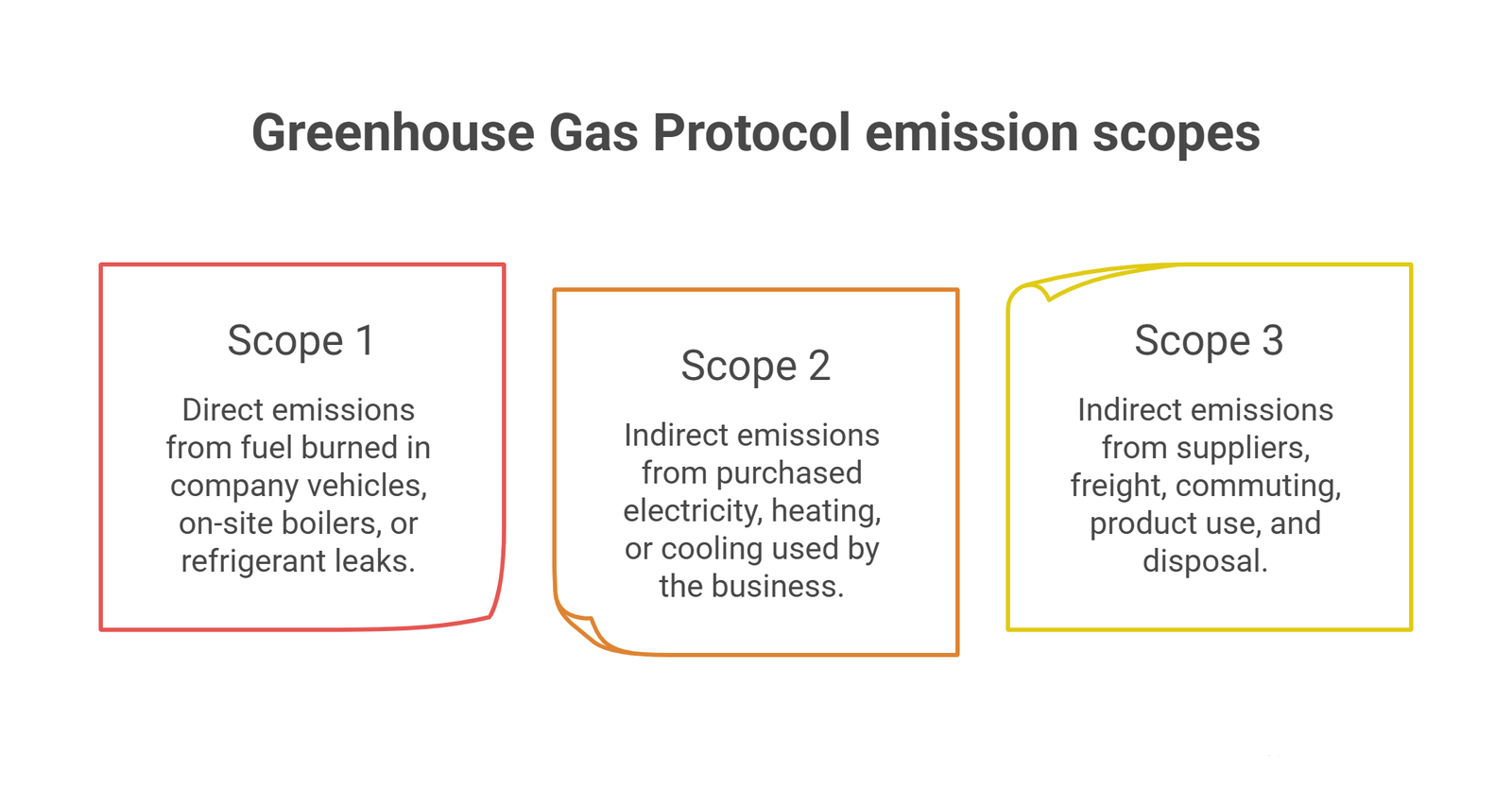
The Greenhouse Gas Protocol was developed by the World Resources Institute and the World Business Council for Sustainable Development. It splits a company’s emissions into three categories so nothing gets counted twice across a supply chain.
Scope 1 covers emissions your business creates directly: fuel burned in a company vehicle, a boiler on-site, refrigerant leaking from an air conditioning unit. If you own or control the source, it belongs here.
Scope 2 covers the electricity, heating, or cooling you buy. The emissions happen at the power plant, not your building, but they exist because of your energy use.
Scope 3 covers everything else: what your suppliers produce, how goods travel to and from you, employee commuting, and business travel. It also covers what happens to your product after a customer buys it.
For most companies, this is the largest of the three by far, often 75 to 90 percent of the total footprint.
| Scope | What it covers | Typical share of total emissions |
| Scope 1 | Direct: fuel, company vehicles, on-site equipment, refrigerant leaks | 5-15% |
| Scope 2 | Indirect: purchased electricity, heating, cooling | 2-8% |
| Scope 3 | Indirect: suppliers, freight, commuting, product use, disposal | 75-90% |
Where most SMEs actually stand today
A 2023 study by Canada’s Business Development Bank looked at SMEs that had calculated their emissions. Only 9 percent had measured all three scopes.
Most stop at scope 1 and 2 because the data sits in a fuel receipt or an electricity bill. Scope 3 requires chasing information that lives with suppliers, shippers, and customers. That is exactly why it gets skipped.
Skipping it is understandable but increasingly costly. If your biggest customer reports under a mandatory framework, your emissions become part of their Scope 3. They will eventually ask you for the number.
Scope 1: what you already control
Scope 1 is the easiest starting point because the data usually already exists in your accounts. It falls into a few clear buckets.
Fuel burned in company vehicles or delivery trucks. Natural gas or diesel used in boilers, generators, or on-site equipment. Fugitive emissions from refrigerant top-ups in HVAC or cold storage systems. Any on-site industrial process that releases gases directly, such as certain manufacturing or food production steps.
For each, the calculation is the same: activity data multiplied by an emission factor. Liters of diesel burned, multiplied by diesel’s emission factor, gives you tCO2e. Fuel purchase receipts, vehicle logs, and utility meter readings are the primary data sources. Lenders now want to see these instead of estimates.
Scope 2: the two ways to report your energy footprint
Scope 2 has one added wrinkle: you can calculate it two different ways, and regulators want both reported.
The location-based method applies the average emissions intensity of your regional power grid. It reflects the physical reality of where your electricity comes from, regardless of what you have contracted for.
The market-based method applies the emission factor tied to your specific energy contract, such as a renewable energy certificate or a green tariff. This can bring your reported Scope 2 close to zero, but only if the certificates are genuinely retired against your consumption.
This is also where SMEs run into one of the most common reporting errors. A business switches to a “green energy” plan and assumes its Scope 2 is now zero. Without the actual retired certificates behind that plan, the claim does not hold up to scrutiny from a lender or auditor.
Scope 3: the 15 categories, and the ones that matter for you
The GHG Protocol splits Scope 3 into 15 categories, 8 upstream and 7 downstream. Not every category applies to every business. Trying to measure all 15 at once is how most SMEs give up before they start.
| Category | Covers | Common for SMEs |
| 1. Purchased goods and services | Materials, supplies, contracted services | Almost always material |
| 4. Upstream transportation | Freight from suppliers to you | Material for retail, manufacturing |
| 5. Waste generated in operations | Disposal and treatment of business waste | Usually small but easy to measure |
| 6. Business travel | Flights, trains, hotels for staff trips | Easy to pull from expense reports |
| 7. Employee commuting | Staff travel to and from work | Estimate via a short employee survey |
| 9. Downstream transportation | Delivery of your product to customers | Material for product-based businesses |
| 11. Use of sold products | Emissions when customers use what you sold | Material only for energy-consuming products |
A services firm with no manufacturing footprint might find that purchased services, business travel, and commuting cover nearly everything material. A product-based manufacturer will likely find purchased goods and upstream freight dominate. The point is to identify which two or three categories carry the real weight for your business. Don’t chase all 15 with equal effort.
A practical starting sequence
Set your boundary first. Decide whether you are consolidating emissions by equity share or operational control, and apply that choice consistently. Skipping this step is the single most common reason a GHG inventory falls apart under review. A subsidiary or leased site gets left out entirely.
Build Scope 1 and 2 from primary data. Pull actual fuel receipts and utility bills rather than estimating. This is the fastest scope to complete and the one lenders check most closely.
Prioritize two or three Scope 3 categories. Use spend-based estimates as a starting point: money spent per category, multiplied by an industry average factor. Then move toward supplier-specific data for your highest-emitting categories over time.
Document every assumption. Note which emission factors you used and why you included or excluded a category. This documentation is what makes the inventory usable for a bank, an auditor, or a customer questionnaire later.
Why lenders and larger customers are asking now
Sustainability-linked loans price your interest rate against emissions targets. A lender cannot set a credible target on a flawed baseline. If your organizational boundary is wrong, the loan terms are built on bad data from day one.
There is also a supply chain effect. Large companies reporting under mandatory frameworks need Scope 3 data from their own suppliers, which often means SMEs like yours. A customer’s ESG questionnaire is rarely optional once it lands in your inbox: it is usually a condition of keeping the contract.
This is where the accounting side matters as much as the environmental side, and it’s exactly the kind of gap cash flow analysis work is built to close. Getting the boundary right, so it matches your actual corporate structure and financial statements, is closer to a financial reporting exercise than a sustainability one. That’s one reason emissions data now comes up in the same conversations as cash flow forecasts and investor reporting. Financial analysis work already touches most of the same source documents an emissions inventory needs.
Common mistakes that undermine the data
Outsourcing delivery and assuming those emissions disappear. They do not vanish, they move into Scope 3 under transportation, and skipping that category understates your real footprint.
Leasing office space and omitting the energy use because you do not pay the utility bill directly. Under the operational control approach, leased space still counts.
Mixing boundary approaches from one year to the next. If last year’s inventory used financial control and this year uses operational control, the two numbers are not comparable. That inconsistency is exactly what a lender or auditor will flag first.
Relying only on spend-based estimates for high-value supplier relationships. A more expensive purchase does not necessarily mean higher emissions. Spend-based data should be a starting point, not the final answer, for your largest suppliers.
Frequently Asked Questions
Do small businesses have to report Scope 3 emissions?
Under most current frameworks, Scope 3 disclosure is voluntary at the SME level, even where Scope 1 and 2 are mandatory. That said, many SMEs face it anyway in practice. If you’re in the supply chain of a larger reporting company, or applying for a sustainability-linked loan, expect it to come up as a practical requirement, even without being a legal one.
Which scope should an SME measure first?
Scope 1 and 2, since the data already sits in fuel receipts and utility bills. Move to two or three material Scope 3 categories once those are solid.
Can we just estimate Scope 3 using spend data?
Yes, as a starting point. Spend-based estimates are an accepted first step. They should improve toward supplier-specific data over time, especially for your highest-spend categories.
Does switching to a green energy plan make our Scope 2 zero?
Only if you hold the retired renewable energy certificates or guarantees of origin tied to that specific contract. Without them, the claim will not survive third-party verification.
How often should an emissions inventory be updated?
Annually, using a consistent 12-month period and the same boundary approach each year. That keeps the numbers comparable over time.
What is the difference between location-based and market-based Scope 2 reporting?
Location-based reflects your regional power grid’s average emissions. Market-based reflects your specific energy contract. Most current frameworks want both figures reported side by side.
Getting the numbers right the first time
An emissions inventory built on a shaky boundary or unverifiable claims costs more to fix later than it does to build correctly from the start. That’s especially true once a lender or customer starts asking questions. Treating it as part of your financial reporting discipline, not a side project, is what makes the numbers hold up.
If your business is weighing a sustainability-linked loan, or preparing for a customer’s ESG questionnaire, Oak’s fractional CFO services can help. We build the financial reporting foundation this kind of disclosure depends on, and our financial analysis services can help you get the underlying numbers in order first.