


The Essential Benefits of Outsourced CFO Services for SMEs
Outsourced CFO services for SMEs: 9 benefits and the real cost
Most SME owners do not decide to hire a CFO. The decision gets forced on them. A bank asks for a forecast the business cannot produce. Cash runs short in a month that looked fine on paper. An investor asks for a model and gets a spreadsheet.
A full-time CFO is the usual answer, and the usual obstacle. The US Bureau of Labor Statistics puts the median wage for financial managers at $161,700 a year, before benefits and payroll tax. A CFO at a growing company usually earns more.
Outsourced CFO services close that gap. A senior finance professional works with your business part time, often remotely, and handles strategy instead of bookkeeping. This guide covers nine benefits, what the service costs against a full-time hire, when it makes sense, and how to choose a provider.
What an outsourced CFO does
An outsourced CFO is a senior finance professional who works with several clients at once on a flexible schedule. The work covers forecasting, cash flow, budgeting, financial reporting and support for lenders and investors. Day-to-day bookkeeping stays with your accountant.
You may see the same service sold as virtual, fractional or part-time CFO support. The labels overlap. The guide to what CFO services are covers the full scope of the role.
9 benefits of outsourced CFO services for SMEs
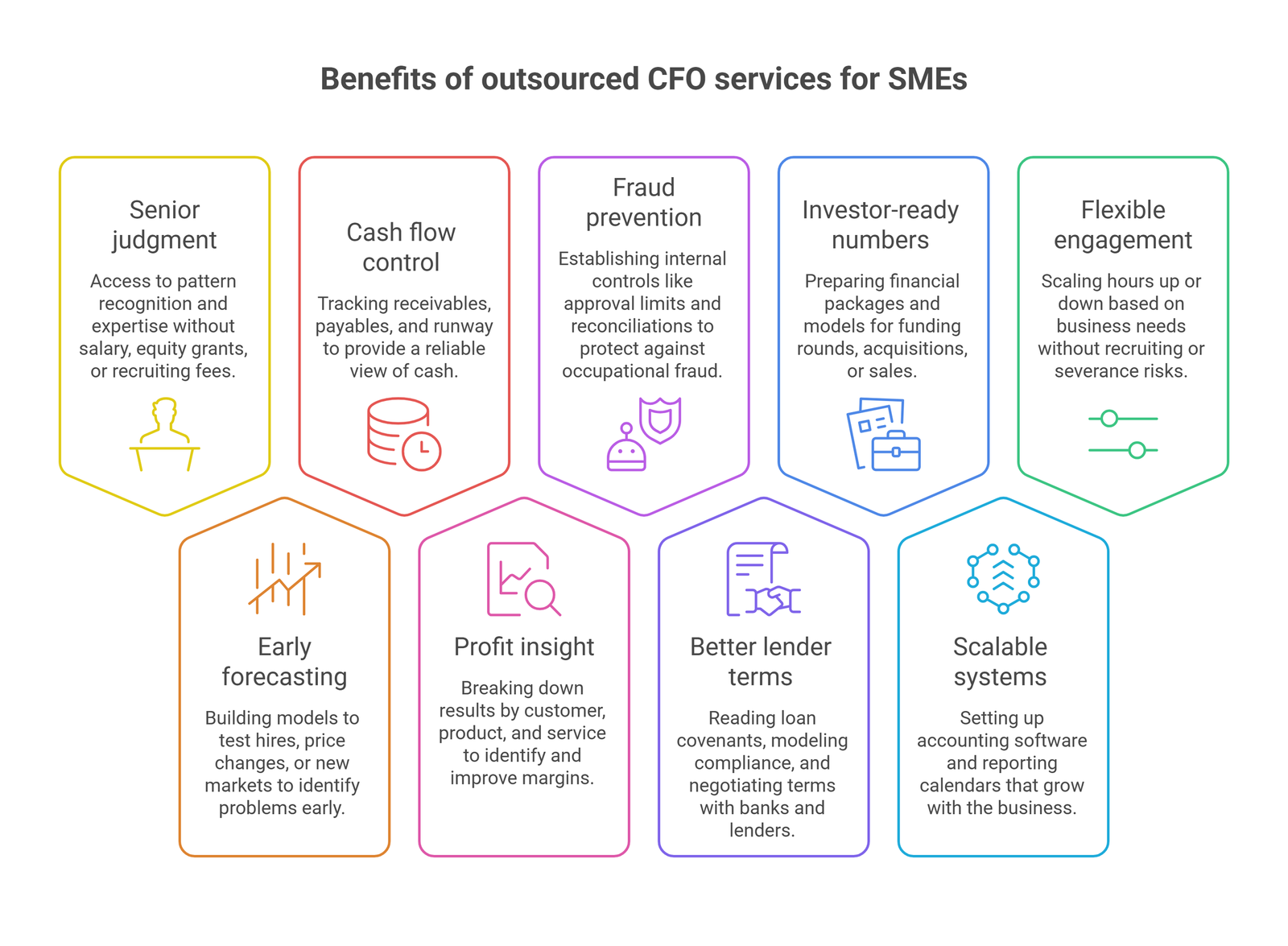
1. Senior judgment at a fraction of the cost
The first benefit is access. An outsourced CFO has usually handled the problem in front of you at several other companies. That pattern recognition is hard to hire for, and it arrives without a salary, an equity grant or a recruiting fee.
Cost is the other half. Retainers typically run from about $3,000 to $15,000 a month. Most small and mid-sized businesses pay $3,000 to $10,000, according to Oak Business Consultant’s fractional CFO cost guide. Over a year, that is $36,000 to $120,000 for a typical SME, with no benefits or payroll tax on top.
2. Forecasts that show problems early
A bookkeeper records what happened. A CFO models what comes next. Outsourced CFOs build forecasts and scenario models. You can test a hire, a price change or a new market before spending the money.
A forecast that flags a shortfall two months out gives you options. The same shortfall found on payday does not.
3. Control over cash flow
Cash flow trouble is a timing problem more often than a revenue problem. A profitable business can still run short if customers pay in 60 days and suppliers want payment in 30.
An outsourced CFO tracks receivables, payables and runway. They set rules for collections, payment timing and credit lines. The owner gets a regular cash view they can trust, instead of a bank balance and a guess.
4. Pricing and profit insight
Revenue growth can hide weak margins. An outsourced CFO breaks results down by customer, product and service line. The busiest customer is often not the most profitable one.
Once the data is clear, the decisions get simpler. Raise a price. Drop a loss-making line. Rework a discount policy. Moves like these can cover the cost of the engagement on their own.
5. Fraud prevention and internal controls
Small businesses are exposed to occupational fraud because few people check each other’s work. The Association of Certified Fraud Examiners has found that losses hit smaller organizations harder, largely because they lack internal controls.
An outsourced CFO sets up controls that fit a small team. That means approval limits, a split between who records a payment and who makes it, and regular reconciliations. Tax and reporting rules also get tracked as part of the role. That lowers the odds of a penalty or an audit finding.
6. Better terms from banks and lenders
Loan agreements often carry covenants, such as a minimum cash balance or a debt coverage ratio. Breaking one can trigger fees or an early repayment demand. A founder reading these terms alone can miss the risk.
An outsourced CFO reads the terms, models whether the business can meet them, and negotiates changes before signing. Lenders also tend to take clean statements more seriously when a CFO presents them.
7. Investor-ready numbers and smoother deals
A funding round, an acquisition or a sale puts your financials under close inspection. Investors expect a three-statement model, clean historical accounts and assumptions you can defend.
An outsourced CFO prepares that package and sits in the meetings to answer questions. They also keep the story consistent, so the model, the pitch deck and the data room all say the same thing. For an acquisition or exit, the CFO can handle due diligence requests as well.
8. Finance systems that scale
Many SMEs outgrow their spreadsheets before they notice. An outsourced CFO chooses and sets up the accounting software, reporting calendar and month-end close. The goal is a setup that still works when the business is twice its current size.
They know which tools work well together because they have seen many setups. The result is reports that arrive on a fixed date and numbers that match across every tool.
9. Flexibility without hiring risk
Needs change through the year. A fundraising quarter needs more hours. A quiet quarter needs fewer. An outsourced CFO scales up or down by agreement.
There is no recruiting search and no severance. Engagements often start within weeks. A full-time hire can take months to find and onboard, and a wrong hire is costly to undo.
Outsourced CFO vs full-time CFO
| Factor | Outsourced CFO | Full-time CFO |
| Annual cost | About $36,000 to $120,000 at typical SME retainers | BLS median wage of $161,700 for financial managers, before benefits and payroll tax |
| Time to start | Often weeks | Often months, including the search |
| Hours | Set by agreement, can change month to month | Full time, whether the work is there or not |
| Experience | Several industries and company stages | Deep in one company |
| Team leadership | Advises your team | Leads a finance team |
| Best fit | SMEs, startups and companies in transition | Larger or multi-entity companies that need daily presence |
Neither option wins every time. A company with several entities, a large finance team or daily approvals may need someone in the building. At the top of the retainer range, heavy outsourced support can approach the cost of a mid-level hire. In that case, compare scope, not price.
Most SMEs reach that point late. Until then, part-time support covers the same decisions for less.
When an SME needs an outsourced CFO
Revenue is a weak signal. Complexity is a better one. These are the common triggers:
- Decisions are being made faster than the numbers arrive.
- Cash has surprised the owner more than once in a year.
- A raise, loan, acquisition or sale is coming within the next year.
- The business is entering a new market or adding a product line.
- The accountant reports on the past, and nobody plans the future.
Some businesses should wait. If the books are months behind, fix that first, because a CFO builds on clean records. If tax filing is the only need, an accountant is the right hire.
The guide to the 7 reasons to hire a virtual CFO goes further. It covers pricing by engagement type, the signs it is time, and the first 90 days.
How to choose an outsourced CFO provider
Providers are easy to compare once you know what to ask.
- Ask who does the work. The CFO you meet in the sales call should be the one on your account.
- Check industry experience. A CFO who knows your sector’s margins and cash cycle needs less time to become useful.
- Get the scope in writing: reports, meeting schedule, forecast updates and hours included.
- Ask which tools they use, and whether they will work inside your existing accounting software.
- Confirm access and approvals. A CFO normally needs read access to your books. Payment authority should stay with you unless you agree otherwise.
- Ask how the engagement ends. You should keep your models, reports and data if you leave.
For a side-by-side look at providers, see the list of the best CFO services for business growth.
Mistakes that waste the retainer
- Hiring a CFO to do bookkeeping. The role is strategy. Transaction work belongs with an accountant or bookkeeper.
- Waiting for a crisis. A CFO hired during a cash emergency spends the first month on triage, not planning.
- Setting vague goals. Without a target, reports pile up and nothing changes. A cash buffer, a raise date or a margin goal gives the work a point.
- Skipping the review. Check at 90 days whether decisions are faster and better informed. If they are not, change the scope.
Frequently Asked Questions
How much do outsourced CFO services cost for a small business?
Retainers typically run from about $3,000 to $15,000 a month. Most small and mid-sized businesses pay $3,000 to $10,000. Price depends on hours, scope and how complex the business is.
How do I know if my business needs an outsourced CFO?
Look at complexity, not revenue. Repeated cash surprises, a coming raise or sale, a new market, and decisions made without current numbers are the common signs.
What is the difference between an outsourced CFO and an interim CFO?
An interim CFO fills a temporary gap, such as a departure or a leave, and usually works full time for a set period. An outsourced CFO is an ongoing external partner on a flexible schedule. Virtual and fractional CFOs are close cousins of the outsourced model.
Will an outsourced CFO replace my accountant or bookkeeper?
No. Accountants and bookkeepers handle records, tax filing and compliance. The CFO uses that data to plan, forecast and advise. Most SMEs need both.
Can an outsourced CFO help me get a loan or raise money?
Yes. They prepare statements and forecasts, read loan terms, and answer lender or investor questions. They cannot guarantee approval, but better numbers improve the odds.
Will an outsourced CFO have access to my bank accounts?
Usually read-only access to your accounting software and bank feeds. In practice, owners keep payment approval. Put the access rules in the engagement letter.
Is an outsourced CFO only for struggling businesses?
No. Healthy, growing businesses use them to plan ahead. Waiting for trouble tends to make the first months more expensive.
Match the hours to the problem
The case for outsourcing is not that it is cheap. Finance decisions improve when someone with CFO experience is in the room, and most SMEs cannot justify that person full time. Buy the hours that match the problem you have today. Add more as the business grows.
If you are weighing your options, Oak Business Consultant’s CFO services cover cash flow, forecasting, investor reporting and finance systems. Smaller teams can start with CFO services for small businesses. Book a free strategy session to talk through what support would look like for your business.


