
Financial Model for Higher Education to Inform Hiring Budget
Does a new hire pay for itself? A higher ed hiring budget model
A budget office can freeze hiring in a week. Undoing a bad hire can take years. That gap is why a financial model for higher education to inform hiring budget decisions matters more than the budget model a university happens to use.
Labor is the largest fixed cost at most colleges and universities. It is also the hardest cost to move when enrollment shifts. Tuition, state funding, and grants can change faster than the payroll they support. A hiring budget model connects the two sides. It shows what each position costs, what revenue it creates or protects, and what happens if enrollment misses the forecast.
This guide covers how common budget models shape hiring, what a hiring model must contain, a seven-step build, and a worked breakeven example for one faculty line. The figures in the example are illustrative, not client data.
Why hiring is the hardest line in a university budget
Personnel dominates the numbers. Colorado State University’s January 2026 budget update put personnel at about 50% of all funds and 60% of unrestricted funds, with some units above 90%. The same update showed total FTE up 15% between 2018 and 2025 while enrollment rose 1%. It also said expenses were growing faster than revenue, and that the campus could not cut its way out of the gap.
Finance leaders at Miami University made a similar point in a 2025 EvoLLLution piece. Institutions cannot move faculty and staff as quickly as enrollment patterns change, and inflation outpaces what tuition increases can cover.
Hire type matters here. A tenure-track line stays on payroll after the course demand behind it falls. An adjunct section can be dropped at the end of a term. Each hire is a financial commitment with its own risk profile, so the model has to price that risk before anyone signs an offer.
How your budget model shapes who decides on a hire
Every budget model answers one question differently: who gets to say yes to a position? The table below shows what that means for hiring.
| Budget model | Who decides on a hire | Effect on hiring | Main risk |
| Centralized | President, provost, central budget office | Fast reallocation and uniform rules | Units hire or lose roles without seeing the data |
| Incremental | Prior-year base plus adjustments | Stable, predictable position counts | Old vacancies and low-demand lines carry forward |
| Zero-based | Unit leaders, who justify every role each cycle | Exposes low-impact positions | Heavy workload, hard at large institutions |
| Responsibility center management (RCM) | Deans and unit heads, within their own revenue | Units hire where tuition follows | Enrollment swings hit unit budgets directly |
| Performance-based | Unit heads, tied to metrics like graduation rates | Hires aimed at outcome targets | Weak metrics, short-term focus, gaming |
| Zero-sum (program level) | Provost or dean, program by program | Makes cross-subsidies visible | Needs program-level cost data |
Few institutions run one model in pure form. The Miami University authors describe hybrids: line-item budgets with zero-based reviews, RCM tied to performance metrics, and incremental steps for year-to-year stability. They also note that RCM needs smoothing, such as multiyear averages or reserves, so one bad enrollment year does not wreck a unit’s hiring plan.
Whatever the mix, the hiring model should sit on top of it. Oak’s guide to planning and budgeting methods covers the basic budget approaches in more detail.
What a hiring budget model has to include
A hiring model fails when it tracks salary and ignores everything around it. These are the drivers that belong in the build.
| Driver | What to model | Common mistake |
| Net tuition per credit hour | Sticker price minus institutional aid and discounts | Using gross tuition |
| Enrollment and retention | Headcount by cohort, credit hours per student, progression rates | Treating one fall census as the trend |
| Other revenue | State appropriation formulas, grant indirect costs, auxiliary income | Paying permanent positions with one-time or restricted money |
| Fully loaded compensation | Salary, health and retirement benefits, payroll taxes, raises | Budgeting salary only |
| One-time costs | Recruiting, relocation, lab or startup funds, onboarding | Leaving them out of year one |
| Support costs | Space, technology, advising, department administration | Ignoring shared costs that RCM would charge back |
Benefits deserve extra attention. Colorado State’s update flagged a 10% rise in health insurance premiums and a $15 million hit to its education and general budgets from fringe costs. A model that uses last year’s fringe rate will understate every position on the list.
Seven steps to build the model
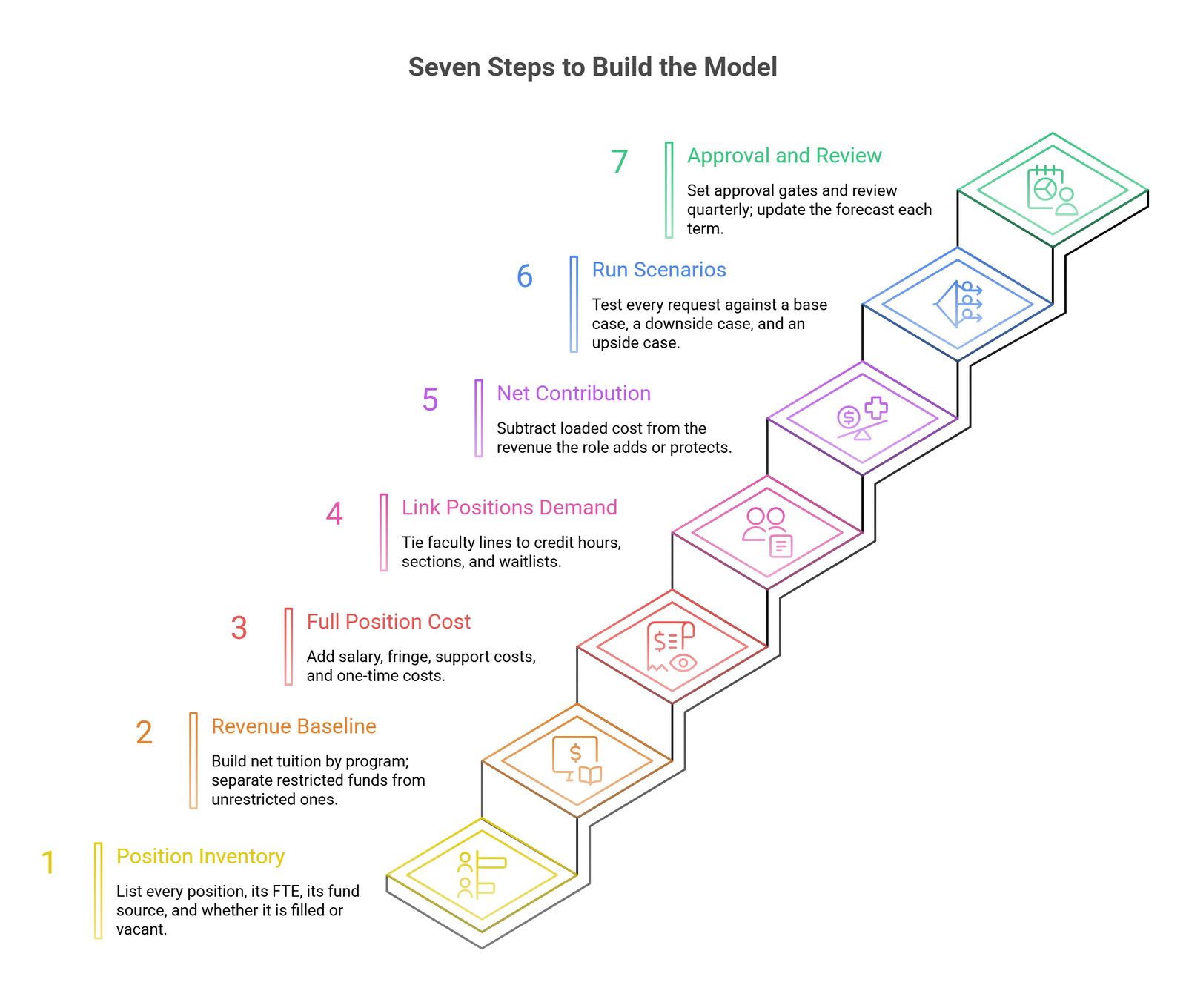
- Start with a clean position inventory. List every position, its FTE, its fund source, and whether it is filled or vacant. Colorado State asked each college and division to document which positions were funded and which were floated. A position not on that list could not be requested.
- Set the revenue baseline. Build net tuition by program from a clear financial budget, and separate restricted funds from unrestricted ones.
- Price each position at full cost. Add salary, fringe, support costs, and one-time costs. Show year one and steady state as separate lines.
- Link positions to demand. Tie faculty lines to credit hours, sections, and waitlists. Tie advising and enrollment roles to retention and net tuition.
- Calculate net contribution per request. Subtract loaded cost from the revenue the role adds or protects. Flag roles that fail the test but serve accreditation, compliance, or research, so the subsidy is a decision and not an accident.
- Run scenarios. Test every request against a base case, a downside case, and an upside case.
- Set approval gates and review quarterly. Compare actual enrollment and spending with the model, and update the forecast each term.
Worked example: does one new faculty line break even?
Take a department that wants one new tenure-track line. The inputs below are hypothetical and simplified.
| Input | Value |
| Base salary | $90,000 |
| Benefits at 30% | $27,000 |
| Fully loaded pay | $117,000 |
| Space, technology, and support | $8,000 per year |
| Steady-state annual cost | $125,000 |
| One-time recruiting and startup | $20,000 (year one only) |
| Teaching load | 6 courses, 30 students each, 3 credits each |
| Credit hours taught per year | 540 |
| Net tuition per credit hour | $300 |
| Revenue if every seat were new | $162,000 |
The main input is the share of seats that are truly new. If those students would have enrolled in the course anyway, taught by existing faculty or an adjunct, the hire adds cost and no revenue.
| Share of seats that are new | Annual revenue | Net after $125,000 steady-state cost |
| 50% | $81,000 | -$44,000 |
| 70% | $113,400 | -$11,600 |
| About 77% (breakeven) | $125,000 | $0 |
| 90% | $145,800 | +$20,800 |
The line pays for itself only when about 77% of the seats it teaches are new. In year one, the $20,000 of one-time cost pushes that threshold to roughly 90%. A department asking for this hire should show waitlists, capped sections, or program growth that supports a number in that range.
The example leaves out state appropriations, which at many public universities follow credit hours or degrees. Add them as another revenue row. A negative result does not always mean no. A role may protect accreditation or a research program. The model makes the subsidy visible, so the provost can decide how much to fund and why.
Scenario planning: test the hire against a bad year
A model that only runs the base case approves hires in good years and regrets them later. Build three cases on net tuition, not headcount alone, since discount rates can erode revenue even when enrollment holds.
The base case uses the enrollment forecast the institution already trusts. The downside case assumes a defined drop in new students and a rise in the discount rate. The upside case assumes growth in the programs the hire would serve.
Then set triggers before the year starts. For example, if fall census misses the forecast by a set percentage, open searches that have not reached the offer stage pause automatically. Pre-agreed triggers remove the argument from the moment.
Time horizon matters too. EDUCAUSE writers noted that leaders are extending long-range financial forecasts to five, eight, and even ten years. A tenure-track hire lasts longer than a three-year forecast, so model at least five years of cost against the enrollment outlook.
Watch for second-order effects. A peer-reviewed system dynamics study of a tuition-dependent college found that cutting faculty improved short-term finances but did not secure long-term viability. Cuts that thin out teaching capacity can hurt the student experience and, later, enrollment.
Approval gates that keep the model honest
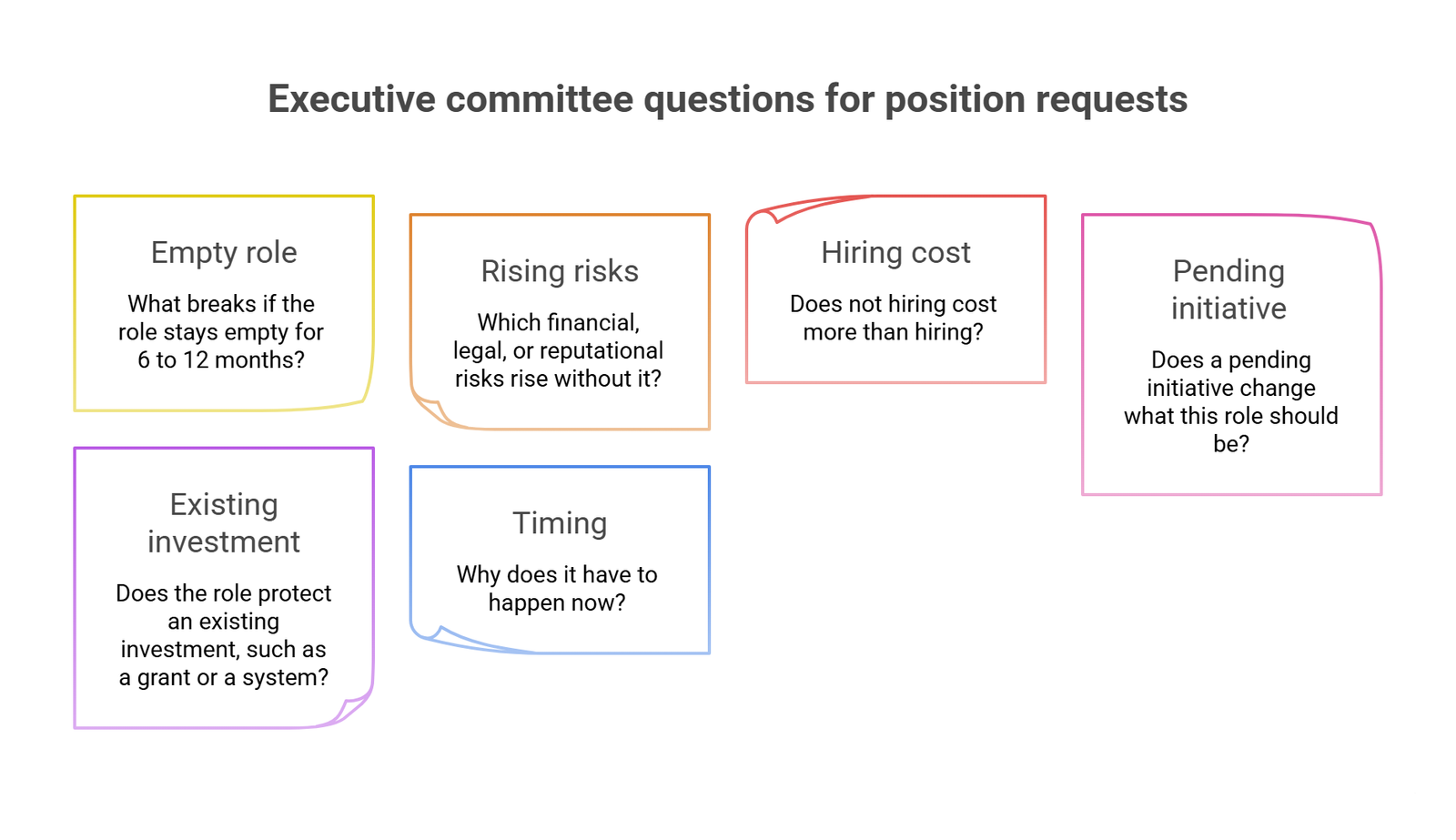
Numbers alone do not decide a hire. Colorado State’s executive committee used a set of questions for position requests, and they work well as a template:
- What breaks if the role stays empty for 6 to 12 months?
- Which financial, legal, or reputational risks rise without it?
- Does not hiring cost more than hiring?
- Does a pending initiative change what this role should be?
- Does the role protect an existing investment, such as a grant or a system?
- Why does it have to happen now?
Colorado State also chose strategic review over a hiring freeze. Safety, compliance, and revenue-protecting roles kept moving, and the campus set a rule of no net new positions, with exceptions for donor-funded and research-funded roles. Internal candidates got preference, and units repurposed existing position numbers. A blanket freeze is simpler, but it stops the hires that protect revenue along with the ones that do not.
The hire type is a gate as well. Match it to how stable the demand is.
| Hire type | Cost behavior | Best fit | Main risk |
| Tenure-track line | Long-term fixed cost | Stable or growing core programs | Hard to reverse if demand falls |
| Full-time non-tenure | Fixed, with shorter contracts | Steady teaching demand, service courses | Turnover |
| Adjunct or part-time | Variable by section | Volatile or unproven demand | Thin advising capacity, extra supplemental pay |
| Advising or enrollment staff | Fixed | Roles that lift retention or net tuition | Value is indirect, so model the retention gain |
The supplemental pay risk is real. Colorado State reported that supplemental pay rose from $8.4 million to $9.4 million in 2025, and it told units to stop backfilling vacancies that way so vacancy savings stay intact.
Mistakes that break hiring models
Most failures are structural. A one-year budget cannot price a commitment that lasts a decade. A model built by one office, with no input from deans or HR, gets ignored. A model with a line for every ledger account becomes too complex for anyone outside finance to read. And rolling last year’s model forward assumes conditions that stopped holding years ago.
Data is another common problem. EDUCAUSE writers pointed out that institutional data sits in many separate SaaS systems, so staff must find and reconcile it before predictive models work. Fix the position inventory and the net tuition data first, then build the forecast.
Two modeling errors are especially costly. The first is paying for permanent positions with restricted or one-time funds. The second is assuming a dip in enrollment will reverse itself. Both turn a temporary gap into a structural one. For school-level basics, see Oak’s education financial budgeting tips.
Frequently Asked Questions
What is a financial model for higher education hiring budgets?
It is a spreadsheet or planning system that prices each position at full cost and compares it with the revenue it adds or protects. It then tests the result against enrollment scenarios and approval rules.
How do you calculate the full cost of a new faculty hire?
Multiply base salary by one plus the fringe rate, then add support costs such as space and technology. Year one also carries one-time costs like recruiting and startup funds. In the example above, $90,000 with 30% fringe and $8,000 of support gives $125,000 a year.
Which budget model works best for hiring decisions?
No single model wins. Most institutions use a hybrid, such as RCM for incentives with central review for hires that carry long-term risk. The right mix depends on institution size and how much data units can see.
Is a hiring freeze better than strategic hiring?
A freeze is easy to enforce, but it blocks every role, including those that protect revenue, safety, and compliance. Colorado State chose a review process with clear exceptions instead. Many institutions find that gates cost less than blanket stops.
How many years should the model cover?
Cover at least five years for tenure-track and other long-term hires. Shorter horizons can work for adjunct and temporary roles. Some leaders now forecast out to eight or ten years for institution-wide planning.
Do we need special software, or is Excel enough?
Excel handles most department-level and college-level models. A custom build starts to pay off when the model must pull live data from HR, finance, and student systems. Oak’s education financial model templates are a practical starting point.
Conclusion
A good hiring model does more than block hires. It lets a dean show, on one page, why a position is worth funding. It also lets a provost say yes quickly when the numbers are already built, before a strong candidate takes another offer. The institutions that handle the next enrollment dip best will be the ones that priced every hire before they made it.
Oak Business Consultant builds custom financial models for education organizations, from position-level hiring budgets to multi-year enrollment scenarios. For an example of how a custom model works in practice, read the art academy financial model case study, then book a call to scope a model for your institution.