Why Financial Analysis is Important for Business Success?
Importance of Financial Analysis for Business Success
Most businesses do not fail because the idea was weak. They fail because nobody was watching the numbers closely enough to catch the warning signs in time. A slow month turns into a cash shortage. A pricing mistake goes unnoticed for two quarters. A loan gets taken on terms nobody stress tested. Financial analysis is the discipline that catches these problems while they are still small and cheap to fix, rather than after they have become the reason a business closes its doors.
This is not a once-a-year exercise reserved for tax season or a board meeting. Done properly, financial analysis is a running diagnostic on the health of a company, built from its income statement, balance sheet, and cash flow statement, and translated into the ratios and trends that actually tell a business owner whether they are winning or slowly losing.
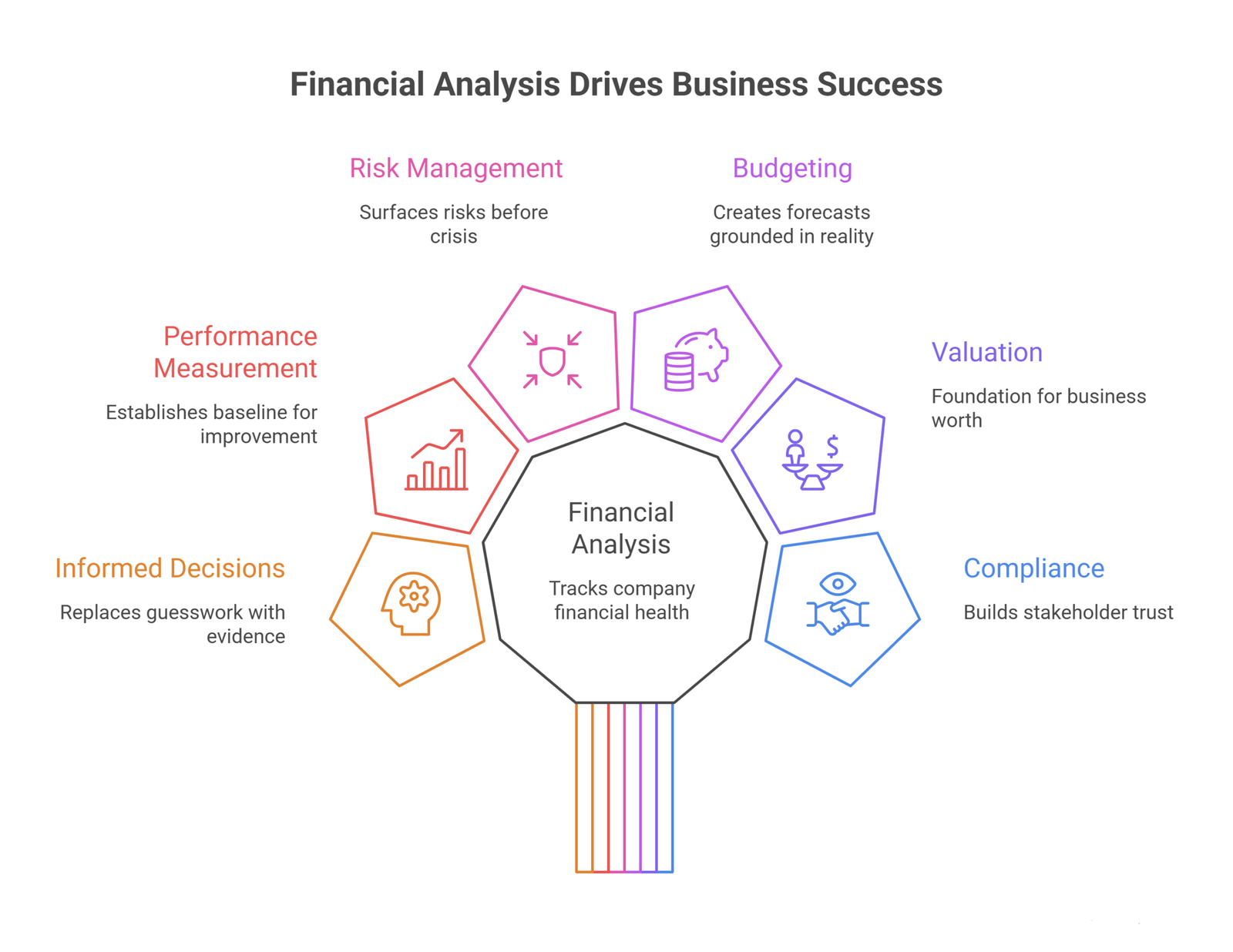
Informed decisions replace guesswork
The core value of financial analysis is that it turns opinions into evidence. Should the business expand into a new market, hire three more people, or hold off for another quarter? Without financial analysis, that decision rests on instinct. With it, the decision rests on gross margin trends, current cash runway, and whether the unit economics of the existing business can actually support growth.
This matters just as much to outside parties as it does to the business owner. Investors and lenders lean on financial analysis to judge risk and expected return before committing capital, weighing profitability ratios, liquidity position, and long-term solvency against what they are being asked to fund.
Performance measurement and benchmarking
A business cannot know if it is improving without a baseline to measure against. Financial analysis gives that baseline. Tracking metrics like return on equity, gross profit margin, and operating margin over time shows whether a company is actually getting more efficient or simply generating more revenue while margins quietly erode.
Benchmarking against competitors sharpens this further. If a company’s return on equity sits well below the industry average, that is a specific, actionable signal, not a vague sense that something feels off. It points toward operational efficiency as the place to dig in, rather than leaving management to guess where the problem lives.
Risk management before the crisis, not after
Every business carries risk: market shifts, regulatory change, a client who pays late, a supplier who raises prices without warning. Financial analysis is what surfaces these risks while there is still time to act on them. A rising debt-to-equity ratio signals that leverage is creeping into dangerous territory before a lender flags it. A shrinking current ratio warns that short-term obligations may soon outpace what the business can quickly turn into cash.
Businesses that skip this step tend to discover risk the hard way, through a missed payment or a covenant breach, rather than through a ratio that quietly moved in the wrong direction two quarters earlier.
Budgeting and forecasting that hold up under pressure
Financial analysis is what makes a budget more than a wish list. By examining historical revenue, expense patterns, and seasonality, a business can build forecasts grounded in what actually happened rather than what management hopes will happen. This is especially critical for cash flow. Even profitable companies fail when cash runs out at the wrong moment, and forecasting rooted in real financial analysis is what gives a business the weeks or months of warning needed to act before a shortfall becomes a crisis. A closer look at forecasting in accounting breaks down the specific methods businesses use to get this right.
Valuation and growth planning
Financial analysis is also the foundation of what a business is actually worth. Whether a company is raising capital, preparing for acquisition, or simply trying to understand its market position, metrics like earnings per share and price-to-earnings ratios only mean anything once they are built on accurate, well-analyzed financial data. The same analysis that supports valuation also identifies where a business has genuine room to grow, whether that is a product line with rising margins or a market segment where the company is quietly outperforming its peers. For a deeper look at how this works in practice, see how business valuation services approach the process.
Compliance and stakeholder trust
Regulators, investors, and lenders all expect accurate, well-documented financial reporting, and financial analysis is what keeps that reporting honest. Businesses that maintain rigorous financial controls avoid the penalties and reputational damage that come with sloppy or late filings, while also building the kind of transparency that keeps investors and creditors willing to stay involved. Clear, consistent financial communication is not just a compliance requirement. It is what makes stakeholders trust that the numbers they are being shown reflect reality.
The ratios that make financial analysis actionable
Financial analysis ratios fall into four main categories, each answering a different question about the health of a business.
| Ratio category | What it measures | Example ratios |
| Liquidity | Ability to cover short-term obligations with available assets | Current ratio, quick ratio |
| Profitability | How efficiently the business converts revenue into profit | Net profit margin, return on equity, return on assets |
| Debt (leverage) | How much the business relies on borrowed capital | Debt-to-equity ratio, debt-to-assets ratio |
| Efficiency | How well the business uses its resources and assets | Inventory turnover, asset turnover |
No single ratio tells the whole story. A business with strong profitability but a weak current ratio can still run into a cash crunch, which is why financial analysis works best when these categories are read together rather than in isolation.
Why some businesses still get this wrong
Many businesses do not fail because financial analysis does not work. They fail because they never build the habit of using it. Without accounting knowledge or reliable data sources, owners often misread their own numbers or skip the review entirely until a crisis forces the issue. Others review their finances irregularly, so problems that would have been minor at the three-month mark have compounded into something much harder to fix by month nine.
Getting this right does not require a finance department. It requires accurate data, a regular review cadence, and a willingness to compare the business honestly against industry standards rather than only against last year’s numbers.
Frequently Asked Questions
How often should a business conduct financial analysis?
Monthly at minimum for cash flow and profitability metrics, with a deeper quarterly review of ratios and trends. Businesses going through rapid growth or facing tight cash positions benefit from reviewing weekly.
What is the difference between financial analysis and financial reporting?
Financial reporting produces the statements: the income statement, balance sheet, and cash flow statement. Financial analysis interprets those statements, turning raw numbers into ratios, trends, and conclusions that support a decision.
Which financial ratio matters most for a small business?
There is no single answer, but the current ratio and net profit margin are usually the first two worth tracking, since they speak directly to whether the business can pay its bills and whether it is actually making money after all expenses.
Can financial analysis predict whether a business will fail?
It cannot predict failure with certainty, but a business that consistently shows deteriorating liquidity, rising debt, or shrinking margins over several periods is showing the early signals that precede most business failures.
Do startups need financial analysis before they have consistent revenue?
Yes. Pre-revenue and early-stage startups still need to track burn rate, runway, and unit economics, all of which are forms of financial analysis that inform whether the business model is viable before revenue scales.
Is financial analysis only useful for large companies?
No. Small businesses often have less margin for error than large companies, which makes financial analysis more urgent, not less, since a single missed cash flow warning can be fatal at a smaller scale.
Conclusion
Financial analysis is not a luxury reserved for large companies with dedicated finance teams. It is the mechanism that turns a company’s financial data into decisions that keep it solvent, competitive, and positioned to grow. Businesses that treat it as a routine practice catch problems early and move on opportunities with confidence. Businesses that treat it as an afterthought usually find out how important it was after it is too late to act on what the numbers were already showing them.
If your business needs a clearer picture of its financial health, Oak’s financial analysis services can help you build the ratios, forecasts, and reporting that support real decisions. For businesses that need ongoing strategic financial leadership without a full-time hire, Fractional CFO services provide that expertise on a flexible basis.