SaaS CFO: Role and Importance In Scaling up Your SAAS Business
SaaS CFO: Role, Responsibilities and When to Hire One
A SaaS company can grow 40% a year and still run out of cash. Subscriptions pay slowly. Acquisition costs hit on day one. Every new customer widens the cash gap before it strengthens the business.
That gap is the SaaS CFO’s main problem. The role is part accountant, part analyst and part strategist, and it changes as the company grows. Founders who hire too late often learn this from a missed payroll or a failed funding round.
This guide explains what a SaaS CFO owns, how the job shifts by stage, which numbers matter most, and when to bring one in.
What makes a SaaS CFO different from a general CFO
A general CFO closes the books, manages cash and reports to the board. A SaaS CFO does all of that, then adds a layer built for recurring revenue.
Revenue arrives in small monthly or annual payments, not in one sale. So the CFO tracks cohorts, not just totals. They separate cash received from revenue earned. They also know what a customer costs to win and how long that customer stays.
Benchmarks show why this matters. SaaS Capital’s 2026 survey covers more than 1,000 private B2B SaaS companies. Bootstrapped firms with $3M to $20M in ARR grow a median 15% a year. Their median net revenue retention is 103% and gross revenue retention is 91%. Those numbers are modest. Small gaps in retention or acquisition cost decide who compounds and who stalls.
How the SaaS CFO’s job changes by stage
The CFO’s focus moves as the company matures. The labels below are a guide. A company with 200 customers and five staff may already need Series B discipline.
| Stage | Main question | CFO focus |
| Pre-seed to seed | Will anyone pay, and for what? | Clean books, first metrics, a simple model, runway |
| Seed to Series A | Can we repeat the sale? | Unit economics, pricing, fundraising model, data room |
| Series A to B | Can we scale without burning too fast? | Sales efficiency, forecasting, board reporting, hiring plan |
| Growth and pre-exit | Is the business ready for audit, valuation or sale? | Revenue recognition, controls, audit readiness, valuation |
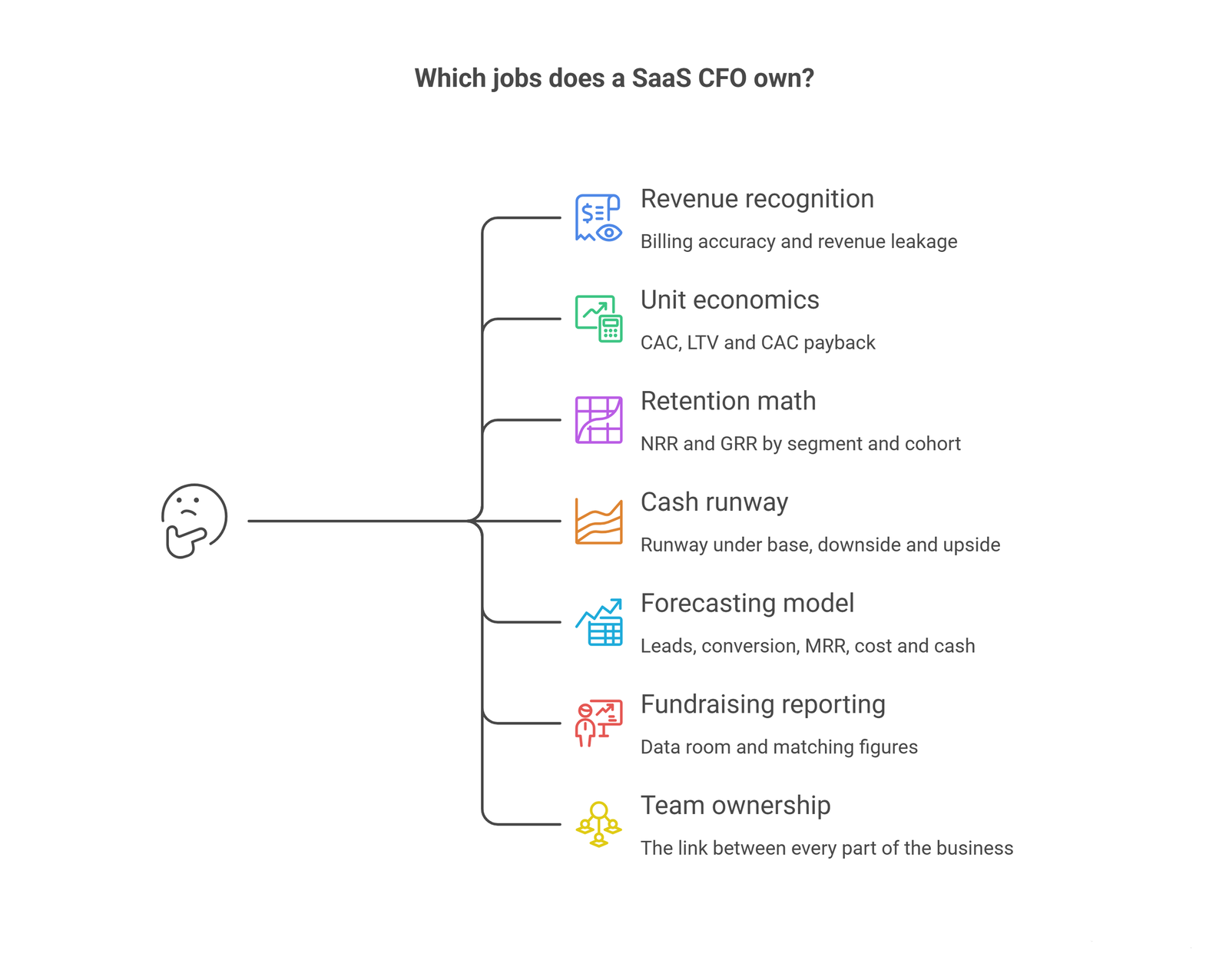
The 7 jobs a SaaS CFO owns
1. Revenue recognition and billing accuracy
Under ASC 606 and IFRS 15, SaaS revenue is recognized as the service is delivered, not when the invoice goes out. An annual prepayment is cash today and revenue over twelve months. Mix the two up and your ARR, margins and tax position are all wrong.
Multi-year deals, usage fees, discounts and implementation work add more complexity. The CFO sets the policy and checks that the billing system follows it. They also hunt for revenue leakage, such as unbilled usage or expired contracts that still run.
Oak’s free SaaS revenue recognition checklist is a practical place to start.
2. Unit economics
Customer acquisition cost (CAC) is total sales and marketing spend divided by new customers won. Count salaries, commissions, tools and agency fees. Leave any of them out and CAC looks better than it is.
Then compare CAC to customer lifetime value (LTV). A 3:1 LTV to CAC ratio is the common rule of thumb. CAC payback, the months of gross profit needed to repay CAC, shows how fast cash comes back.
A blended CAC hides losing channels. The CFO calculates it by channel and by segment. Oak’s article on CAC and customer lifetime value walks through the formulas.
3. Retention math
Net revenue retention (NRR) measures what a fixed group of customers pays you twelve months later. It counts upgrades, downgrades and cancellations, but no new customers. Gross revenue retention (GRR) strips out upgrades and shows pure retention.
An NRR above 100% means the existing base grows on its own. SaaS Capital reports that the 90th percentile of bootstrapped companies reaches 117.9% NRR and 100% GRR. That is the gap between the median and the best.
A good CFO reports both numbers by segment and cohort. A healthy blended figure can hide one segment that is leaking customers.
4. Cash runway and burn
Growth consumes cash before it returns any. The CFO models runway under three cases: base, downside and upside. The downside case should assume higher churn and a longer sales cycle.
Burn multiple is a useful check. It is net cash burned divided by net new ARR. A lower number means the company buys growth more cheaply.
Annual prepayment improves cash but creates deferred revenue, which is an obligation to deliver. The CFO tracks both so that cash in the bank is not mistaken for profit.
5. Forecasting and the financial model
A SaaS forecast is driver-based. It starts with leads and conversion, builds an MRR bridge (new, expansion, contraction, churn), then layers in cost and cash. Change one driver, such as churn, and every downstream number moves.
A model built this way becomes the planning tool for hiring, pricing and fundraising. Oak builds these through its SaaS financial model services.
6. Fundraising and board reporting
Investors ask for the same figures: ARR, NRR, gross margin, burn, payback. The CFO builds the data room and makes sure the numbers match across the deck, the model and the bank statements.
Mismatched numbers cost deals. One figure in the pitch and a different one in diligence suggests weak controls, even when the gap is innocent.
7. Ownership across teams
Finance sees every part of the business, so the CFO becomes the link between them. With sales, they design commission plans that reward profitable deals. With customer success, they watch renewal signals. With product, they test pricing and packaging. With HR, they plan headcount against runway.
The metrics a SaaS CFO keeps on one dashboard
| Metric | Formula | What it tells you | Watch for |
| MRR / ARR | Recurring revenue per month / x12 | Size and trajectory | Growth driven by one large customer |
| Gross margin | (Revenue – cost of revenue) / revenue | Profit per dollar of revenue | Support and hosting costs hidden in operating expenses |
| NRR | (Start + expansion – contraction – churn) / start | Growth from existing customers | Expansion masking logo churn |
| GRR | (Start – contraction – churn) / start | Pure retention | A drop in one segment |
| CAC payback | CAC / (monthly revenue per customer x gross margin) | Speed of cash recovery | Payback lengthening as you scale |
| LTV to CAC | LTV / CAC | Whether acquisition pays off | A ratio far above 5:1 can mean underinvestment |
| Burn multiple | Net burn / net new ARR | Efficiency of growth | Rising burn with flat ARR |
| Rule of 40 | Growth % + profit margin % | Balance of growth and profit | Margin basis changing between reports |
Oak’s guide to SaaS metrics and KPIs covers the full set, including funnel and customer success metrics.
The Rule of 40, used honestly
The Rule of 40 adds revenue growth to profit margin. A company growing 30% with a 10% margin scores 40. Some firms use EBITDA margin and others use free cash flow margin. Pick one and stay consistent.
Most companies miss it. Aventis Advisors analyzed 55 listed SaaS companies in May 2026. Only 8 of them, or 15%, cleared 40 on an EBITDA basis.
So treat the rule as a trade-off tool, not a pass or fail test. A company at 25 with 30% growth and a 5% loss is in a different position from one at 25 with 5% growth and 20% margin. The CFO explains which one you are.
Signs you need a SaaS CFO now
- You plan to raise money in the next six to nine months.
- Sales and finance report different ARR figures.
- Founders still approve every expense.
- Nobody can explain last quarter’s churn.
- A customer asks for audited statements or a multi-year contract.
- Your bookkeeper cannot answer a deferred revenue question.
One or two of these is normal. Three or more means the finance function has outgrown its setup.
Full-time, fractional or interim
Most early SaaS companies do not need a full-time CFO. The question is how much senior finance time you need, and when.
| Option | Best for | Trade-off |
| Fractional or virtual CFO | Seed to Series A, a few days a month | Less daily presence |
| Interim CFO | A gap between hires, a fundraise or a restructure | Fixed term, handover needed |
| Full-time CFO | Series B and beyond, complex reporting | Highest fixed cost |
Many companies start fractional, then convert to a full-time hire once the finance team and reporting demands justify one.
Frequently Asked Questions
What does a SaaS CFO do day to day?
They review revenue and billing accuracy, update the forecast, track retention and CAC, manage cash and prepare board or investor reports. Early on they also build the finance systems from scratch.
When should a SaaS startup hire a CFO?
Common triggers are a coming funding round, growing complexity in billing or revenue recognition, or founders spending too much time on finance. A fractional CFO is usually the first step.
How is a SaaS CFO different from a controller?
A controller focuses on accurate books, close and compliance. A CFO also owns forecasting, fundraising, strategy and capital allocation. Many SaaS companies need both.
Which SaaS metrics should a small team track first?
Start with MRR, gross margin, churn and CAC payback. Add NRR and burn multiple once you have a year of customer data.
Is the Rule of 40 relevant for early-stage companies?
Less so. Below a few million in ARR the number is noisy. Growth rate and unit economics give a clearer signal.
How does a SaaS CFO help with fundraising?
They build the model, prepare the data room, keep the numbers consistent across documents and answer investor diligence questions. They also help decide how much to raise and when.
Closing thought
The best SaaS CFOs make growth boring. Revenue is recognized on schedule, cash is forecast within a narrow band and the board sees few surprises. That calm gives founders room to take real product and market risks.
Oak Business Consultant provides CFO services for SaaS companies, from fractional support to full financial leadership. If you want a quick view of your current setup, start with the free SaaS CFO readiness checklist.