How to Write Ride-Hailing Business Plan
Learn to Write a Ride-Hailing Business Plan
A ride-hailing or taxi collection business is a smart way to generate revenue for start-ups and entrepreneurs alike. UBER, despite being the biggest ride-hailing platform in the world, does not own a single car. It is an excellent example of how a business structure built around a powerful online app platform can dominate the ride-hailing market. By owning the software, you can generate income through commissions without investing in buying or maintaining vehicles.
UBER has penetrated markets across the world with over 2 million drivers and counting. Instead of driving for UBER, you can buy an app package, launch your own taxi collection business, and operate as an independent entrepreneur. This guide walks you through every section of a ride-hailing business plan so you can build one that is ready for investors, lenders, and TNC permit authorities.
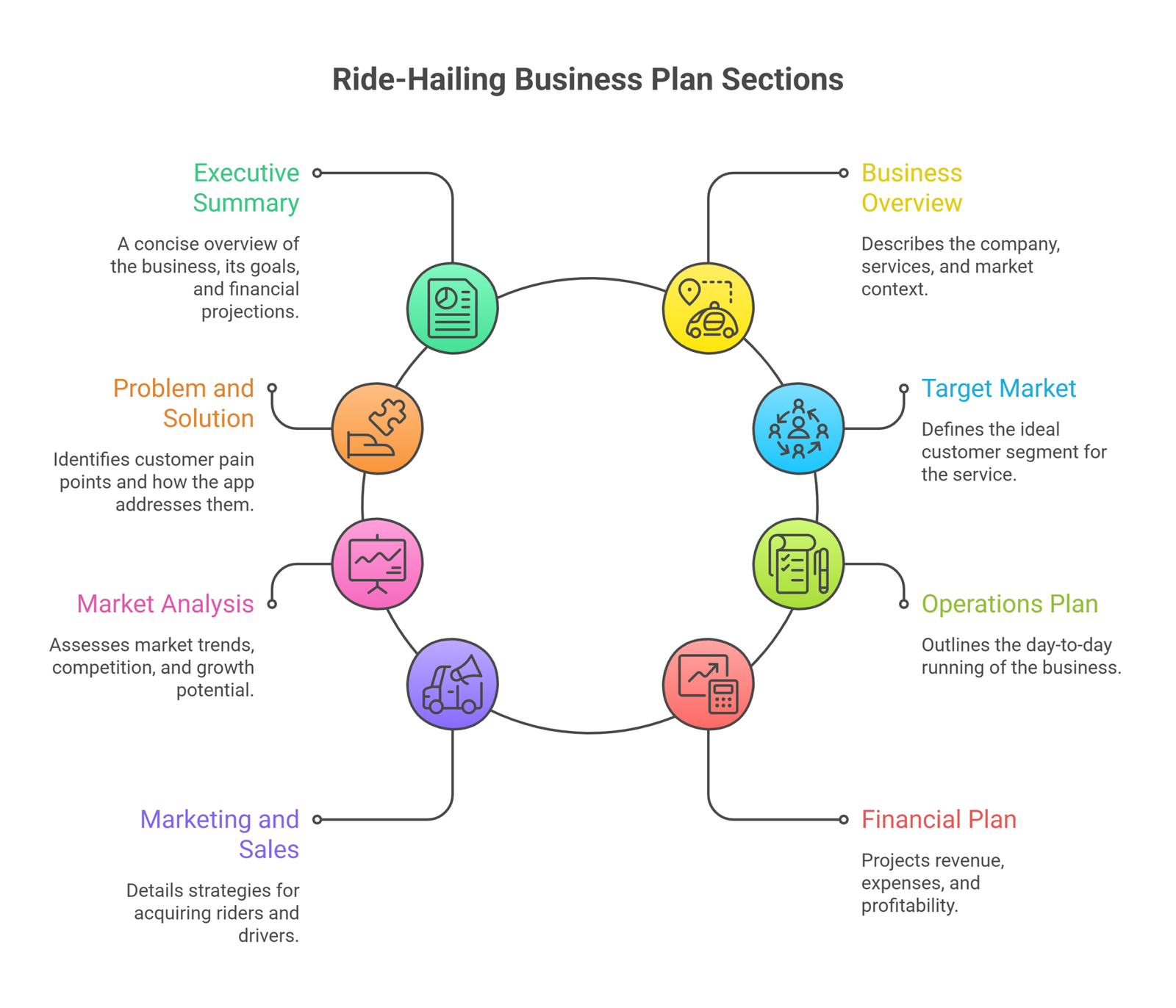
1. Executive Summary
Write your executive summary last, even though it appears first in your ride-hailing business plan. Once you know every detail of your business inside and out, you will be fully prepared to summarize it with confidence.
The executive summary introduces your business, describes what you do, and explains what you are asking from investors or lenders. It should cover your business concept, the problem you are solving, your target market, your competitive advantage in the ride-hailing market, and a snapshot of your financial forecast. Keep it to two or three pages. The goal is a quick read that sparks enough interest to make investors want to hear more.
Include brief financial highlights, key business milestones, and the funding amount you are seeking along with how you plan to use it. The executive summary should be able to stand alone as a document that gives any reader a complete picture of the opportunity.
2. Business Overview and the Urban Mobility Landscape
This section describes your company, the ride-hailing services you offer, and the market context that makes this a compelling opportunity.
The urban mobility landscape has shifted dramatically over the last decade. Traffic congestion in major metropolitan areas has reached record levels, and public transportation systems have struggled to keep pace with population growth. This gap has driven explosive demand for on-demand mobility services that offer faster, more flexible alternatives to both private car ownership and public transport systems.
App-based transportation has disrupted the traditional taxi cab association model, displacing incumbents like City Taxi and Mighty Cab that once held dominant local market share. Cities like San Francisco were among the earliest proving grounds for rideshare app software, and the model has since replicated across every major urban market worldwide. New entrants offering real-time tracking, seamless payment, and superior customer experience have fundamentally changed customer expectations around urban transport.
In this section, describe your company name, legal structure, founding story, the specific ride types you plan to offer such as economy, premium, shared, and wheelchair-accessible, and whether your fleet will rely on driver-owned vehicles, operator-owned hybrid vehicles or electric vehicles, or a combination of both. Be specific about your launch city and your plan for business development into additional markets over time.
3. Problem and Solution
Start this section by describing the problem you are solving for your target customers. What is the pain point? How are they currently getting around? Maybe existing ride-hailing services in your target market deliver poor customer service with no real-time tracking and no transparent fare estimation. Additionally, maybe the local taxi cab association operators charge unpredictable fares and offer no app-based transportation option. Maybe public transport systems in your city are unreliable and leave large residential zones underserved.
Be specific. Investors want to see that you have identified a real, documented gap rather than simply deciding to compete with Uber because the market is large.
Then describe your solution. Explain how your ride-hailing app addresses the problem better than anything currently available. Define your key differentiators, whether that is pricing, driver quality, app performance, coverage area, or ride types not offered by current operators.
4. Target Market
Who is your ideal customer? It is critical here to be specific. If you are launching a rideshare company, you are not targeting everyone just because many people need transportation. You are targeting a defined market segment such as students and young professionals without cars, daily commuters in corridors underserved by public transport systems, tourists in hotel districts, or corporate employees needing reliable airport transfers.
The individuals using ride-hailing applications are classified by different criteria including level of education, age, annual income, and location. Whether a person lives in an urban or rural area strongly predicts how likely they are to use on-demand mobility services. For example, in 2018 less than a quarter of North American high school graduates used Lyft or Uber, while more than half of post-graduates used these apps regularly. Educated urban residents represent the highest-conversion demographic and should anchor your initial target market.
Being specific about your market segment makes it far easier to target your marketing initiatives, set realistic Customer Acquisition Cost assumptions, and choose the right user acquisition channels.
5. Market Analysis
The market analysis section demonstrates that you understand the landscape your business is entering. Start with market research to identify market trends, current market share held by existing operators, and the size of each market segment you plan to serve.
Analyzing market share data from existing players reveals how fragmented or consolidated your target market is. In markets where two or three platforms already hold most of the market share, your plan needs a clear differentiation strategy, whether that is superior customer service, coverage of underserved areas, a fleet of electric vehicles, or dynamic pricing strategies that beat incumbents on value.
Look at how ride-hailing services have grown in comparable cities. Examine the role of traffic congestion and inadequate public transportation as demand drivers. Assess the competitive position of any active taxi cab association in your target city and their capacity to respond to a new entrant. Identify whether the market supports demand for premium ride types, corporate accounts, or hospital shuttle contracts that could anchor your early revenue.
Do not fall into the trap of defining the market as everyone who needs transportation. Defining a narrow, serviceable market segment first and then showing a credible path to expanding market share is far more convincing to investors than claiming the entire transportation market as your opportunity.
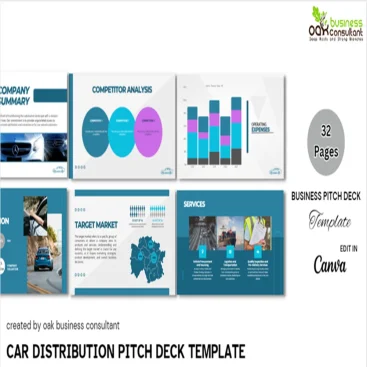
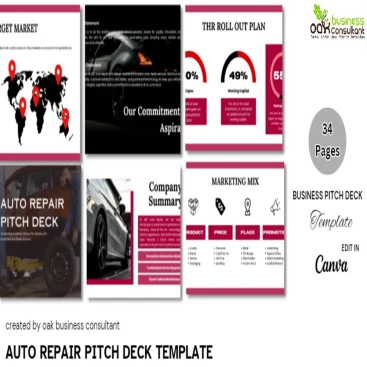
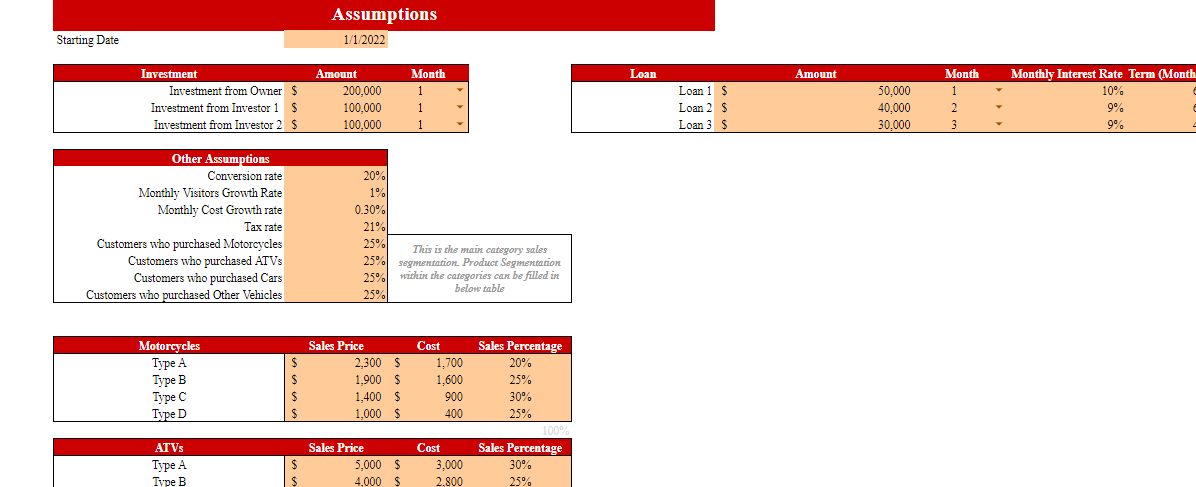
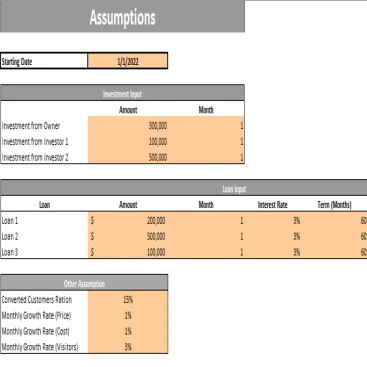
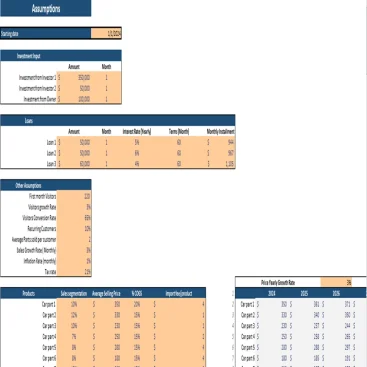
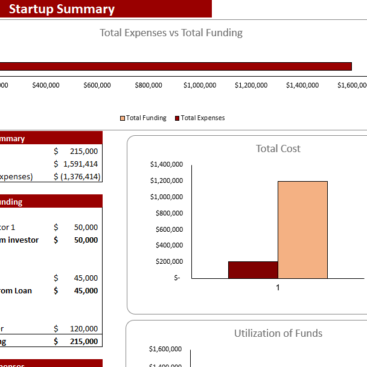
Related Products: Ride-hailing Excel Financial Model | Ride-hailing Pitch Deck
6. Operations Plan

The operations plan explains how your ride-hailing business runs day to day. This section should cover your technology infrastructure, driver program, fleet approach, and regulatory compliance framework.
Technology and App Development
Your entire business runs on your app. App development for a ride-hailing platform is a multi-phase process covering MVP testing, beta rollout, and full-scale launch. Your rideshare app software must handle simultaneous bookings, dynamic driver matching, live map rendering, and payment management without app performance degradation.
A production-ready ride-hailing app must include real-time GPS tracking so riders can follow their driver from booking confirmation to arrival, accurate fare estimation before every trip, a dispatch system that matches each request to the nearest available driver, in-app user ratings after every completed ride, credit card processing and credit/debit card payment support, and a driver-facing dashboard covering trip history, earnings, and navigation.
Fleet management software and taxi tracking software give operators a live view of every active vehicle, enabling real-time intervention and performance monitoring. Your cloud infrastructure must be architected for elastic scaling, and your Server Infrastructure Setup costs must be captured as a line item in your Initial App Development budget alongside ongoing app performance monitoring.
Driver Recruitment and Onboarding
Your supply side depends entirely on your ability to attract and activate quality drivers. Driver recruitment should prioritize professional, reliable drivers during the pre-launch phase when consistent supply matters more than driver volume.
Driver onboarding must include criminal background screening, driving history checks, driver verification of license and identity, vehicle inspection, and commercial auto insurance confirmation. In most jurisdictions, driver verification requirements are mandated by TNC permits and must be documented for regulatory audits. Describe your onboarding timeline, training process, and the driver roles your platform will support.
Driver incentives keep supply healthy during the low-volume early phase. Guaranteed minimum earnings, sign-on bonuses, and milestone rewards are the most effective driver incentives for new market entry. These costs belong in your financial model as a variable cost that scales down as the platform matures.
Fleet and Vehicle Management
Describe your approach to fleet management. If you are operating an owner-driver model, explain your minimum vehicle standards, vehicle maintenance inspection requirements, and how drivers are responsible for their own vehicle acquisition costs. If you are running an operator-owned fleet, explain your vehicle acquisition strategy, your vehicle maintenance schedule, and whether you are investing in hybrid vehicles or electric vehicles to reduce fuel costs and qualify for available fleet incentives.
Regulatory Compliance
Describe the regulatory compliance requirements for every market you plan to operate in. Most jurisdictions require a Transportation Network Company permit before your first driver goes live. TNC permits govern driver background check standards, insurance minimums, data reporting obligations, and fare transparency rules. In addition to TNC permits, you will need standard business licenses and proof of a commercial auto insurance policy structured for ride-hailing operations.
Ride insurance requirements differ by operational period. Period 1 covers drivers while the app is active but no ride has been accepted. Moreover, period 2 covers the time between ride acceptance and passenger pickup. Period 3 covers the active trip. Each period carries different insurance policy minimums. Commercial auto insurance is a significant Direct Cost of Sales and must be modeled accurately in your financial forecast.
Acknowledge the position of any existing taxi cab association in your target market. Associations representing City Taxi operators and Mighty Cab companies have historically lobbied to limit TNC permit issuance for new entrants. Demonstrating a compliance-first approach in your business plan protects your launch timeline.
7. Marketing and Sales Plan
The marketing and sales plan explains how you will acquire riders and grow your market presence. Before writing this section, your target market must be clearly defined. Without a specific buyer persona, your marketing plan will have little practical value.
Customer Acquisition
Ride-hailing is a two-sided marketplace. You must acquire riders and drivers simultaneously, and the economics of each are different. Customer Acquisition Cost tracks your total spend to acquire each new paying rider. Buyer CAC includes first-ride promotions, referral bonuses, and digital ad spend. Driver CAC tracks the fully loaded cost of recruiting, screening, and activating each new driver. Present both figures separately in your plan.
User acquisition on the rider side typically relies on promo codes for first rides, referral programs, social media advertising, and local event sponsorships. On the driver side, driver recruitment is driven by job board advertising, community outreach, and driver referral programs. Include a 90-day Roadmap in this section showing exactly how you plan to build supply and demand in parallel during your launch window.
Marketing Channels and Initiatives
With a solid user base established, you can expand revenue through cross-selling and partnerships. Partner with local businesses like food delivery services, coffee shops, hotels, and shopping platforms to create mutual referral arrangements. Email marketing and SMS campaigns are cost-effective ways to re-engage existing users. Sponsoring local events builds brand awareness efficiently in a defined geographic area.
Dynamic pricing strategies should be explained transparently in your marketing materials. Framing surge pricing as a supply-demand mechanism rather than opportunistic behavior protects customer experience during high-demand periods.
Setting up and actively managing your Google Business Profile is a low-cost, high-return marketing initiative. Riders searching for transportation in your city will encounter your listing before opening any app store. Customer feedback captured through in-app ratings and post-ride surveys should feed directly into service improvements and marketing messaging. A 24/7 customer service channel and a clear dispute resolution process are not just operational requirements. They are brand assets that drive organic word-of-mouth growth.
8. Financial Plan
The financial plan is often what startup founders find most challenging, but it does not have to be. Most ride-hailing financial plans follow a standard structure, and a business finance degree is not required to build a credible financial model. A typical plan covers five years and includes a sales forecast, personnel plan, income statement, cash flow statement, and balance sheet.
Revenue Model
Your primary revenue source is the Platform Take Rate, the commission percentage retained from each gross fare before the driver is paid. A typical Platform Take Rate ranges from 20 to 30 percent. Secondary revenue streams include dynamic pricing premiums during peak demand, in-app partner advertising, and corporate account subscription fees. Document every revenue stream clearly in your financial forecast.
Sales Forecast
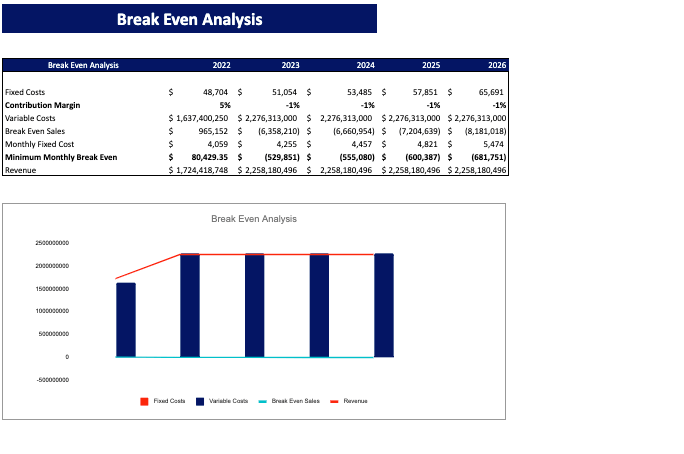
The sales forecast projects how much revenue you will generate over the next five years. Break it down by ride type rather than listing everything in a single row. Include a matching row for Direct Cost of Sales beneath each revenue line, covering driver payouts after the Platform Take Rate, credit card processing fees, and per-trip Ride insurance costs. Your Variable Cost Breakdown should show exactly how Contribution Margin is calculated per ride. A positive Contribution Margin on every incremental trip is your first major financial milestone.
Personnel Plan
Your personnel plan details headcount and Total Payroll by role across operations, engineering, customer service, and marketing. For smaller teams, list every position individually. For larger organizations, group by department. Include employee burden costs beyond base salary such as payroll taxes, medical insurance, and benefits. Payment Days assumptions, the timing of driver payouts relative to fare collection, affect your working capital requirements and must be reflected in your cash flow model.
Income Statement
The income statement, also called the profit and loss or PnL, pulls data from your sales forecast and administrative expenses to show whether your business is generating a net profit or operating at a loss in each period. Key metrics to track include Net Profit Margin and Return on Equity. Net Profit Margin will be negative in early periods due to driver incentive spend and platform investment, but your plan should show a credible path to profitability.
Cash Flow Statement
The cash flow statement is different from the income statement. While the PnL measures profitability, the cash flow statement tracks how much cash you have at any point in time. Understanding the distinction between the two is critical during the high-spend early phase of your business. Ride-hailing platforms benefit from near-instant payment via credit/debit card, which reduces the gap between revenue recognition and cash receipt. Monitor Net Working Capital alongside your cash flow statement as an early warning signal if costs are outpacing revenue.
Balance Sheet
The balance sheet gives investors an overview of your financial position at a specific point in time. It lists fixed and non-fixed assets, short and long-term liabilities, and owner’s equity. Subtracting total liabilities from total assets gives you the net worth of the business.
Key Financial Ratios
Support your three core financial statements with a ratios analysis. Liquidity Ratios including the Current Ratio confirm you can meet short-term obligations. Debt Ratios including Debt to Net Worth show how leveraged your balance sheet is. Activity Ratios including Total Asset Turnover and Accounts Payable Turnover measure operational efficiency. Interest Coverage tells lenders whether operating earnings can service your debt. Pre-tax Return on Assets and Return on Equity give equity investors the performance benchmarks they need to assess your growth trajectory.
Related Products: Ride-hailing Excel Financial Model | Ride-hailing Pitch Deck
Frequently Asked Questions
What is a ride-hailing business plan and why do I need one?
It is a document covering each section of your business from market analysis through financial forecast. Investors, lenders, and TNC permit authorities require it before committing capital or approving your launch.
How much does it cost to build a ride-hailing app?
A basic MVP with real-time GPS tracking, fare estimation, driver verification, and payment management typically costs $30,000 to $80,000. A fully custom platform with AI tools, computer-aided dispatch, and scalable cloud infrastructure can exceed $150,000.
How do ride-hailing platforms make money?
The main revenue source is the Platform Take Rate, typically 20 to 30 percent of each gross fare. Additional streams include dynamic pricing strategies during peak demand, in-app partner advertising, and B2B corporate account contracts.
What is the difference between Buyer CAC and Driver CAC?
Buyer CAC is the total cost to acquire a new paying rider including promo codes and ad spend. Driver CAC is the fully loaded cost to recruit, screen, and activate a new driver. Since ride-hailing is a two-sided marketplace, tracking both separately is essential.
Should I buy an existing taxi business or build from scratch?
Acquiring an existing taxi collection business provides an established driver base and business licenses but often comes with outdated taxi tracking software. Building from scratch gives full control over the technology and brand. A hybrid approach that keeps existing driver relationships while replacing the technology with modern rideshare app software is increasingly common.
Let’s Customize Your Ride-Hailing Business Plan
At Oak Business Consultant, we specialize in building customized business plans for ride-hailing and transportation startups. If you need a tailored plan or specific customizations for your venture, reach out to us. We are here to build a roadmap that fits your business precisely.