Renewable Energy Financial Modeling Solution – Case Study
Client Overview
Our client is a startup focused on converting landfill gas into electricity, contributing to clean energy solutions. They engaged Oak Business Consultant to develop a comprehensive renewable energy financial modeling framework to assess the project’s financial viability, attract equity investors, and secure debt financing.
The model incorporated key elements such as cash flows, income statement, balance sheet, discounted cash flow, debt service, capital stack, and sensitivity analysis. It also accounted for Investment Tax Credits (ITC), carbon offsets, Renewable Identification Numbers (RINs), and other revenue streams critical to renewable energy projects.
Our financial modeling enabled the client to understand their long-term financial outlook, support investor discussions, and make strategic decisions with confidence.
Challenges to the Client
Before engaging Oak Business Consultant, the client—a startup in the renewable energy sector—faced several critical challenges that hindered their ability to move forward confidently with their business planning and investment strategy. These challenges were multifaceted, involving both technical and financial complexities:
1. Unstructured Financial Planning
The client lacked a formalized and forward-looking renewable energy financial model to assess long-term business viability. Without a structured approach to projecting cash flows, operating expenses, and return metrics, they struggled to make data-driven decisions and articulate the financial potential of the business to prospective investors.
2. Complex Revenue Structure
The revenue model involved monetizing multiple streams—electrons, Renewable Identification Numbers (RINs), and carbon offset credits—each governed by separate regulatory frameworks and pricing mechanisms. Estimating values based on gas yield, heat rates, BTUs per SCF, and equivalency values was highly complex and required deep industry knowledge and modeling precision.
3. Lack of Clarity on Capital Requirements
The client was unclear about the total capital required to launch and sustain operations. With no concrete plan distinguishing pre-operational expenditures from operational capital needs, they were unable to define how much to raise through equity or debt financing, which created hesitation among potential investors.
4. Investment Tax Credit (ITC) Application
The client aimed to utilize federal Investment Tax Credits (30%–50%) but lacked clarity on eligibility criteria and how to integrate ITC benefits into financial projections. This created ambiguity in total project cost and after-tax savings, which are crucial for investor ROI calculations.
5. Incomplete CapEx and OpEx Forecasting
Estimating the lifecycle costs of Capstone microturbines, wells, gas recovery infrastructure, and ongoing operational expenses (OPEX) was a challenge. The absence of a detailed capital expenditure schedule and departmental costing prevented the client from understanding their breakeven point and long-term profitability.
6. Investor-Readiness and Valuation Strategy
The client lacked a compelling investment narrative supported by credible financial metrics such as NPV, IRR, Payback Period, and Equity Returns. Without a well-structured equity table or valuation forecast, it was difficult to engage or negotiate with institutional investors or strategic partners.
7. No Sensitivity or Scenario Analysis
The client had no tools to analyze how market fluctuations (e.g., energy prices, gas production variability, or policy changes) would impact their financial outcomes. This limited their ability to mitigate risks or adjust their strategy in a volatile regulatory and economic environment.
Key Features of the Renewable Energy Financial Model
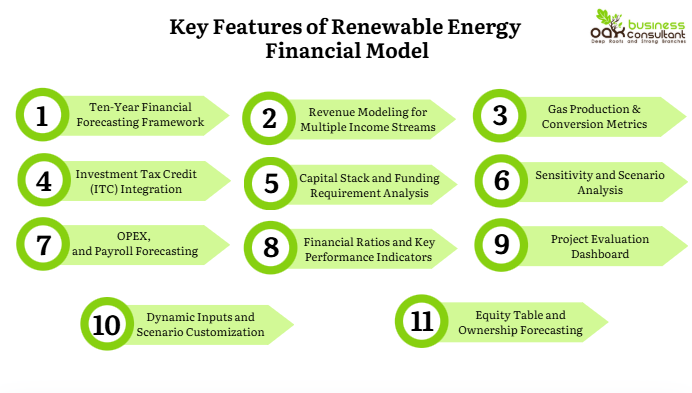
Oak Business Consultant developed a comprehensive and dynamic renewable energy financial model tailored specifically for the client’s landfill gas-to-electricity startup project. Designed to support long-term strategic planning, investor engagement, and operational decision-making, the model includes a suite of integrated features that reflect the technical, financial, and regulatory complexity of the renewable energy industry.
Below are the key features and functionalities that make this financial model both robust and investor-ready:
1. Ten-Year Financial Forecasting Framework
Our renewable energy financial model offers a detailed 10-year forecast across all critical financial statements, including:
- Income Statement (Profit & Loss)
- Cash Flow Statement (Direct and Indirect Methods)
- Balance Sheet Forecast
- Capital Expenditure Schedule
- Debt Service and Amortization Schedule
Each sheet is fully integrated and dynamically linked, ensuring real-time updates and interdependencies are preserved throughout the model. This allows stakeholders to simulate various business scenarios with confidence.
2. Revenue Modeling for Multiple Income Streams
Given the complexity of the client’s renewable energy business model, our financial model includes individualized revenue streams with granular detail:
- Electricity Sales (“Selling the Electrons”): Based on kWh production, market electricity prices, and power purchase agreements (PPAs).
- Renewable Identification Numbers (RINs): Modeled based on gas equivalency (BTU/SCF), regulatory multipliers, and RIN market pricing.
- Carbon Offset Credits: Evaluated using verified methodologies and carbon market pricing mechanisms, considering gas recovery and emissions reduction.
This multi-stream revenue modeling is essential for assessing revenue diversification, risk mitigation, and financial sustainability.
3. Gas Production & Conversion Metrics
The model includes advanced technical conversion metrics to simulate the gas-to-energy process:
- Gas Yield Projections (SCF per landfill well)
- Heat Rate Conversions (BTU/SCF)
- Energy Output Calculation (MW production from SCF)
- Gas Capture Efficiency and Loss Factors
This engineering-backed modeling provides more accurate and credible forecasts, essential for both investor due diligence and bank loan underwriting.
4. Investment Tax Credit (ITC) Integration
Our model includes full support for Investment Tax Credit scenarios:
- ITC at 30%, 40%, and 50% levels based on client qualification
- Post-credit cost basis calculations for CapEx and equipment
- Monthly tax reduction adjustments
- Real-time impact on EBT, tax liability, and net income
This ensures that all applicable federal renewable energy incentives are captured in the financial outlook, improving ROI projections and supporting tax equity investment analysis.
5. Capital Stack and Funding Requirement Analysis
We calculated the total capital required to launch and sustain the business, clearly distinguishing:
- Pre-operational expenditures (borne by the owner)
- Operational startup capital (to be funded via equity or debt)
The model also includes:
- Capital Stack Breakdown (Equity vs. Debt)
- Debt Servicing Schedule
- Loan Covenants and Interest Coverage Ratios
- Equity Table with Shareholding Scenarios
This makes the model ideal for use in fundraising rounds, investor presentations, and loan applications.
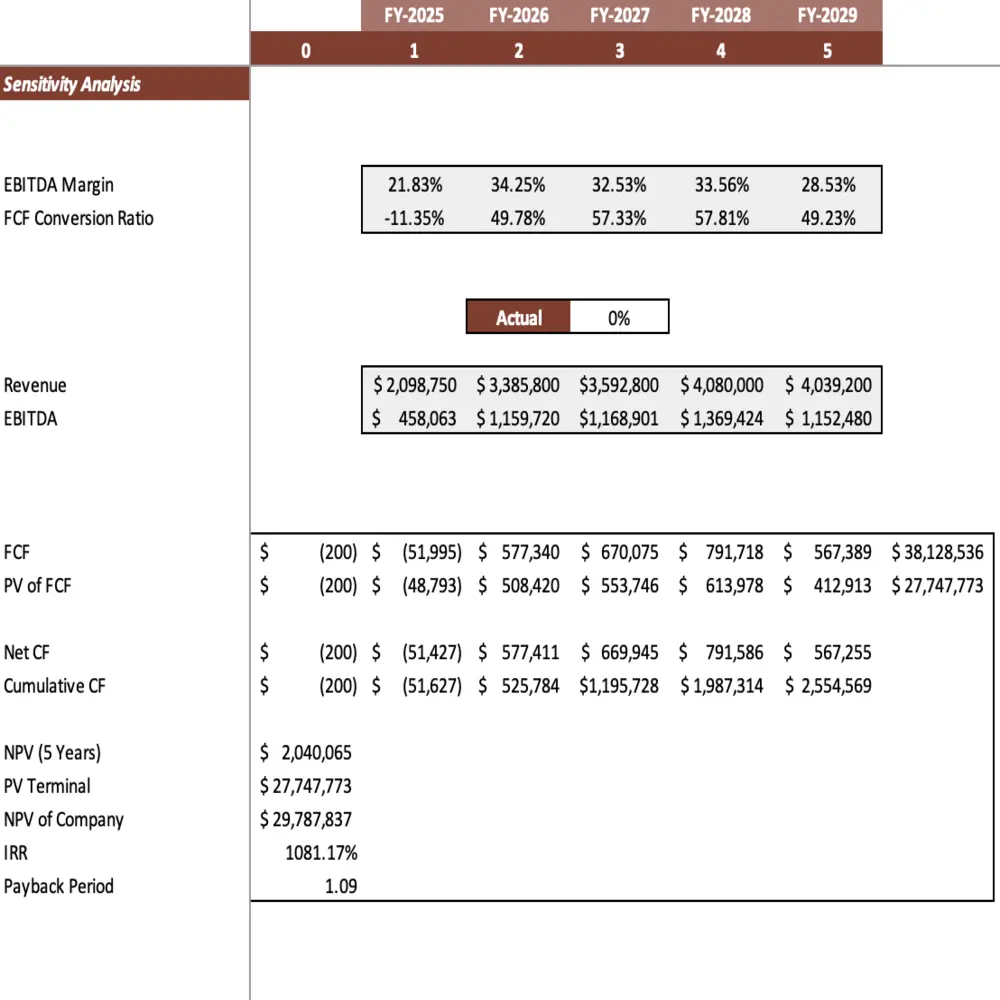
6. Sensitivity and Scenario Analysis
Our financial model allows for robust sensitivity analysis on key variables:
- Gas production variability
- Electricity pricing changes
- CapEx escalation
- O&M cost fluctuations
- Policy or tax credit changes
This feature supports risk management by enabling stress testing of assumptions and scenario planning, which is critical in a volatile energy and policy environment.
7. OPEX, Departmental Costing, and Payroll Forecasting
The model includes a department-wise operating expense forecast that breaks down:
- Payroll and headcount planning
- Maintenance and engineering costs
- Utility and administrative expenses
- Landfill gas purchase costs (if applicable)
It allows the client to monitor cost efficiency and plan future organizational growth sustainably.
8. Financial Ratios and Key Performance Indicators (KPIs)
The model automatically calculates key financial ratios to assess company health:
- Net Profit Margin
- EBITDA Margin
- Debt Service Coverage Ratio (DSCR)
- Return on Investment (ROI)
- Return on Equity (ROE)
- Asset Turnover and Working Capital Ratios
These KPIs support internal performance monitoring and meet the reporting expectations of institutional investors and lenders.
9. Project Evaluation Dashboard
The model features a dedicated Project Evaluation Sheet that consolidates:
- Net Present Value (NPV)
- Internal Rate of Return (IRR)
- Payback Period
- Equity Multiple
- Minimum Equity Requirement
This section is designed for investor due diligence and supports project finance modeling best practices.
10. Dynamic Inputs and Scenario Customization
To increase usability and reduce technical friction, the model includes:
- An Assumptions/Input Sheet with dropdowns and user-friendly formats
- Real-time recalculation capabilities
- Editable parameters for inflation, discount rate, asset lifespan, and more
This enables the client and their stakeholders to easily modify the model without technical knowledge, ensuring transparency and usability.
11. Equity Table and Ownership Forecasting
We provided a complete equity structure analysis that includes:
- Internal and external shareholder breakdown
- Share price per unit, number of shares, and total capital raised
- Cumulative ROI for investors
- Exit value and investor return scenarios
This supports cap table planning, investor negotiations, and equity funding strategy.
Outcome
Oak Business Consultant delivered a robust, investor-ready renewable energy financial modeling solution. It helped the client understand financial viability and clearly define funding needs. The model enabled accurate forecasting and integrated ITC along with multiple revenue streams—electrons, RINs, and carbon credits. It also supported strategic decisions through scenario and sensitivity analysis. As a result, the startup was well-positioned to raise capital and confidently advance its landfill gas-to-electricity project.
What’s In It for You?
Launching or scaling a renewable energy project involves navigating capital-intensive investments, regulatory complexities, and the challenge of securing funding. Without a tailored financial model, accurate forecasting, and a clear investment strategy, your project may face delays, funding gaps, or reduced viability.
How to Overcome These Challenges?
To attract investors and drive long-term success, you need to:
- Build a detailed renewable energy financial model that forecasts revenues, expenses, and cash flows specific to your project—be it solar, wind, or landfill gas.
- Analyze project returns using IRR, NPV, and payback periods to evaluate financial viability and risk exposure.
- Incorporate funding structures with equity, debt, grants, and build in assumptions for debt service, grace periods, and DSRA.
- Prepare an investment-ready business plan and confidential information memorandum (CIM) to present your project to banks, investors, and government agencies.
- Optimize your model with tools such as drop-down menus, timing sheets, and sensitivity analysis to simulate multiple scenarios.
Let’s Build Your Roadmap to Success
At Oak Business Consultant, we specialize in renewable energy financial modeling, investor documentation, and strategic funding advisory. Book a free consultation today
and take the first step toward building a bankable, investor-ready clean energy venture.
Frequently Asked Questions
Why is a Debt Service Reserve Account (DSRA) important?
DSRA protects lenders by covering shortfalls in debt service payments when operational cash flow is unstable.
How does investment banking support renewable energy?
Investment banking helps structure capital, prepare confidential information memorandums, and attract equity or debt investors for renewable energy investments.
What is business valuation modeling in this context?
It estimates the value of a renewable energy asset using methods like DCF, considering long-term revenue, CAPEX, and risk-adjusted returns.
Conclusion
Oak Business Consultant delivered a tailored renewable energy financial modeling solution that enabled the client to assess feasibility, structure financing, and attract investors. The model covered cash flows, capital costs, tax credits, and multi-source revenues—equipping the startup with a clear financial roadmap to scale its landfill gas-to-energy project.
Ready to build a solid financial foundation for your renewable energy project? Contact Oak Business Consultant today for expert support in renewable energy financial modeling, investor-ready projections, and strategic funding insights. Let’s turn your clean energy vision into a profitable reality.