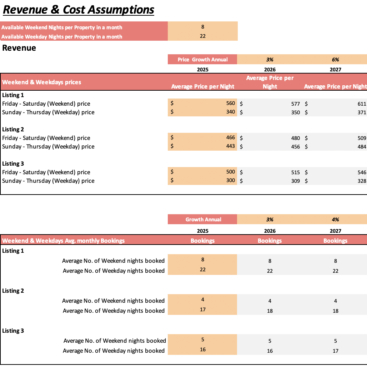
Case Study for E-Commerce Financial Model
Client Overview
Our client, a serial entrepreneur, planned to invest in a niche e-commerce platform through foreign investment. The platform focused on a specific product. We developed a detailed financial model to project cash flow, revenue, and costs. This e-commerce financial model included key metrics such as customer acquisition cost and variable costs. It also included essential financial statements like the income statement and balance sheet. This enabled the client to make informed decisions and ensured the platform’s long-term success.
Challenges in E-Commerce Investment
Our client, an investor based in Europe, faces several key challenges in evaluating an e-commerce investment opportunity in a foreign market.
- Currency Conversion: The most immediate challenge is dealing with currency conversion. Since the investment spans multiple countries with different currencies, accurately converting and tracking financial data in both local and European currencies is crucial. Exchange rate fluctuations must be carefully monitored to ensure accurate financial forecasting and reporting.
- Cost Analysis: A deep analysis of transportation costs is essential. This includes managing logistics, shipping, and customs expenses, all of which are crucial for understanding the true cost of doing business across borders. Additionally, the business will likely operate through multiple sales channels, each with its own set of costs and revenue structures. This complexity requires careful tracking and analysis to ensure accurate financial planning.
- Sensitivity to Market Variability: Conducting a sensitivity analysis to account for different scenarios is vital. The client needs to evaluate how changes in market conditions, such as shifts in sales volume, marketing spend, or variable costs, will impact the overall financial performance of the business. The ability to model various potential outcomes allows the client to assess risk and make better-informed decisions.
These challenges must be carefully managed to ensure a successful cross-border investment.
Features of Provided ECommerce Financial Model
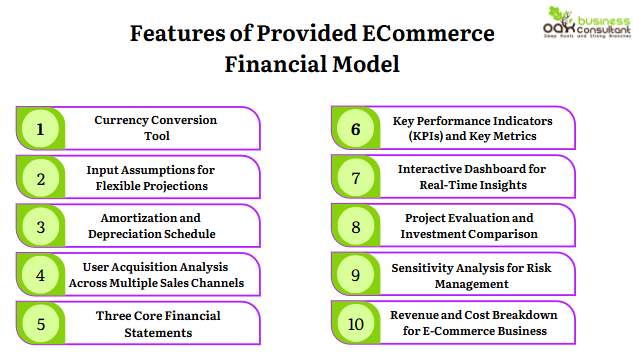
Oak Business Consultant crafted a robust and dynamic e-commerce financial model designed to empower our client. The model provides deep insights into the financial performance, potential risks, and growth opportunities of an e-commerce business. This comprehensive ecommerce financial model is built to support informed decision-making. It leverages powerful financial tools and key metrics that ensure complete transparency and efficiency. Below are the key features:
Currency Conversion Tool
Given the international nature of the investment, we’ve incorporated an input button for currency conversion. This tool allows our client to seamlessly switch between multiple currencies. It ensures that all financial data—revenue, costs, profit margins, and financial projections—are accurately reflected in the investor’s local currency. The model automatically updates cash flow projections and balance sheet items to account for fluctuating exchange rates. This ensures that the client has a clear understanding of foreign investment and its financial outcomes.
Input Assumptions for Flexible Projections
The financial model spanned three years, gathering all input assumptions—such as sales volume, marketing costs, fixed costs, variable costs, and growth forecasts—into one central sheet. This allowed our client to easily adjust and experiment with different scenarios, helping them test the impact of cost estimations, tax rates, and other financial variables on the income statement, cash flow, and balance sheet. With this flexibility, our client could simulate various scenarios and optimize their revenue model.
Amortization and Depreciation Schedule
For the business with fixed assets such as machinery and equipment, we provided a comprehensive amortization and depreciation schedule. This schedule tracked the value of both tangible and intangible assets over time, helping our client assess asset development and make better-informed decisions about capital allocation. By calculating depreciation periods and providing detailed asset valuations, we ensured our client understood how asset investments impacted the business’s financial projections, cash flow, and balance sheet.
User Acquisition Analysis Across Multiple Sales Channels
The e-commerce business model supported multiple sales channels, including B2C, B2B, Drop Shipping, Ads Space, and Product Listings. We carefully analyzed each channel, providing real projections of customers and estimating Customer Acquisition Cost (CAC) and Customer Lifetime Value (CLV). Our client’s marketing budget was allocated across various channels like SEO, Instagram, Facebook, and promotions. We then evaluated the return on investment (ROI) for each, helping our client identify the most profitable marketing channels. Additionally, we tracked sales volume and assessed the effectiveness of different strategies in driving customer acquisition.
Three Core Financial Statements
Once customer acquisition and sales volume projections were established, we created the three essential financial statements: the Income Statement, Cash Flow Statement, and Balance Sheet. These documents provided an overview of the business’s financial health, including profitability, liquidity, and capital structure. Through these statements, our client gained visibility into operating expenses, fixed costs, and variable costs, allowing them to evaluate revenue projections, cost management, and overall business performance.
Key Performance Indicators (KPIs) and Key Metrics
To ensure accurate business performance measurement, we built a set of industry-specific KPIs and key metrics. These included Average Order Value (AOV) for both B2C and B2B, Customer Acquisition Cost (CAC), Churn Rate, Net Monthly Recurring Revenue (MRR), Customer Lifetime Value (CLV), Average Revenue per Account (ARPA), CLV to CAC ratio, and Value per Visit (VPV). These metrics were tracked monthly, offering in-depth insights into sales performance, customer behavior, and profitability trends. With this data, our client could assess the efficiency of their marketing strategy and refine their approach to drive sustainable growth.
Interactive Dashboard for Real-Time Insights
The dashboard provided our client with a real-time overview of the company’s performance, featuring key metrics graphs such as CAC, CLV, MRR, Breakeven Analysis, and Cash Flow. Our client could track profitability, identify financial trends, and monitor financial projections in one centralized location. The profitability dashboard allowed for easy monitoring of critical metrics, helping them pinpoint areas for improvement, optimize the revenue model, and track financial outcomes more effectively.
Project Evaluation and Investment Comparison
Understanding the value of the business was critical for our client. We provided project evaluation tools such as Discounted Cash Flow (DCF), Net Present Value (NPV), Internal Rate of Return (IRR), and Free Cash Flow analysis. Additionally, we conducted an Investment vs. Equity Comparison to help our client assess the company’s valuation relative to their equity stake. This allowed our client to gauge whether the future earnings potential justified the initial investment and provided a clear understanding of the value of equity in relation to sales volume and growth potential.
Sensitivity Analysis for Risk Management
Recognizing the uncertainties early-stage businesses face, we offered sensitivity analysis to evaluate how different market conditions would affect financial performance. The analysis included low, moderate, and optimistic sales scenarios, accounting for fluctuating revenue projections and cost estimations. This helped our client assess profitability under various market conditions and gain insights into potential risks and financial outcomes. It was an essential tool for managing risks, particularly when facing uncertain sales targets or unexpected operational challenges.
Revenue and Cost Breakdown for E-Commerce Business
To give our client a clear understanding of the platform’s profitability, we broke down revenue channels, variable costs, fixed costs, and marketing spend in detail. This breakdown enabled our client to evaluate the cost structure of the business, identify where savings could be made, and understand how different sales channels contributed to overall profit margins. By analyzing these costs, our client could better estimate future financial projections and optimize their investment strategy.
The outcome of ECommerce Financial Model
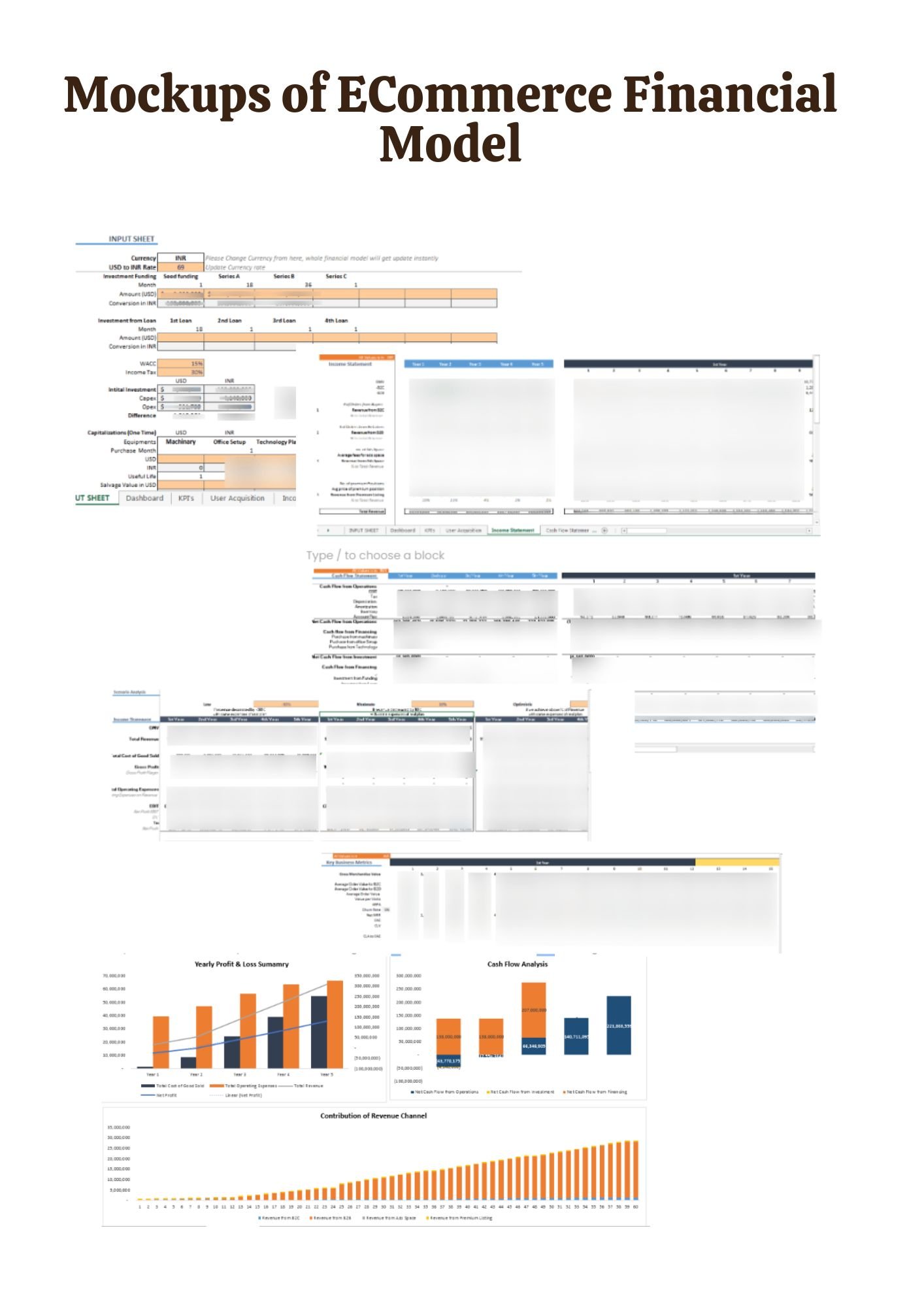
Oak Business Consultant’s e-commerce financial model equipped our client with a comprehensive, data-driven tool to make informed decisions, optimize operations, and ensure the long-term success of their e-commerce investment. With features such as currency conversion, input assumptions, sensitivity analysis, and detailed financial statements, our client could easily track performance, manage risks, and forecast growth. This model ultimately supported our client in making informed decisions and maximizing their return on investment.
What’s in It for You?
As an e-commerce business owner, investor, or financial decision-maker, scaling your online platform and maintaining financial stability in a competitive digital market can be daunting. Without a well-structured financial model, your business’s growth may face significant risks, such as:
- Inaccurate revenue forecasts, leading to poor financial planning and missed opportunities for growth.
- High operating costs, including marketing, customer acquisition, and logistics, which can erode your profit margins and impact profitability.
- Unoptimized pricing strategies, limiting your ability to maximize revenue per customer and affecting overall financial performance.
- Cash flow instability, which makes it difficult to manage day-to-day operations and fund business growth.
- Investor uncertainty, causing delays in securing capital or hindering your ability to expand your e-commerce business.
How Can You Overcome These Challenges?
By leveraging a comprehensive financial model, you can address these challenges and set your e-commerce business up for long-term success:
- Develop a Scalable Financial Model: Build an integrated model that tracks revenue, expenses, and cash flow, providing clear visibility into your financial health.
- Optimize Pricing & Revenue Streams: Implement dynamic pricing strategies and subscription models to maximize profitability and improve revenue per customer.
- Enhance Customer Acquisition & Retention: Use insights into Customer Acquisition Cost (CAC), Lifetime Value (CLV), and churn rate to refine your marketing and sales strategies.
- Improve Cash Flow Management: Accurately forecast operational costs, investment needs, and projected revenue growth for stable cash flow management.
- Boost Investor Confidence: Present clear, data-driven financial projections that demonstrate your business’s scalability and potential returns, making it easier to secure funding.
Ready to Strengthen Your E-Commerce Financial Strategy?
At Oak Business Consultant, we specialize in crafting customized financial models, revenue forecasting, and strategic business planning for e-commerce business owners. Book a free consultation today, and let’s work together to develop a financial roadmap that will drive your e-commerce business toward sustained success and growth.
Frequently asked questions
What is an E-Commerce Financial Model?
An Ecommerce financial model forecasts the financial performance of an online business, including key financial statements and metrics like customer acquisition cost (CAC) and lifetime value (CLV). It helps investors assess the business’s potential and profitability.
How does currency conversion work?
The model includes a currency conversion feature that allows investors to view all financial data in their preferred currency, automatically updating all figures in real-time.
Why is the amortization and depreciation schedule important?
The schedule tracks the decline in value of assets, helping investors understand how these affect cash flow and overall profitability.
How is user acquisition analysis handled?
The model analyzes customer acquisition from multiple channels, calculating important metrics like CAC and CLV to measure the effectiveness of marketing efforts and their impact on sales.
Conclusion
Oak Business Consultant successfully helped our client, a serial entrepreneur, evaluate an e-commerce investment in a niche market. We developed a comprehensive financial model that addressed challenges like currency conversion, cost analysis, and market sensitivity. By incorporating key financial statements, user acquisition analysis, and essential KPIs (CAC, CLV), we provided clear insights for better decision-making and growth planning. The model also included amortization schedules and sensitivity analysis, allowing the client to forecast various market scenarios. This empowered the client to make informed investment decisions and optimize long-term success. Ready to take your e-commerce business to the next level? Contact Oak Business Consultant for a tailored financial strategy.