What Is a Cap Table? A Guide for Founders and Investors
Don’t Get Diluted: What Founders and Investors Need to Know About Cap Tables
If you have ever started a company or taken on investors, someone has probably asked you about your cap table. Maybe you nodded along, maybe you opened a spreadsheet, or maybe you quietly Googled it later. Either way, this guide will walk you through everything you need to know in plain language.
What Is a Cap Table?
A cap table, short for capitalization table, is a document that shows who owns what in a company. It lists every shareholder, how many shares they hold, what type of shares those are, and what percentage of the company they own.
Think of it as a live snapshot of your company’s ownership structure. It is not just a formality, it is one of the most important documents your company will ever maintain.
At its core, a cap table answers three questions:
Who owns the company? How much do they own? And on what terms?
What Does a Cap Table Include?
A well-maintained cap table tracks several key data points. Here is what you will typically find in one:
- Shareholder details including names, contact information, and whether they are founders, investors, or employees.
- Share class breakdowns showing common stock, preferred shares, restricted stock, and any other stock type your company has issued.
- Outstanding shares meaning every share that has been issued and is currently held by someone.
- Option pool which covers stock options and equity awards that have been granted or reserved for employees and advisors.
- Convertible notes and SAFE notes—which are convertible instruments that will eventually turn into equity.
- Ownership percentages calculated both on a basic and fully diluted basis.
- Vesting schedules for founders and employees who earn their shares over time.
- Pre-money valuation and post-money valuation tied to each funding round.
Why Does a Cap Table Matter?
Your cap table is not just a spreadsheet. It is a legal record of who owns your company. It has real legal implications every time you raise money, hire someone with equity, or consider selling the company.
Here are the main reasons it matters:
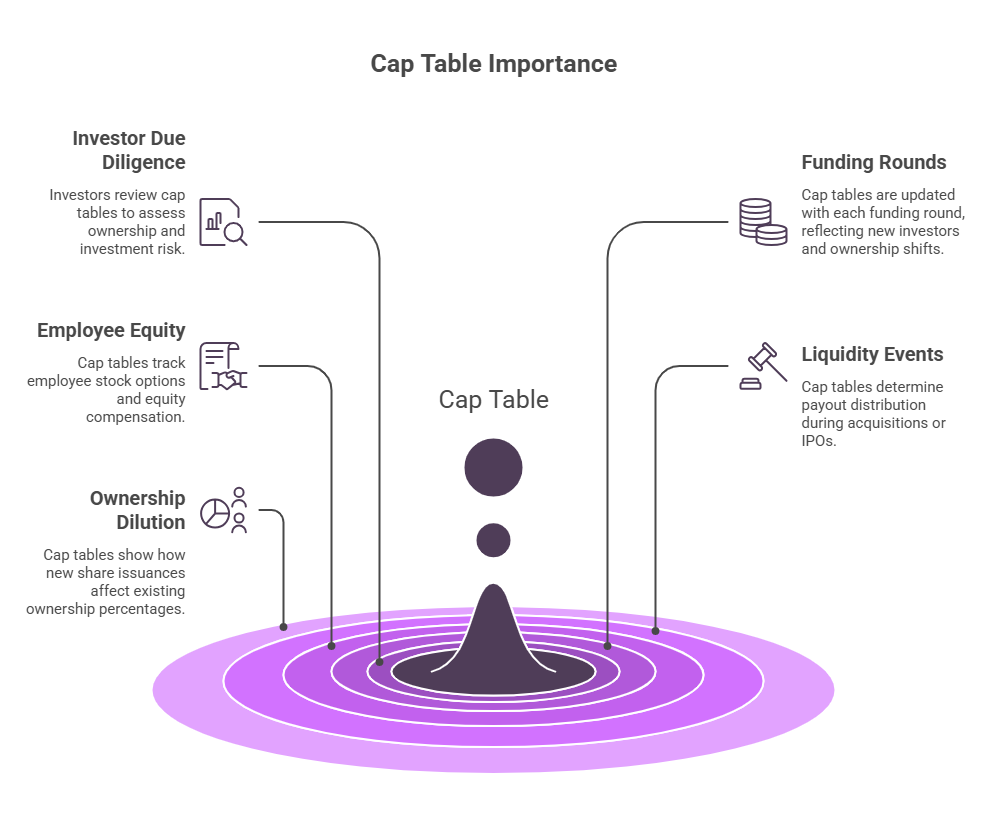
Investor due diligence. Venture capitalists and investment bankers will review your cap table before writing a check. They want to see the full ownership structure, understand liquidation preferences, and know how much of the company they are actually buying.
Funding rounds. Every time you raise money, whether it is a seed round, Series A Preferred, or Series D—the cap table gets updated. New investors come in, existing ownership percentages shift, and sometimes new share classes are created.
Employee equity plans. Employees and early team members often receive stock options or equity-based compensation. Your cap table shows exactly how large the employee stock option pool is and how much has been granted.
Liquidity events. When your company gets acquired or goes public, the cap table determines who gets paid and how much. Liquidation preferences built into preferred stock can significantly affect the payout to each shareholder.
Ownership dilution. Every time you issue new shares, existing shareholders get diluted. Founders especially need to understand how equity dilution works across multiple investment rounds.
Types of Shares on a Cap Table
Not all shares are equal. A cap table will usually contain several different types.
- Common stock is typically held by founders and employees. It comes with voting rights but sits at the bottom of the liquidation stack.
- Preferred shares are usually held by investors. They come with special rights, including liquidation preferences, anti-dilution protections, and sometimes guaranteed dividends. Preferred stock is what most early-stage investors receive in exchange for their investment.
- Restricted stock is stock that has been granted but is subject to a vesting schedule. If an employee leaves before their shares vest, they forfeit the unvested portion.
- Stock options give employees and advisors the right to buy shares at a fixed share price in the future. They are a common form of equity-based compensation in startups.
- Convertible notes and SAFE notes are not equity yet—they are debt or agreements that convert into shares when certain conditions are met, usually during a future financing round. They often come with valuation caps that limit how much the conversion dilutes existing shareholders.
How Funding Rounds Change the Cap Table
Each financing round reshapes your cap table. Here is how it typically works.
Before any outside money comes in, founders own 100 percent of the company. The cap table is simple. There may be a small option pool reserved for future hires.
When you raise your first round—seed funding or a bridge round—new investors come in. They receive shares, usually preferred shares, in exchange for their capital. The pre-money valuation determines the share price, and the post-money valuation reflects what the company is worth after the investment.
As you move through investment rounds—Series A, Series B, and beyond—more investors join the cap table. The option pool often gets refreshed. Convertible instruments from earlier rounds convert into equity. Ownership percentages for earlier shareholders get diluted.
By the time a company reaches later-stage rounds or a liquidity event, the cap table can be quite complex. Dozens of shareholders, multiple share classes, layered liquidation preferences, and years of vesting schedules all need to be tracked precisely.
Liquidation Preferences Explained
Liquidation preferences are one of the most misunderstood parts of a cap table—and one of the most consequential. They determine who gets paid first when the company is sold or wound down.
Preferred shares almost always come with a liquidation preference. This means preferred shareholders get their money back before common stockholders receive anything. A 1x liquidation preference means an investor gets back at least what they put in. Participating preferred stock means they get their money back and then share in the remaining proceeds with common stockholders.
For founders and employees holding common stock, liquidation preferences can significantly reduce what they walk away with in a modest exit. Understanding this dynamic early helps founders negotiate better terms in later investment rounds.
The Option Pool and Equity Dilution
The option pool—sometimes called the employee stock option pool—is a block of shares set aside for future employees, advisors, and contractors. It is typically created before a funding round because investors will ask for it.
The size of the option pool matters. Investors usually want it to be large enough to hire a strong team. But the pool comes out of the pre-money valuation, which means founders bear most of the dilution.
Every time you grant stock options, the outstanding shares on a fully diluted basis increase. This is called ownership dilution. It does not necessarily reduce the value of your stake, but it does reduce your percentage of ownership.
Vesting Schedules
Most equity in startups is subject to a vesting schedule—a timeline over which shares or options become fully owned by the recipient.
A standard vesting schedule for founders and employees is four years with a one-year cliff. That means nothing vests in the first year. After the cliff, shares begin vesting monthly or quarterly over the remaining three years.
Vesting schedules protect the company. If a co-founder leaves after six months, they should not walk away with a large chunk of the company. A proper vesting schedule ensures that equity is earned over time.
How to Build a Cap Table
For very early-stage companies, a cap table can be maintained in a spreadsheet. A basic Excel template will work when you have just a few shareholders and no complex instruments in play.
As the company grows, spreadsheets become risky. Errors creep in. Version control becomes a nightmare. And the legal implications of a mistake are significant.
That is why most growing companies move to dedicated cap table management software or online software platforms. These tools offer features like automated cap table tracking, e-sign for share transactions, an investor portal, employee access for checking their equity, and scenario modeling for round modeling and future investment rounds.
Cap table management done right means every stakeholder always has an accurate, up-to-date view of their share ownership. That clarity builds trust and prevents costly disputes down the road.
Common Cap Table Mistakes to Avoid
Even experienced founders make mistakes with their cap tables. Here are the most common ones:
Not updating after every share transfer or new grant. An outdated cap table is worse than having none at all.
Ignoring convertible instruments until a financing round. Convertible notes and SAFE notes do not live on the balance sheet as equity, but they will convert and dilute existing shareholders. Always model what this looks like before raising.
Setting the option pool too small. An underfunded employee stock option pool will need to be refreshed—usually at the cost of founder dilution.
Forgetting about fully diluted share counts. Ownership percentages look very different on a basic versus fully diluted basis. Always model both.
Not having a shareholder agreement. A cap table is a living document, but it needs to be backed by proper legal documentation including a share register, stock certificates, and signed agreements.
Cap Table and Company Valuation
Your cap table directly affects your company valuation in the eyes of investors. A clean, well-organized cap table signals that your company is professionally run.
When investors calculate market value or assess the equity distribution of your business, they are working from your cap table data. If the numbers are messy or incomplete, it creates doubt.
Pre-money valuation is what investors assign to your company before their money goes in. Post-money valuation includes their investment. These figures directly determine how much of the company they receive and what the resulting ownership stakes look like for everyone on the cap table.
Who Should Have Access to the Cap Table?
Not everyone needs to see the full cap table. Here is a practical breakdown:
Founders and the board should have full access at all times.
Current investors typically have the right to view the full capitalization table as part of their shareholder rights.
Employees can and should have visibility into their own equity—including their vesting schedule, strike price, and the size of the option pool. Platforms with employee access features make this easy.
Potential investors during due diligence will request the full cap table before closing any deal.
Frequently Asked Questions
What is the difference between a cap table and a share register?
A share register is the official legal record of shareholders, required under company law in most jurisdictions. A cap table is broader—it includes not just current shareholders but also option holders, convertible note holders, and SAFE note holders. Think of the share register as a subset of the cap table.
How often should a cap table be updated?
It should be updated every time there is a change in ownership. That includes new share issuances, option grants, share transfers, conversions of convertible instruments, and any other equity event. Many founders update it after each financing round at a minimum, but ideally, changes are recorded immediately.
What is an option pool shuffle?
This is a term for when investors require the option pool to be created or expanded before a financing round closes. Because the pool is included in the pre-money valuation, it dilutes founders rather than investors. It is a negotiation point that founders should understand and push back on when possible.
What are valuation caps on convertible notes?
Valuation caps protect early investors who use convertible instruments like SAFE notes or convertible notes. They set a maximum valuation at which the note will convert into equity. If the company is valued higher at the next round, the investor still converts at the capped valuation, giving them a larger ownership percentage than investors who came in at the higher price.
How does a share split affect the cap table?
A share split increases the number of outstanding shares while decreasing the share price proportionally. It does not change ownership percentages. It is often done to make shares more affordable or to clean up the cap table before an IPO.
Conclusion
A cap table is more than a spreadsheet, it is the foundation of your company’s financial and legal structure. It tracks every share, every investor, every employee equity grant, and every convertible instrument from day one through to a liquidity event.
Getting it right from the start prevents headaches, builds investor confidence, and ensures every stakeholder knows exactly where they stand.
Managing equity well is a core part of running a financially healthy company. If you want expert guidance on structuring your equity, navigating funding rounds, or keeping your cap table clean as you scale, the CFO services team at Oak Business Consultant can help. Reach out today to learn more about how we support founders and finance teams with the financial clarity they need to grow.