Is Your Outsourced CFO Worth it? A Scorecard to Find Out
How to Measure Your Outsourced CFO’s Value
An outsourced CFO sends a report every month. The invoice arrives the same week. Few owners can say whether the first justifies the second.
That gap is common. CFO work does not produce a simple output count like sales calls or invoices sent. The value shows up as a cash shortfall that never happened. It shows up as a loan on better terms or a price change that lifted margin. Those wins are easy to miss unless someone tracks them.
This guide shows owners how to track them. It covers how to count the cost and the value. It lists which metrics to review by function. It also explains what to do when the numbers disappoint. For a definition of the role itself, see our guide on what an outsourced CFO is.
Why the value is hard to see
Three things hide the return.
First, much of the value is prevention. A forecast that flags a cash gap eight weeks early saves a crisis that never makes a headline.
Second, results arrive late. A fundraise or a margin change can take months to pay off.
Third, credit gets blurred. The CFO analyzes, the owner decides and the team executes. If margin improves after a pricing review, who earned it?
A scorecard fixes the third problem by setting attribution rules before the work starts. Agree on what counts, how it is traced and who signs off.
Count the full cost first
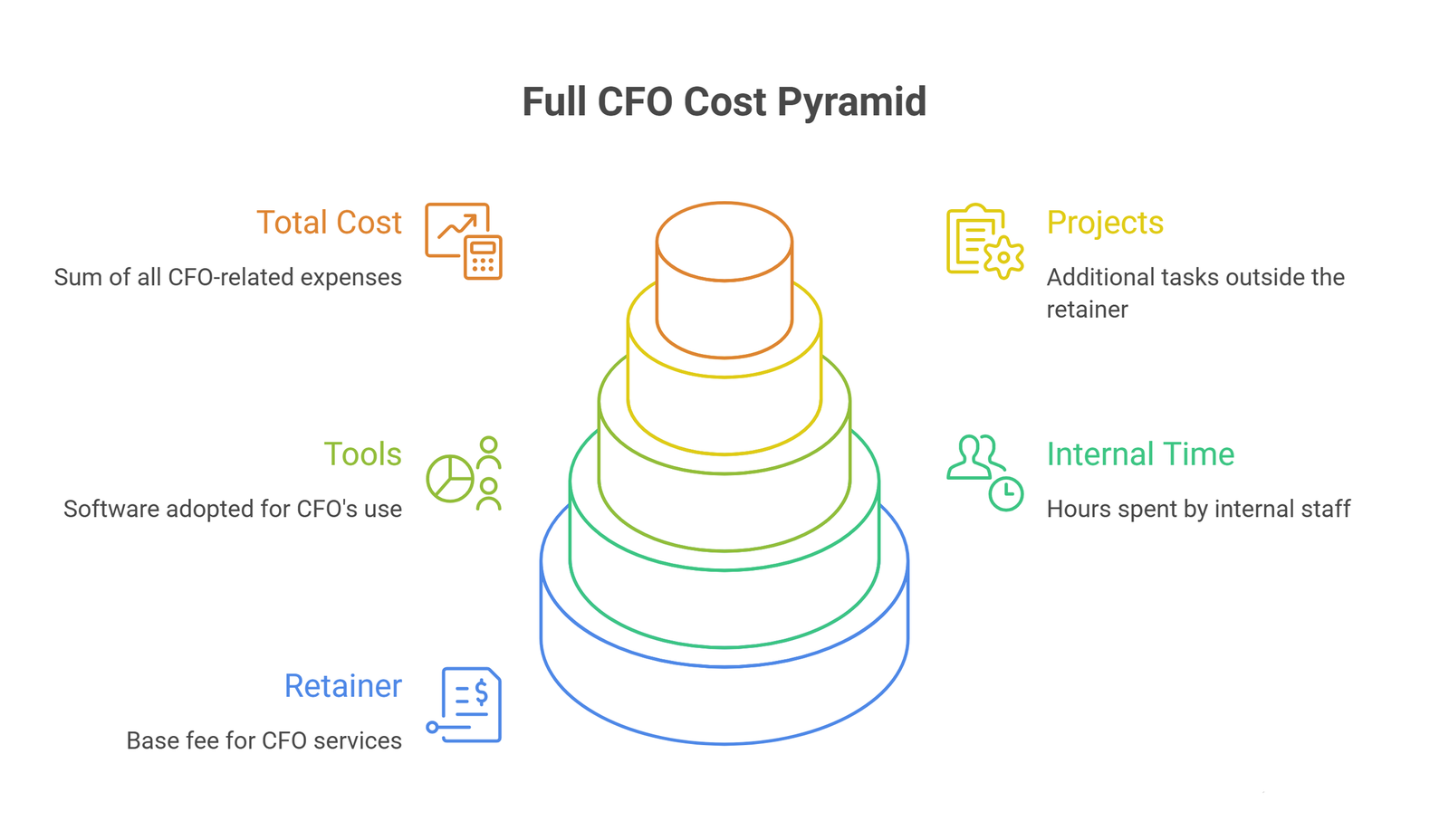
The retainer is only part of the bill. Add these:
- Internal time. Hours your bookkeeper, controller and own team spend preparing data and joining meetings.
- Tools. Software the CFO asks you to adopt.
- Projects outside the retainer. A model build, a data room or a diligence sprint.
These costs apply whether the CFO is fractional, virtual or part of a firm. If you work with a part-time CFO, our guide on what a fractional CFO is explains that model. Add everything up for a full year. That total is your cost base. For typical price ranges by engagement model, see our guide to the cost of a fractional CFO.
Count the value in four buckets
Not every benefit deserves the same weight. Sort them by how well you can prove them.
| Bucket | What counts | How to trace it | Weight |
| Hard savings | Fees renegotiated, duplicate spend cut, penalties or errors avoided | Invoices and statements before and after | Hard |
| Margin gains | Price, mix or discount changes that came from CFO analysis | Margin by product or customer before and after the change | Hard, if documented |
| Financing benefit | Lower interest, better loan terms, less dilution in a raise | Term sheets and loan offers | Hard |
| Time returned | Owner and team hours moved back to selling and building | A simple time log before and after | Soft |
Keep the soft bucket separate. A CFO who needs it to break even has not delivered yet.
Freed cash is not profit
Faster collections or tighter inventory release cash. That is a liquidity win, so track it in your cash metrics. Do not add it to ROI, because the money was already yours. Count the financing cost it saved instead.
The ROI formula
Use hard value only:
ROI = (hard value minus total cost) divided by total cost
Here is a hypothetical year to show the arithmetic. The figures are illustrative, not client results.
| Item | Amount |
| Retainer | $60,000 |
| Internal time and tools | $6,000 |
| Total cost | $66,000 |
| Vendor and fee savings | $30,000 |
| Margin gain from a pricing change | $45,000 |
| Lower financing cost | $15,000 |
| Hard value | $90,000 |
| Net gain | $24,000 |
| ROI | about 36% |
Some owners prefer a payback view. The same inputs work with the payback period formula.
Set a baseline before the first review
Every improvement needs a starting point. Without one, progress is a story instead of a number.
Capture these at the start:
- Weeks of cash runway
- Forecast versus actual for revenue and cash
- Days to close the books each month
- Days to collect from customers
- Gross margin by product or customer
If the engagement is already running, rebuild the baseline from the last two or three quarters. It will be rough. It is still better than nothing.
The scorecard by CFO function

Match each function to a metric, a healthy sign and a warning sign.
| Function | Metric | Healthy sign | Warning sign |
| Cash | Weeks of runway, forecast versus actual cash | Gap narrows each quarter. Shortfalls flagged weeks ahead. | The owner still hears about shortfalls first. |
| Planning | Budget variance, scenarios built | Variances explained within the month. Scenarios exist for big decisions. | Budget set once and never revisited. |
| Reporting | Days to deliver the monthly pack | Pack arrives on a fixed date with a short list of metrics tied to goals. | Late, long, or full of numbers nobody uses. |
| Margin | Gross margin by product or customer | CFO shows where profit comes from and recommends changes. | Only total margin is reported. |
| Capital | Readiness for lenders and investors | Model, data room and likely answers are ready before anyone asks. | A scramble when a lender requests documents. |
| Controls | Reconciliation timing, audit or diligence findings | Fewer findings each cycle. | The same findings repeat. |
Do not track all six from day one. Pick the three or four that match why you hired the CFO. A planned raise points to the capital row. A cash squeeze points to the cash row. Spreading attention across everything dilutes it.
The cash row deserves extra care. Our guide to sound cash flow management covers the habits that sit behind a good forecast.
Evidence to expect at day 30, 60 and 90
Activity is not evidence. Look for proof of change.
- By day 30: a live cash forecast, an agreed list of metrics and a written baseline.
- By day 60: one full cycle of reporting delivered on a fixed date, with variances explained and a ranked list of improvements, each with a dollar estimate.
- By day 90: at least one real decision shaped by the CFO’s analysis, and an owner who can state current runway without asking anyone.
If day 90 passes with none of these, raise it directly. A short, specific conversation now beats a vague one at renewal.
Check your own side first
Attribution cuts both ways. A low score does not always mean a weak CFO.
Ask three questions before you judge:
- Did the CFO receive clean data on time?
- Did leadership act on the recommendations?
- Did the CFO get access to the people and systems they needed?
If the answer to any is no, fix that first. A forecast built on late books will stay inaccurate whoever builds it.
Red flags that activity is replacing results
Watch for these patterns:
- Many meetings and few decisions
- Reports that describe the past and never recommend an action
- Recommendations with no dollar estimate attached
- Vague answers when asked what changed because of the CFO’s work
- No written log of recommendations and outcomes
One flag is a prompt for a conversation. Several together are a pattern.
What to do when the score is low
Work through the options in order.
Start with a direct conversation, using the scorecard as the agenda. Then narrow the scope to one clear goal for the next quarter. If the cause is poor fit, change the person or the firm. If the original need has passed, reduce the hours. If workload has grown past what part-time can cover, consider a larger commitment.
Sometimes the forecast model is the weak point. In that case, a purpose-built financial model usually fixes more than extra hours will.
How to run a quarterly review
Thirty to forty-five minutes is enough. Follow this order:
- Update the cost base with the latest hours, tools and projects.
- Update the value log with evidence for each item.
- Score each tracked function against its baseline.
- Agree the one or two goals for the next quarter.
- Record decisions in writing.
Hold a light monthly check-in between reviews. Reserve a fuller scope reset for once a year.
Frequently Asked Questions
How do you calculate the ROI of an outsourced CFO?
Add the hard value delivered, subtract the total cost of the engagement and divide by that cost. Hard value covers savings, margin gains and financing benefits you can trace to documents. Leave time savings and freed cash out of the headline figure.
Should the CFO report their own ROI?
Yes. A good CFO keeps a log of recommendations, decisions made and the dollar effect of each. The owner then checks the log against invoices, statements and term sheets. Shared evidence prevents arguments over credit.
Which KPIs should an outsourced CFO report each month?
Cash runway, forecast versus actual, margin by product or customer, days to collect and days to close the books. Add one or two measures tied to your main goal, such as raise readiness. Keep the list short enough to read in a few minutes.
How often should I review the engagement?
Run a light check-in each month and a full scorecard review each quarter. Reset the scope once a year, or sooner if the business changes direction.
What if the CFO’s work cannot be tied to a dollar figure?
Use leading indicators instead. Forecast accuracy, closing speed and decision quality all show whether finance is improving. If none move after two quarters, treat that as a warning.
When is it time to end an outsourced CFO engagement?
Consider it when the original goal is met. Consider it when scores stay flat for two quarters after a scope reset and owner-side fixes. Also consider it when the need has outgrown a part-time arrangement.
Conclusion
The best test of an outsourced CFO is simple. Name the last decision their analysis changed. If the answer comes quickly, the engagement is probably working. If it does not, the scorecard will show where to look.
Oak Business Consultant provides CFO support for startups and growing companies. If you want an outside view of your current engagement, talk to our CFO services team.