Creating A Professional Financial Plan Template
How to build a financial plan lenders trust: 7 steps
Most small business financial plans fail in one of two ways. They sit in a folder after the bank meeting. Or they hold a revenue forecast that nobody can defend when a lender asks a follow-up question.
A professional financial plan, or financial plan template, works differently. It ties every goal to a number, every number to an assumption, and every assumption to a decision. Lenders and investors read it to judge how the owner thinks. Owners use it to decide when to hire, borrow, or hold cash.
This guide covers what belongs in the plan and the seven steps to build it. It also flags the mistakes that cost a plan its credibility.
What a financial plan template should include
A financial plan is more than a set of statements. It is a connected set of documents that answer specific questions. The table below shows each component and the question it answers.
| Component | Question it answers | Typical horizon |
| Goals and strategy | What must the numbers achieve? | 1 to 5 years |
| Assumptions sheet | What are we betting on, and why? | Same as forecast |
| Sales forecast | How much will we sell, and when? | Monthly, then annual |
| Income statement (P&L) | Will the business make a profit? | Monthly or quarterly |
| Cash flow statement | Will cash arrive before bills are due? | Monthly |
| Balance sheet | What do we own, owe, and keep? | Quarterly |
| Personnel plan | When do we hire, and can we afford it? | 12 to 36 months |
| Ratios and break-even | How healthy is the business? | Updated each period |
| Scenarios and contingency | What if plans go wrong? | Base, upside, downside |
Lenders often start with the cash flow statement. Investors often start with the assumptions. A professional plan gives both groups what they look for first.
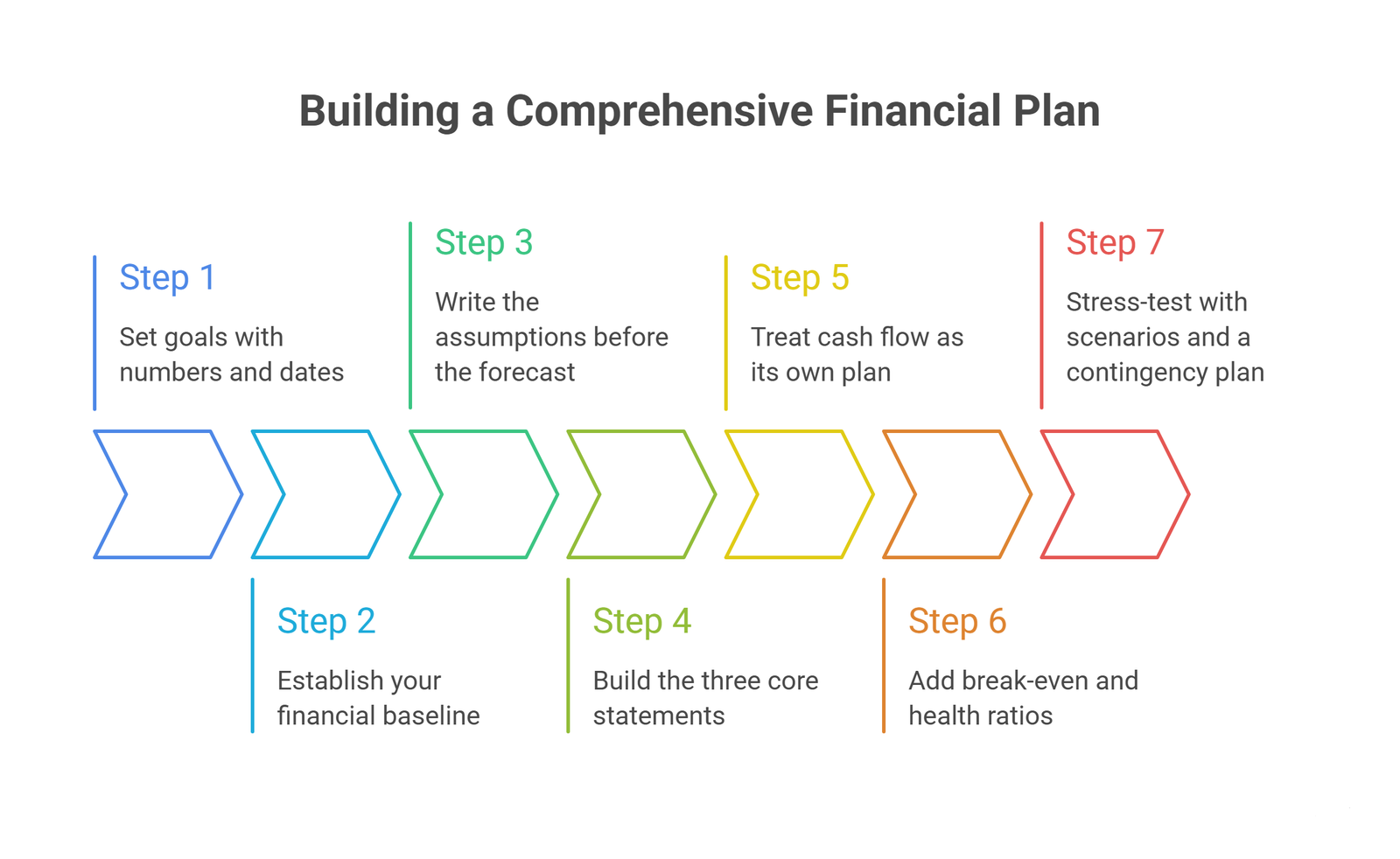
Step 1: Set goals with numbers and dates
“Grow the business” is not a financial goal. “Reach $40,000 in monthly revenue by December while keeping gross margin above 45%” is one.
Write three to five goals. Each one needs a metric, a target, and a deadline. Typical goals include revenue growth, margin improvement, debt reduction, and building a rainy-day reserve.
Then add the cost of reaching each goal. New equipment, extra staff, or a bigger marketing budget all change the plan. Listing them first stops the numbers from feeling like a surprise later.
Step 2: Establish your financial baseline
A forecast is only as good as its starting point. Before projecting anything, collect the current facts.
- Revenue by product, service, or customer group
- Monthly fixed costs and variable costs
- Outstanding debts, interest rates, and repayment dates
- Cash on hand and money owed by customers
- Unpaid supplier bills and upcoming tax payments
Split costs into two groups, because they behave differently.
| Cost type | When it occurs | Typical items |
| Startup costs | Once, before or at launch | Registration and license fees, opening inventory, equipment, rent deposit, utility setup |
| Operating expenses | Every month or year | Rent, salaries, utilities, selling and promotion costs, loan payments, supplies, maintenance |
Startup costs decide how much funding the business needs on day one. Operating expenses decide how much revenue it needs to survive.
Use the last 12 months of actual results where they exist. New businesses can use quotes, supplier price lists, and comparable local businesses instead. Mark every estimated figure so nobody mistakes it for a recorded one.
Step 3: Write the assumptions before the forecast
Assumptions drive the whole plan. Price, sales volume, customer growth, payment terms, and cost inflation all sit here.
Give each assumption its own line with a source and a date. “Average order value of $85, based on the last six months of invoices” is defensible. “Sales grow 20% per month” with no explanation is not.
A separate revenue assumptions worksheet keeps this clean. Change one input, and the income statement, balance sheet, and cash flow statement all update together.
Step 4: Build the three core statements
The income statement, balance sheet, and cash flow statement must agree with each other. Net profit flows into equity on the balance sheet. The closing cash figure on the cash flow statement must match cash on the balance sheet.
A common convention is monthly detail for the first two years. Years three to five can move to quarterly or annual figures. This shows near-term discipline without pretending to know the distant future.
Excel handles this well for most small businesses. Oak’s guide to a financial model template shows how the statements link together. A separate walkthrough on building a financial model in Excel covers the mechanics.
Follow a recognized accounting framework such as GAAP or IFRS where possible. Private companies often use one voluntarily because it makes the numbers easier for outsiders to trust.
Step 5: Treat cash flow as its own plan
Profit is an accounting result. Cash is what pays the payroll.
Here is a simple example. A business invoices a customer $10,000 in March on 60-day terms. March shows a profit on the income statement. But the cash arrives in May, and rent and wages are due in April. The business is profitable and still short of cash.
A monthly cash flow projection catches this gap early. Build it by listing three things for each month:
- Opening cash balance
- Cash in, timed by when customers actually pay
- Cash out, timed by when bills, loan payments, and taxes are due
The closing balance becomes next month’s opening balance. Any month where it turns negative needs a plan: faster invoicing, a credit line, or delayed spending.
Step 6: Add break-even and health ratios
Break-even analysis shows the sales volume where revenue exactly covers costs. The formula is fixed costs divided by contribution margin per unit.
Take a hypothetical example. Fixed costs are $12,000 a month. Each unit sells for $50 and costs $30 to make. The contribution margin is $20 per unit, so break-even is 600 units a month.
Ratios add context to the statements. The table below lists five that lenders and investors commonly check.
| Ratio | Formula | What it signals |
| Gross margin | (Revenue minus cost of goods sold) ÷ revenue | Pricing power and production efficiency |
| Net profit margin | Net profit ÷ revenue | Overall profitability |
| Current ratio | Current assets ÷ current liabilities | Ability to pay short-term bills |
| Debt-to-equity | Total debt ÷ owner’s equity | Reliance on borrowed money |
| Cash runway | Cash balance ÷ monthly net cash burn | Months until cash runs out |
Choose benchmarks from your own industry. A retailer, a software company, and a contractor each carry very different healthy ranges.
Step 7: Stress-test with scenarios and a contingency plan
A single forecast invites one kind of confidence. Three scenarios build a better one.
| Scenario | What changes | Purpose |
| Base case | Recent trends continue | Your working plan |
| Downside case | Sales fall short and customers pay late | Tests cash reserves |
| Upside case | Growth plan works faster than expected | Tests capacity and funding needs |
The downside case matters most. Run it honestly, then decide in advance what you would do. Options include cutting discretionary spending, pausing hiring, drawing on a credit line, or selling idle assets.
Lenders read this section closely. It shows the owner has already thought about what could go wrong. The balance sheet then shows what the business would be worth at the end of the plan.
Review the plan on a fixed rhythm
A plan that is never revisited becomes fiction within a quarter. Set a simple schedule:
- Monthly: compare actual results with the plan and note the reasons for any gap
- Quarterly: update the forecast using real results and new information
- Annually: reset goals, assumptions, and the multi-year outlook
Focus on variances that repeat. One weak month is noise. Three weak months in a row means an assumption is wrong.
Common mistakes that weaken a financial plan
- Optimistic revenue, light costs. Underestimating expenses and overestimating sales is the most common error. Build in a buffer for taxes and unexpected repairs.
- Mixing personal and business money. Separate accounts keep the numbers clean and simplify tax reporting.
- Forecasting profit but not cash. A profitable plan can still run out of cash.
- No documented assumptions. Reviewers cannot test a number they cannot trace.
- Building it once and filing it. Static plans lose accuracy quickly.
- Ignoring the personnel plan. Salaries are usually the largest cost, so hiring dates deserve their own line.
When to bring in a professional
Some situations justify outside help. Examples include preparing for a bank loan or investor round. Others are planning a major expansion or building a multi-year model with several revenue streams.
Owners weighing ongoing support can read Oak’s guide on when a startup should hire a CFO. It explains why many small businesses start with fractional support rather than a full-time hire.
A professional also brings a second pair of eyes to the assumptions. That review often catches the errors that owners are too close to see.
Frequently Asked Questions
What should a small business financial plan include?
At minimum, it should hold an income statement, cash flow statement, balance sheet, and sales forecast. A professional version adds an assumptions sheet, personnel plan, break-even analysis, key ratios, and scenarios.
How far ahead should a financial plan look?
Most plans cover three to five years. Monthly detail for the first one or two years is a common approach. Later years can be quarterly or annual.
How often should a financial plan be updated?
Compare actual results with the plan every month. Reforecast quarterly. Rewrite the plan fully once a year. Do it sooner after a major event, such as a new loan, a lost customer, or a pricing change.
What is the difference between a financial plan and a business plan?
A business plan describes the market, strategy, operations, and team. The financial plan turns that strategy into numbers. It is normally one section of the business plan, but it can also stand alone for internal use.
Can I build a financial plan in Excel?
Yes. Excel works well for most small businesses. Problems appear when several people edit the file, formulas break, or the model grows too complex to audit. At that point, a structured template or professional review helps.
Do lenders and investors want different things?
Yes. Lenders focus on cash flow, debt service ability, and downside protection. Investors focus more on growth assumptions, margins, and how the business will scale. A strong plan speaks to both.
Turn the plan into a decision tool
A financial plan earns its place when it changes a decision. The right plan tells an owner whether to hire now or wait, borrow or save, expand or consolidate.
Oak’s financial planning services help business owners build plans with defensible assumptions, linked statements, and clear scenarios. Owners who want ongoing financial leadership can explore CFO services for startups. That keeps the plan current as the business grows.