What Is Financial Modeling?
What is financial modeling? A practical guide for business owners
Most business owners have heard the phrase “financial model” long before they’ve actually built one. It sounds like something reserved for investment banks and Fortune 500 boardrooms. In reality, it’s just a spreadsheet that turns your assumptions about the future into numbers you can act on, and every business, from a two-person startup to an established firm preparing for acquisition, needs one to make decisions with any confidence.
What is financial modeling?
Financial modeling is the process of building a numerical representation of a business, usually in Excel, that forecasts how it will perform over a future period. The model takes historical data and a set of assumptions (revenue growth, costs, pricing, headcount) and uses them to project the income statement, balance sheet, and cash flow statement forward.
At its core, a financial model answers one question: if these assumptions hold, what happens to the business? Change an assumption, such as a slower sales ramp or a higher cost of goods, and the model shows the downstream effect on profit, cash, and valuation. That’s what makes it useful. It’s not a prediction so much as a structured way to test decisions before you commit money to them.
What is financial modeling used for?
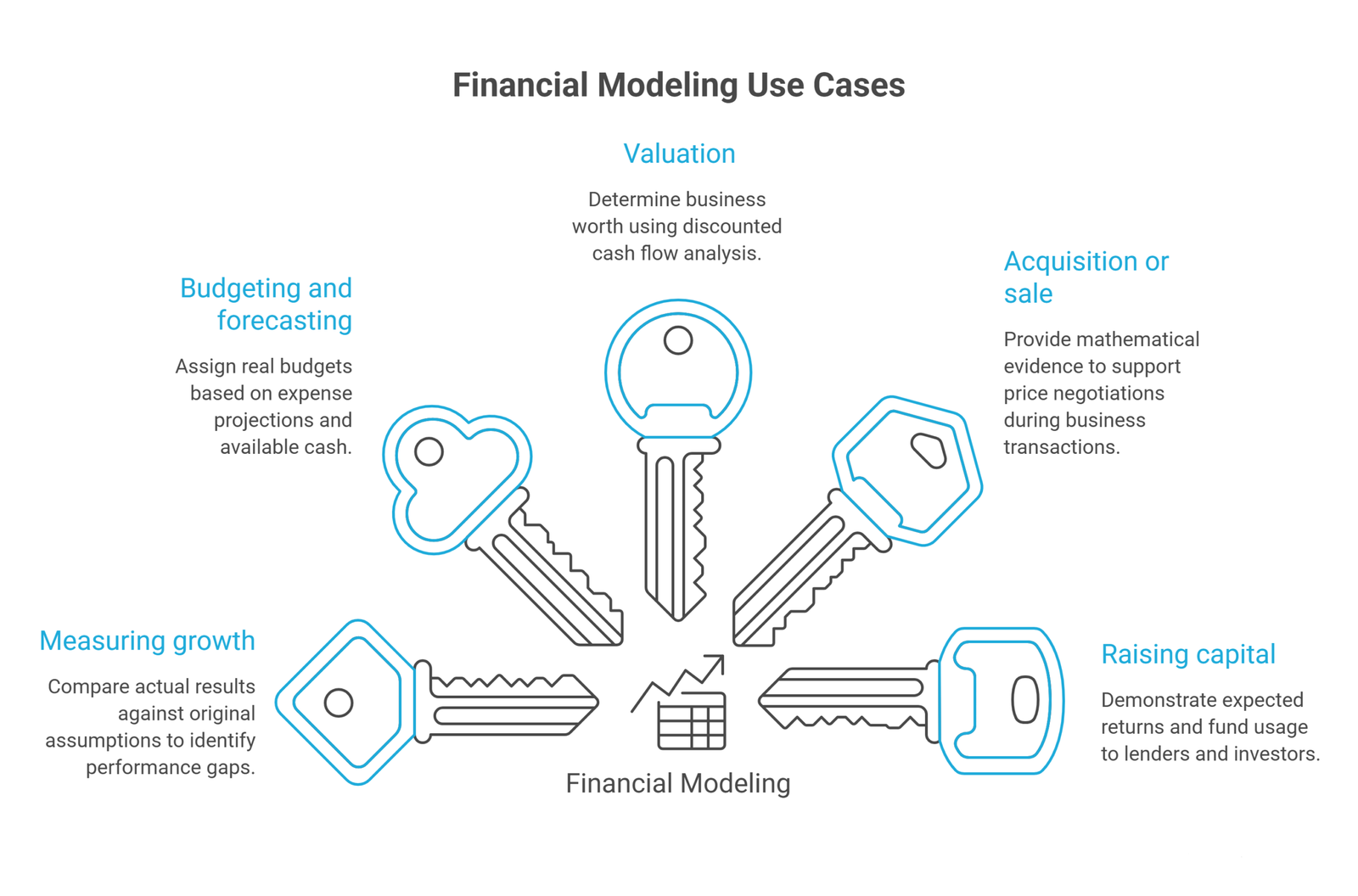
Business owners build models for a handful of recurring reasons. The details change by industry, but the core use cases stay consistent.
Measuring growth. A model lets you compare actual results against your original assumptions and see exactly where the business is outperforming or falling short. That gap is often more useful than the raw numbers themselves, because it tells you which assumptions to revisit.
Budgeting and forecasting. Once you can see where expenses are headed, you can assign a real budget instead of guessing. This also feeds directly into your broader financial position and how much cash the business can safely commit to new spending.
Valuation. Investors, buyers, and lenders all want to know what a business is worth, and that figure almost always comes from a model. A discounted cash flow analysis projects future cash flows and discounts them back to today’s value, which is the standard method for putting a number on a company that isn’t publicly traded.
Acquisition or sale. Anyone considering buying your business, or agreeing to be bought, will ask for a model before they negotiate a price. Without one, you’re negotiating from a position of “trust me” instead of “here’s the math.”
Raising capital. Lenders and investors expect to see how their money will be used and what return they can expect. A credible model, built on defensible assumptions rather than optimism, is usually the difference between a productive pitch meeting and a quick no.
Types of financial models
Not every business needs the same kind of model. The right one depends on what decision you’re trying to support.
| Model type | What it’s for | Typical user |
| Three-statement model | Links the income statement, balance sheet, and cash flow statement to show overall financial health | Almost every business, as the base for other models |
| Discounted cash flow (DCF) | Estimates what a company is worth today based on projected future cash flows | Owners raising capital, sellers, investors |
| Budget and forecast model | Projects revenue and expenses for internal planning, usually updated monthly or quarterly | Finance teams, small business owners |
| Comparable company analysis | Values a business by comparing it to similar companies’ trading multiples | Bankers, buyers, sellers |
| Merger or acquisition model | Shows the combined financial impact of buying or merging with another company | Acquirers, boards |
| Leveraged buyout (LBO) model | Tests whether a debt-financed acquisition can hit a target return | Private equity firms |
| Industry-specific model | Builds sector drivers (occupancy, churn, reserves) on top of the three-statement structure | Real estate, SaaS, oil and gas, and similar sectors |
For most small and mid-sized businesses, the three-statement model and a DCF cover the majority of real-world needs. The more specialized models matter once you’re raising institutional capital or sitting across the table from a private equity buyer.
Key components of a financial model
Regardless of which type you’re building, a well-built model tends to include the same building blocks:
- Assumptions and drivers. Revenue growth rate, gross margin, headcount plan, pricing, and anything else that drives the numbers. These belong in one clearly labeled place, not scattered through the workbook.
- Income statement. Revenue, cost of goods sold, operating expenses, and net profit, forecasted period by period.
- Balance sheet. Assets, liabilities, and equity, which should always balance if the model is built correctly.
- Cash flow statement. How much cash actually moves in and out, reconciled from the income statement by adding back non-cash items and adjusting for changes in working capital.
- Supporting schedules. Depreciation, loan amortization, and other detail that would otherwise clutter the core statements.
- Outputs and sensitivity analysis. Charts, KPIs, and a way to flex key assumptions to see how the results shift under different scenarios.
How to build a financial model, step by step
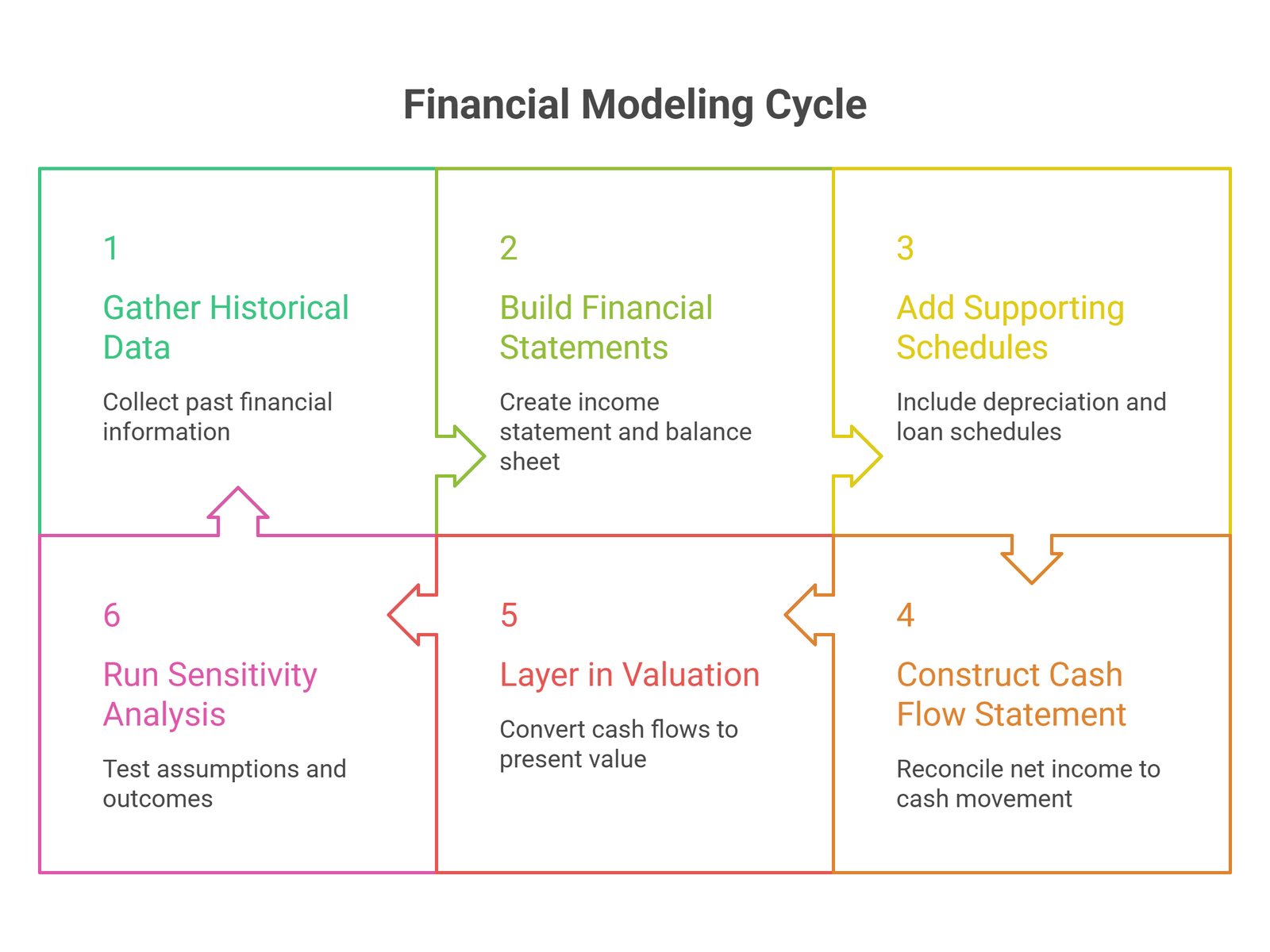
1. Start with historical data and assumptions. Pull at least two to three years of past financials if you have them. Patterns in past performance, seasonality, customer churn, margin trends, are the most reliable basis for future assumptions.
2. Build the income statement and balance sheet. Apply your assumptions to forecast revenue and expenses first, then let those numbers flow into the balance sheet.
3. Add supporting schedules. A depreciation schedule and a loan amortization schedule are the two most common. Larger models add schedules for inventory, accounts receivable, or specific cost categories.
4. Build the cash flow statement. This ties everything together by reconciling net income to actual cash movement, which is what tells you whether the business can fund itself or needs outside capital.
5. Layer in valuation. Once you have projected cash flows, a DCF or comparable company analysis converts those numbers into a present-day value.
6. Run sensitivity analysis. Flex your key assumptions, growth rate, margin, discount rate, and see how much the output moves. A sensitivity model shows a range of outcomes instead of one number that’s likely to be wrong.
Financial modeling best practices
A model that’s technically correct but impossible to follow doesn’t help anyone make a decision. A few habits keep that from happening:
- Separate inputs, calculations, and outputs. Keep every hard-coded assumption in one place so anyone reviewing the model knows exactly what to change and what not to touch.
- Color code consistently. A common convention is blue for hard-coded inputs and black for formulas, so it’s obvious at a glance what’s an assumption and what’s calculated.
- Keep formulas simple. Long, nested formulas are hard to audit and easy to break. Break complex calculations into multiple rows instead of cramming them into one cell.
- Build in error checks. The most basic one confirms that assets equal liabilities plus equity on the balance sheet. If that check fails, something upstream is wrong.
- Document your assumptions. A comment explaining why you assumed 8% revenue growth, tied to a specific source or rationale, saves hours the next time someone (including you) revisits the model.
- Test scenarios before you trust the output. Base, upside, and downside cases give a far more honest picture than a single “expected” number.
Common mistakes to avoid
Even experienced builders fall into a few recurring traps. Don’t perform calculations directly on the balance sheet; link them from separate supporting schedules instead, since that makes the model far easier to audit. Don’t re-enter the same input (a company name, a discount rate, a start date) in multiple places; reference the original cell so an update only has to happen once. And don’t let a single broken link or an outdated assumption sit unnoticed. A model that hasn’t been updated in six months is often worse than no model at all, because it creates false confidence.
Benefits and challenges
A good model supports faster, better-informed decisions on hiring, pricing, and expansion, and it gives lenders or investors something concrete to evaluate instead of a verbal pitch. It also forces discipline: you can’t build a credible forecast without first understanding what actually drives your revenue and costs.
The challenges are just as real. Models are only as good as the assumptions behind them, and a business owner with limited time often doesn’t have the bandwidth to build, test, and maintain one properly alongside everything else on their plate. That’s usually the point where outside help makes sense.
Frequently Asked Questions
Do small businesses actually need a financial model?
Yes. Even a basic cash flow projection helps a small business plan hiring, inventory, and spending decisions. The model doesn’t need private equity-level complexity to be useful.
What’s the difference between financial modeling and financial forecasting?
Forecasting is the output, projected revenue or expenses for a period. Financial modeling is the broader structure (the linked statements, assumptions, and schedules) that produces those forecasts and lets you test how they change under different conditions.
Which software is best for financial modeling?
Excel remains the industry standard because of its flexibility, and it’s what most investors and lenders expect to see. Google Sheets works for simpler models, and dedicated FP&A platforms make sense once a business has outgrown manual spreadsheet updates.
Can I build a financial model without an accounting background?
You can build a basic version, but the assumptions behind revenue and cost projections carry the most risk. A model with a confident-looking spreadsheet but flawed assumptions is often more dangerous than no model, since it creates false certainty.
How often should a financial model be updated?
Monthly for an active budget or forecast model, and immediately after any major change: a new hire, a pricing change, a new contract, that would materially affect the assumptions.
Does a financial model guarantee accurate results? No. A model is only as reliable as the assumptions feeding it. Its value is in making those assumptions explicit and testable, not in producing a guaranteed outcome.
Conclusion
Building a financial model well requires both technical Excel skill and enough finance experience to know which assumptions are reasonable and which are wishful thinking. Many business owners handle a simple budget internally, then bring in a chief financial officer, fractional or otherwise, once the stakes go up: fundraising, an acquisition, or a major expansion.
At Oak Business Consultant, we build financial models and run the valuation and forecasting work that goes with them, so you’re negotiating from a position backed by numbers instead of guesswork. If you’re weighing whether to build in-house or bring in outside expertise, our fractional CFO services are worth a look before you commit either way.