The Secret of Entrepreneurial Success
The secret of entrepreneurial success: a founder’s financial playbook
Entrepreneurs who succeed more than once are not simply lucky. They have learned to play a specific game, and most of that game is financial, not inspirational. Study their track record closely and a pattern shows up long before the big win: discipline with money, long before there was much money to be disciplined about.
Entrepreneurs vs. business people
Entrepreneurs are opportunistic, self-confident, and willing to take on real uncertainty. They spot a gap in the market and build something new to fill it, driven as much by the problem as by the payoff. Business people, by contrast, often take an existing product or service and replicate it to grow revenue and a career.
Neither approach is wrong. But if you’re building something new, that willingness to take on uncertainty only pays off if you pair it with the financial habits below. Ideas fail all the time. Financially undisciplined ideas fail faster.
Every failure teaches you where the real risk was
You can lower your odds of failure by studying where other businesses actually broke down, not just where founders assumed they would. Most new businesses that fail do so because of a weak fit between the product and the market, not because the founder lacked passion or effort.
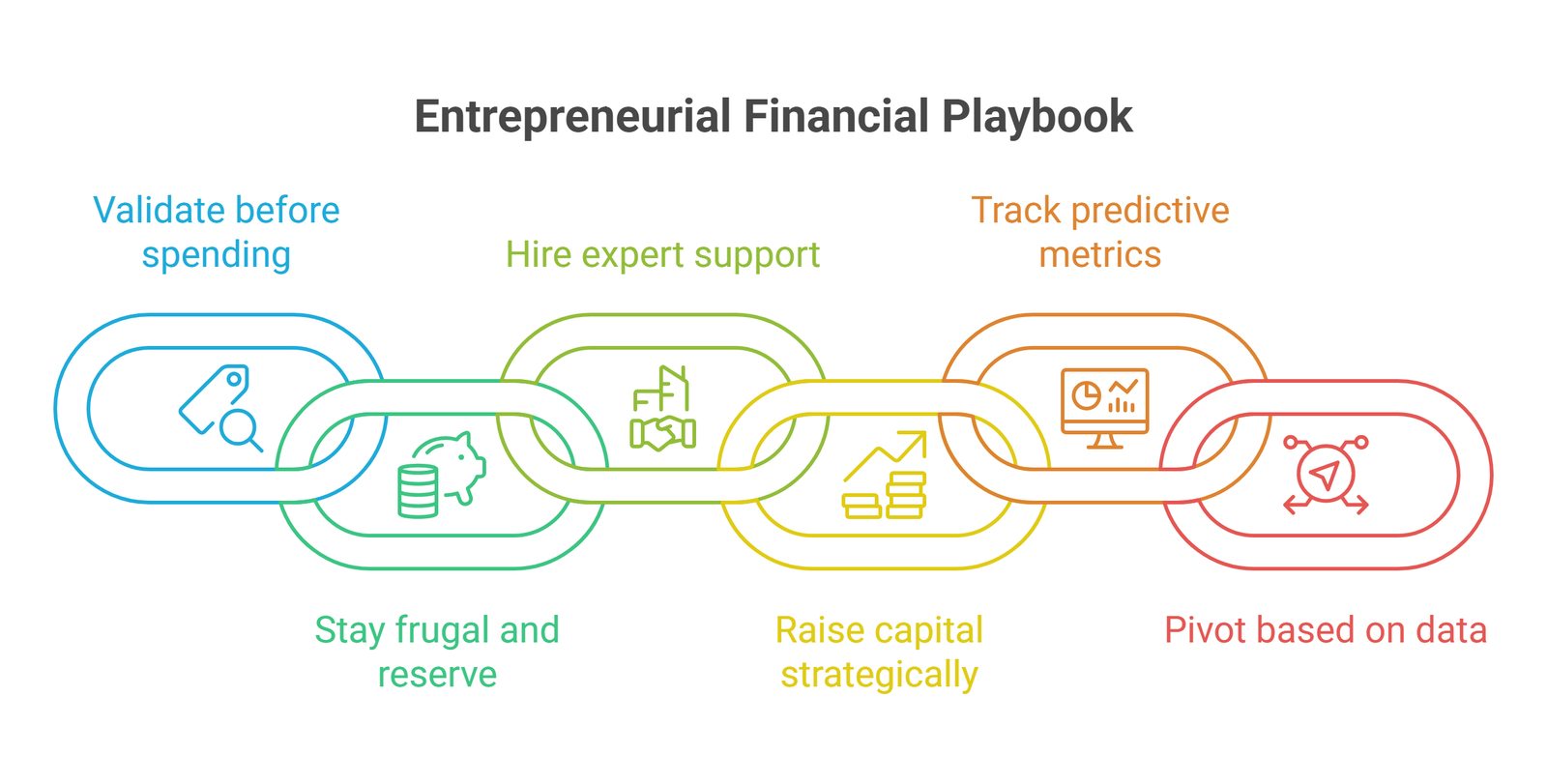
Before you spend heavily on production or marketing, validate the idea itself. Talk to the people you think will buy it. Price it, then ask whether they would actually pay that price. A product that starts weak and gets patched later costs far more, in both cash and reputation, than one that was validated before launch.
Stay frugal, then bank for the downturn
Every business goes through cycles. The businesses that survive a downturn are usually the ones that didn’t spend everything during the upswing.
Train yourself to question any spending that isn’t necessary, especially early on. Then take it a step further: keep at least three months of operating capital in reserve, set aside before you need it, not scrambled together once a bad quarter has already started. That reserve is what lets a business absorb a slow month without panic decisions.
The same logic applies to you personally. Before committing full-time to a venture, aim to have enough personal savings to cover your own essentials for around two years. Most companies take roughly that long to find stable footing, and you need to still be standing when they do.
Find mentors, then hire the expertise they can’t give you
A good mentor calls you out when you’re indulging in wishful thinking and helps you think through decisions you’re too close to see clearly. Find people worth taking seriously, and consult them often enough that they can actually track your progress.
But mentorship has a limit. A mentor can point out that your numbers look off. They usually can’t build you a defensible financial model or set up a chart of accounts that holds up under an investor’s due diligence. That’s a different kind of expertise, and trying to DIY it is one of the more expensive mistakes an entrepreneur can make.
This is exactly where outsourced CFO support earns its cost. It gives you access to financial strategy at a fraction of what a full-time hire would cost, scaled to what your business actually needs at its current stage.
Raise more than feels comfortable, and keep a reserve after
Founders consistently underestimate both how much capital they’ll need and how long raising it will take. The instinct to ask for less, so a rejection stings less, usually just means going back to raise again sooner, on worse terms.
Once the capital is in, the discipline doesn’t stop. Keeping a reserve after a raise means you can make payroll during a slow month, negotiate with lenders from a position of strength, and act on an opportunity without scrambling for funding first.
Track the few numbers that actually predict trouble
Instinct has a place in entrepreneurship, but it’s a poor substitute for a dashboard. The founders who catch a cash problem early are the ones who already know their runway, their margin, and their burn rate before a vendor calls asking why an invoice is late.
You don’t need dozens of metrics. A handful, reviewed on a fixed schedule, will tell you almost everything: cash on hand and runway, gross margin, and how efficiently you’re acquiring customers relative to what they’re worth over time. A budgeting app built for startups can carry this early on. Later, a proper KPI dashboard does the same job with more precision.
Know when to push through, and when to change direction
Perseverance gets celebrated in every founder story, but it’s only half the skill. Knowing when to change direction, or abandon an approach that isn’t working, matters just as much. The difference usually comes down to whether the decision is based on what the market and the numbers are actually saying, or on pride and sunk cost.
Matching financial support to your growth stage
| Growth stage | What’s usually needed | Where it commonly breaks down |
| Idea stage, pre-revenue | A budgeting app and a simple cash tracker | Founder has no time to keep it current, so it goes stale |
| Early revenue, a few hires | A part-time bookkeeper or accountant | Records are accurate, but there’s no forward-looking strategy |
| Scaling, preparing to raise | An outsourced or virtual CFO | Reporting exists but doesn’t hold up to investor scrutiny |
| Complex operations, active fundraising | A fractional CFO | Business needs strategic financial leadership it can’t yet justify hiring full time |
Frequently Asked Questions
What is the real secret to entrepreneurial success?
There’s no single trick. The entrepreneurs who succeed more than once consistently treat financial discipline (a cash reserve, disciplined spending, and honest tracking of the numbers) as seriously as they treat the idea itself.
What’s the difference between an entrepreneur and a business person?
An entrepreneur typically identifies a gap in the market and builds something new to fill it. A business person more often takes an existing product or service model and replicates it to grow revenue. Both can succeed, but they’re playing different games.
How much cash reserve should a startup keep?
A common baseline is at least three months of operating expenses, kept in reserve before you need it. Businesses with less predictable revenue may want more.
When should a founder hire outsourced CFO support instead of relying on a mentor?
A mentor is valuable for judgment and accountability, but usually can’t build a defensible financial model or prepare the kind of reporting investors expect. Once you need that level of financial rigor, outsourced or fractional CFO support becomes worth the cost.
How much personal savings should I have before quitting my job to start a business?
A reasonable rule of thumb is enough to cover your own essential expenses for about two years, since most businesses take roughly that long to find stable footing.
How do I know when to pivot instead of pushing through?
Look at what the market and your financials are telling you over a sustained period, not just how you feel about the idea. If both point the same direction, that’s usually the signal to change course rather than push harder.
Conclusion
Passion gets an idea off the ground. What keeps it standing is financial discipline: a cash reserve built before it’s needed, mentors who keep you honest, and expertise brought in the moment a mentor’s advice isn’t enough. Entrepreneurs who treat those habits as seriously as they treat the idea itself are the ones still building five years later.
If your business has outgrown DIY spreadsheets and informal advice, Oak Business Consultant’s Fractional CFO Services can build that financial foundation with you.