How to Start a Hospitality Business
Steps to Start a Successful Hospitality Business
The hospitality industry continues to thrive as one of the most dynamic sectors in the global economy, with projections indicating the market will reach $5.8 trillion by 2025. Whether you’re passionate about opening a boutique hotel, launching a food truck, managing a bed and breakfast, or operating a travel agency, understanding how to start a hospitality business is your first step toward turning your entrepreneurial dreams into reality.
This comprehensive guide walks you through every essential aspect of launching a successful hospitality venture, from initial market research to grand opening and beyond. By following these proven strategies and industry best practices, you’ll be well-equipped to navigate the challenges and capitalize on the tremendous opportunities that the hospitality industry offers.
Understanding the Hospitality Industry Landscape
Before diving into how to start a hospitality business, it’s crucial to understand the breadth and diversity of this sector. The hospitality industry encompasses several key segments: accommodation services (hotels, boutique hotels, bed and breakfast establishments, vacation rentals), food service (restaurants, food trucks, catering companies), travel and tourism (travel agencies, tour companies, fishing charters, scenic air tours), and event management (event venues, event planning services).
The industry currently employs over 15.9 million people and continues adding 200,000 new jobs annually. Market trends show increasing consumer preferences for personalized experiences, sustainable practices, and technology-driven convenience. Understanding these market trends will help you position your business for success.
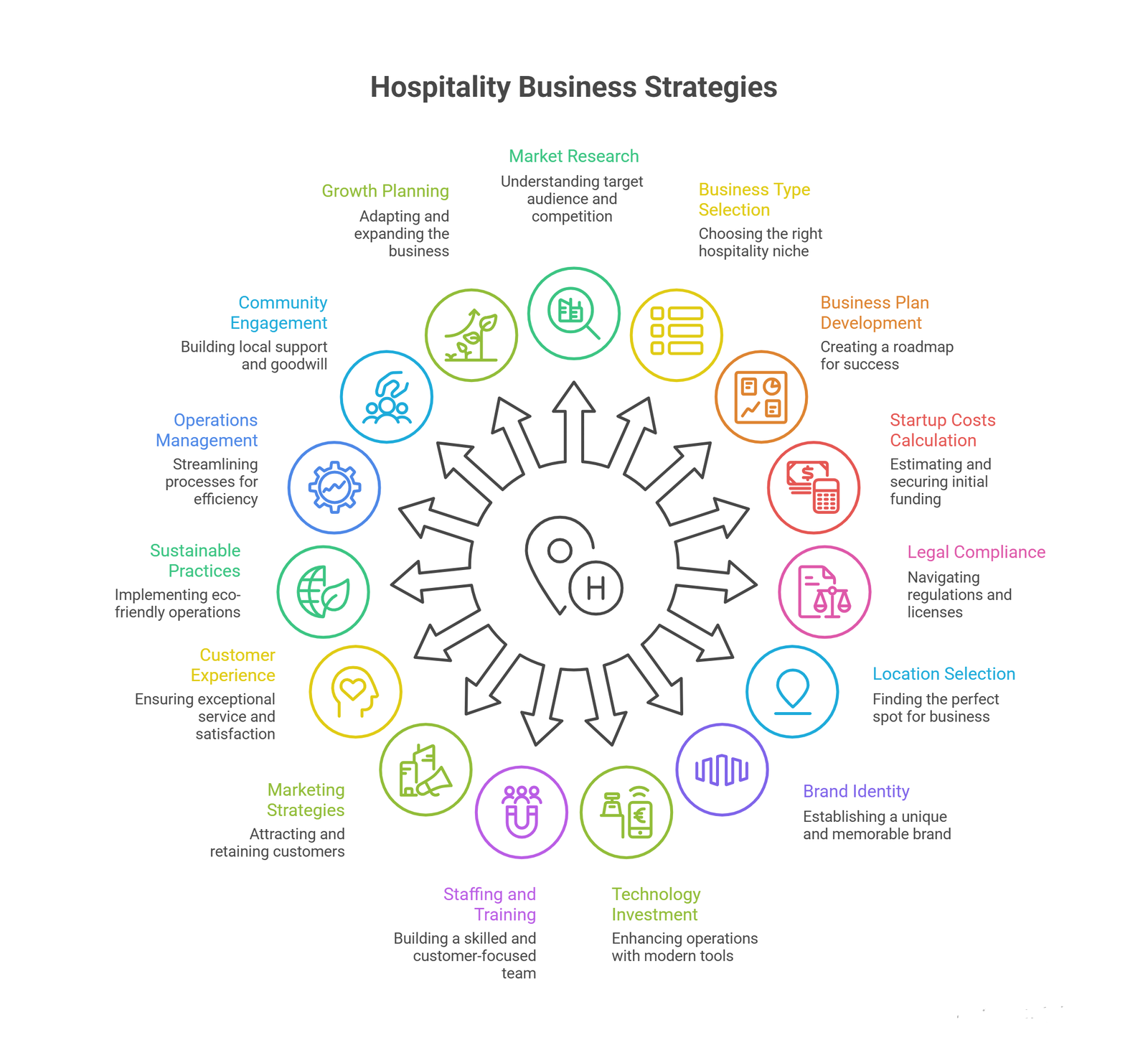
Step 1: Conduct Comprehensive Market Research
Market research forms the foundation of any successful hospitality business. This critical phase helps you understand your target audience, identify consumer preferences, analyze the competition, and validate your business concept.
Start by analyzing your local market to understand demand patterns and market saturation. Research competitor insights by visiting similar establishments, studying their offerings, pricing strategies, and customer reviews. Pay attention to foot traffic patterns in potential locations and seasonal demand fluctuations. Use both primary research (surveys, focus groups, direct customer feedback) and secondary research (industry reports, market analysis tools, demographic data) to build a complete picture of your market opportunity.
Understanding your target audience is paramount. Define who your ideal customers are based on demographics, psychographics, travel habits, spending capacity, and specific needs or pain points your business will address. For instance, wine tourists have different expectations than business travelers, while families seeking vacation rentals prioritize different amenities than solo adventurers booking scenic air tours.
Step 2: Choose Your Hospitality Business Type
The question of how to start a hospitality business becomes clearer once you’ve selected your specific niche. Consider these popular options:
Accommodation Businesses: Hotel business ventures range from small boutique hotels offering 10-20 rooms to larger properties with 100+ rooms. Bed and breakfast establishments provide intimate, personalized experiences typically in residential settings. Vacation rental businesses capitalize on platforms like Airbnb to offer short-term accommodations. Each requires different startup costs, operational models, and management approaches.
Food Service Businesses: Food trucks represent a relatively low-cost entry point with startup costs ranging from $50,000 to $200,000. Traditional restaurants require substantially higher investment but offer stability and brand-building opportunities. Catering companies provide flexibility and lower overhead than fixed-location restaurants.
Tourism and Experience Businesses: Travel agencies connect travelers with service providers and earn commissions or service fees. Tour companies create and operate guided experiences, from food tours showcasing local cuisine to fishing charters and private charter helicopter services offering luxury experiences. Pet sitter services cater to travelers’ needs while they’re away, representing a growing niche in the hospitality sector.
Specialized Venues: Event venues and event planning services capitalize on the weddings, corporate events, and celebrations market. These businesses require careful attention to guest experiences and strong relationships with vendors and service providers.
Step 3: Develop a Comprehensive Business Plan
A detailed business plan is non-negotiable when learning how to start a hospitality business. This document serves as your roadmap to success and is essential for securing funding from venture capital firms, angel investors, or traditional lenders.
Your business plan should include an executive summary outlining your vision, mission, and primary objectives. The company analysis section details your unique value proposition and brand identity. Include thorough industry analysis demonstrating your understanding of the hospitality industry, current market trends, and growth projections.
The competitive analysis section should use SWOT methodology (Strengths, Weaknesses, Opportunities, Threats) to evaluate your position relative to competitors. Your marketing strategies must detail how you’ll attract and retain customers through digital marketing, social media, partnerships, and traditional advertising.
Financial projections are critical and should cover at least three years. Include detailed startup costs, monthly operating expenses, revenue projections, cash flow forecasts, and break-even analysis. For hotel management or larger hospitality ventures, consider revenue management strategies to optimize pricing and occupancy.
Step 4: Calculate and Secure Startup Costs
Understanding startup costs is crucial when determining how to start a hospitality business successfully. Costs vary dramatically based on your chosen business type:
Hotel Business Costs: Small hotels typically require $1-5 million in startup capital, while a 115-room hotel averages $22 million. Luxury boutique hotels can exceed $50 million. Costs include land acquisition ($33,900 per room on average), construction ($221,500 per room), soft costs like permits and legal fees (12% of total budget), furniture, fixtures, and equipment (FF&E), and technology infrastructure including POS systems, booking systems, and hotel management software.
Restaurant and Food Business Costs: Traditional restaurants range from $95,000 to over $2 million depending on size and concept. Food trucks offer more accessible entry at $50,000-$200,000. Key expenses include kitchen equipment, POS hardware and Point of Sale software, initial inventory, permits and licensing, and buildout or renovation costs.
Tourism Business Costs: Travel agency and tour company startups are relatively low-cost at $10,000-$50,000, primarily for licensing, website development, marketing, and office setup. Specialized operations like fishing charters or private charter helicopters require substantial equipment investment.
Common Costs Across All Hospitality Businesses: Business insurance protecting against liability and property damage, licenses and permits (business licenses, health permits, food safety certifications, liquor licenses, fishing permits, coast guard licenses for water-based businesses), professional services (legal, accounting, consulting fees), marketing and branding expenses, and working capital to cover operations until profitability is achieved.
Step 5: Navigate Legal and Regulatory Compliance
The legal landscape for hospitality businesses is complex and varies by location and business type. Proper regulatory compliance from day one prevents costly delays and legal issues.
Start by choosing an appropriate business structure. LLC structures offer liability protection and tax flexibility, making them popular for small to medium hospitality businesses. Corporations provide the strongest liability protection but involve more complex tax obligations. Partnerships work for multi-owner operations but require clear partnership agreements.
Obtain all necessary licenses and permits before opening. Health and safety standards compliance is mandatory for all food service businesses, requiring regular inspections and Food Safety Supervisor certification. Hotel licensing varies by jurisdiction but typically includes building permits, occupancy permits, and fire safety inspections. VAT registration is required once revenue thresholds are met in applicable jurisdictions.
Food service businesses must comply with food regulations, food standards rules, and maintain proper food hygiene standards. Establishments serving alcohol need liquor licenses. Environmental health service inspections ensure compliance with health codes. If offering water-filling stations or reusable branded water bottles, ensure compliance with health regulations.
Step 6: Choose the Perfect Location
Location can make or break your hospitality venture. Strategic location selection considers multiple factors that directly impact your bottom line.
For hotel businesses and bed and breakfast establishments, proximity to attractions, business districts, or transportation hubs drives occupancy. Analyze foot traffic patterns, parking availability, and accessibility. Consider whether your location supports your target market—business travelers prioritize different locations than leisure tourists.
Food service businesses depend heavily on visibility and foot traffic. Study local demographics, nearby competitors, and whether your concept matches the neighborhood’s character and spending power. Food truck operators need strategic positioning but benefit from flexibility to move to high-traffic events.
Travel agencies and tour companies can operate in lower-cost office spaces or even remotely, focusing resources on digital presence rather than premium retail locations. However, tour companies offering local experiences benefit from proximity to tourist areas or activity centers.
For event venues, consider accessibility, parking capacity, local zoning regulations permitting events, and whether the space can accommodate your target event types.
Step 7: Build Your Brand Identity and Online Presence
In today’s digital-first world, your brand identity and online presence often make first impressions before guests step through your doors.
Develop a cohesive brand identity including a memorable name and logo, consistent color schemes and typography, brand voice and messaging, and visual elements that reflect your unique value proposition. For eco-friendly hotels or businesses focusing on sustainable practices, incorporate environmental values into your branding.
Your online presence must be comprehensive and professional. Create a mobile-responsive website optimized for bookings and reservations. Implement robust booking systems or reservation platforms that streamline the guest experience. Establish profiles on relevant platforms—hotels on OTAs, vacation rentals on Airbnb, food businesses on delivery platforms, tour companies on TripAdvisor.
Digital marketing strategies should include search engine optimization (SEO) for relevant keywords, social media marketing across platforms where your target audience engages, content marketing showcasing your expertise and experiences, email marketing for customer retention, and online reputation management responding to reviews and feedback.
Consider pursuing Cvent certifications if you’re in the hotel business or event venue space, as these demonstrate professional expertise and can increase your visibility to event planners.
Step 8: Invest in Technology and Systems
Modern hospitality businesses depend on technology for operational efficiency and customer experience enhancement. Strategic technology investments differentiate successful operators from struggling competitors.
Essential Technology for Hotel Management: Property Management Systems (PMS) for reservations, check-in/out, and guest management, revenue management platforms optimizing pricing based on demand, customer relationship management (CRM) systems tracking guest preferences and history, and keyless entry and smart room technology enhancing security and convenience.
Food Service Technology: Modern POS systems processing transactions, managing inventory, and generating reports. Kitchen display systems improving order accuracy and timing. Online ordering and delivery integration platforms. Inventory management systems reducing waste and optimizing purchasing.
Cross-Industry Technology: Accounting and financial management software, employee scheduling and payroll systems, customer feedback and review management tools, analytics platforms providing actionable insights, and cybersecurity measures protecting sensitive customer data.
For businesses prioritizing sustainable practices, invest in energy and water consumption monitoring systems that track usage and identify efficiency opportunities.
Step 9: Plan Your Staffing and Training
Your staff represents your brand and directly impacts guest experiences. Strategic staff recruitment and training creates the foundation for exceptional customer service.
Identify necessary positions based on your business type and size. Hotel businesses need front desk staff, housekeeping, maintenance, food and beverage staff (if applicable), and management. Restaurants require chefs and kitchen staff, servers, host staff, and managers. Tour companies need knowledgeable guides, booking coordinators, and operational support.
Implement comprehensive training programs covering customer service excellence, operational procedures and safety protocols, product knowledge and upselling techniques, conflict resolution and problem-solving, and brand values and culture. For food service businesses, mandatory food safety training ensures compliance and protects guest health.
Develop competitive compensation packages that attract and retain quality staff. High turnover plagues the hospitality industry, so focus on employee satisfaction, growth opportunities, positive work culture, and recognition programs.
Step 10: Implement Marketing and Promotion Strategies
How to start a hospitality business successfully extends beyond opening day—you need customers. Effective marketing strategies build awareness, drive bookings, and establish your reputation.
Pre-Launch Marketing: Generate buzz through social media teasers, local media outreach, partnership development with complementary businesses, influencer collaborations, and special grand opening promotions.
Ongoing Marketing Strategies: Maintain active social media presence showcasing experiences and engaging with followers. Implement local SEO ensuring you appear in relevant local searches. Develop referral programs incentivizing word-of-mouth marketing. Create partnerships with local businesses, tourism boards, and corporate clients. Participate in industry events and trade shows.
For hotel businesses, consider joining loyalty programs or creating your own to encourage repeat bookings. Tour companies should optimize presence on review platforms and tourism sites. Food service businesses benefit from strategic use of food delivery platforms and local food bloggers.
Marketing for Specific Niches: Boutique hotels and bed and breakfast establishments benefit from highlighting unique features, personal touches, and local experiences. Food trucks leverage social media to announce locations and build follower communities. Fishing charters and scenic air tours use stunning visual content showcasing experiences. Event venues create comprehensive packages and maintain strong relationships with wedding planners and corporate event coordinators.
Step 11: Focus on Customer Experience and Service Excellence
In the hospitality industry, customer experience isn’t just important—it’s everything. Guest experiences directly impact reviews, repeat business, and word-of-mouth referrals.
Develop service standards ensuring consistency across all guest touchpoints. Train staff in personalization and customization techniques that make guests feel valued. Implement systems for gathering and acting on customer feedback. Respond promptly and professionally to reviews, both positive and negative.
Create memorable moments through unexpected amenities, personalized greetings, special occasion recognition, and exceeding expectations. These gestures build customer loyalty and generate positive reviews that attract new guests.
For hotel businesses and vacation rentals, attention to guest relations includes streamlined check-in processes, responsive communication, immaculate cleanliness, and thoughtful amenities. Food service businesses focus on consistent quality, dietary accommodation, pleasant atmosphere, and attentive service. Tour companies emphasize knowledgeable guides, safety, unique experiences, and engaging storytelling.
Step 12: Implement Sustainable Practices
Sustainability and eco-friendly practices are increasingly important to consumers and can differentiate your business while reducing operational costs.
Consider these sustainable initiatives: Energy-efficient lighting, HVAC systems, and appliances to reduce energy and water consumption. Waste reduction programs including composting and comprehensive recycling options. Water-filling stations and reusable branded water bottles eliminating single-use plastics. Sourcing from local, sustainable suppliers. Implementation of green building standards for renovations or new construction.
Hotels can pursue Green Leaders program certification demonstrating environmental commitment. Promote your eco-friendly practices in marketing materials to attract environmentally conscious travelers. Document your sustainability journey and share progress with guests, building community engagement around shared values.
Zero waste generation is an aspirational goal that some leading hospitality businesses pursue through comprehensive waste auditing, partnership with waste management services, and continuous improvement programs.
Step 13: Manage Operations and Revenue
Operational efficiency and revenue management separate thriving hospitality businesses from those merely surviving.
Hotel Management Best Practices: Implement dynamic pricing strategies adjusting rates based on demand, season, and local events. Monitor and optimize RevPAR (Revenue per Available Room). Diversify revenue streams through food and beverage, spa services, event spaces, and parking fees. Control costs through efficient scheduling, energy management, and vendor negotiations.
Restaurant Operations: Monitor food costs as percentage of revenue (typically 28-35%). Optimize table turnover rates without rushing guests. Implement effective inventory management preventing waste. Track and respond to key performance indicators daily.
Tourism Business Operations: Manage capacity and bookings to optimize utilization. Maintain equipment and vehicles meticulously ensuring safety and reliability. Build strategic partnerships with hotels, other tour operators, and local businesses for referral networks.
Use revenue management platforms and analytics tools to make data-driven decisions. Regular financial reviews identify trends, opportunities, and areas requiring attention.
Step 14: Build Local Community Engagement
Successful hospitality businesses become integral parts of their communities, building goodwill and generating local support.
Engage with local community through sponsoring community events, participating in tourism boards and hospitality associations, hiring locally and supporting employee development, featuring local products and suppliers, and giving back through charitable initiatives.
Strong local community engagement creates word-of-mouth marketing, builds resilience during challenging times, generates positive local media coverage, and creates a network of business partners and supporters.
Step 15: Plan for Growth and Adaptation
The hospitality industry constantly evolves. Successful businesses plan for growth while remaining adaptable to changing market conditions.
Expansion Opportunities: Additional locations for proven concepts, franchise opportunities for scalable models, new service offerings complementing existing business, partnerships and acquisitions expanding capabilities, and market expansion into new geographic areas or customer segments.
Staying Competitive: Monitor competitor insights and industry benchmarks. Invest in continuous staff training and development. Regularly update technology and systems. Refresh physical spaces and experiences to maintain appeal. Adapt to changing consumer preferences and market trends.
Consider whether a hotel franchise arrangement offers advantages over independent operation. Evaluate opportunities to expand from a single food truck to a food business empire. Assess whether adding vacation rental properties complements an existing bed and breakfast operation.
Common Challenges and Solutions
Understanding how to start a hospitality business includes anticipating and preparing for common challenges.
Challenge 1: Seasonal Fluctuations
Solution: Diversify your market (target both leisure and business travelers), create off-season promotions and packages, develop corporate partnerships for steady business, and maintain financial reserves for slower periods.
Challenge 2: Managing Online Reputation
Solution: Implement systems for encouraging positive reviews, respond promptly and professionally to all reviews, address issues quickly before they become major problems, and focus on continuous improvement based on feedback.
Challenge 3: Staffing Difficulties
Solution: Offer competitive compensation and benefits, create positive work culture and growth opportunities, implement efficient staff recruitment processes, and cross-train employees for operational flexibility.
Challenge 4: Rising Operational Costs
Solution: Regular vendor negotiations, energy efficiency improvements, waste reduction initiatives, and revenue management optimization.
Challenge 5: Changing Regulations
Solution: Stay informed through industry associations, maintain relationships with regulatory officials, budget for compliance costs, and work with legal professionals specializing in hospitality.
Financing Your Hospitality Business
Securing adequate financing is often the most challenging aspect of how to start a hospitality business. Understanding your options helps you make informed decisions.
Funding Sources:
- Personal Savings: Reduces debt but requires substantial capital accumulation
- Traditional Lender Loans: Banks and credit unions offering business loans with competitive rates for qualified borrowers
- SBA Loans: Government-backed loans with favorable terms for qualifying small businesses
- Angel Investors: Wealthy individuals providing capital in exchange for equity, often bringing industry expertise
- Venture Capital: Institutional investors funding high-growth potential businesses, typically requiring significant equity
- Crowdfunding: Platform-based fundraising from multiple small investors
- Hospitality-Specific Financing: Equipment financing, franchise financing, and revenue-based lending tailored to hospitality operations
Prepare comprehensive financial projections, detailed business plans, and professional presentations for potential investors or lenders. Consider working with a hospitality finance specialist who understands industry-specific funding requirements and opportunities.
For hotel franchise opportunities, franchisors often have preferred lender relationships and can facilitate financing.
Key Takeaways for Success
Starting a hospitality business requires careful planning, adequate capital, industry knowledge, and unwavering commitment to customer service. Success factors include thorough market research validating your concept, comprehensive business planning guiding your journey, adequate funding ensuring financial stability, prime location selection matching your target market, strong brand identity differentiating your business, technology integration optimizing operations, exceptional customer service creating memorable guest experiences, sustainable practices attracting conscious consumers and reducing costs, effective marketing generating awareness and bookings, and continuous adaptation to industry changes and customer preferences.
Frequently Asked Questions (FAQs)
What licenses do I need to start a hospitality business?
Essential licenses include a general business license, health and safety permits, food service certifications (for food businesses), liquor licenses (if serving alcohol), and specific permits like hotel licensing, entertainment licenses, or fishing permits depending on your business type. Requirements vary by location and jurisdiction.
Do I need prior experience to start a hospitality business?
While prior experience in the hospitality industry is beneficial, it’s not mandatory. Many successful entrepreneurs enter the industry through passion and commitment to learning. Consider working in the industry first, taking hospitality management courses, hiring experienced managers, or partnering with industry veterans to compensate for limited experience.
What are the biggest challenges in running a hospitality business?
Common challenges include managing seasonal fluctuations, maintaining consistent customer service standards, controlling operational costs, navigating regulatory compliance, recruiting and retaining quality staff, and adapting to changing market trends. Successful operators anticipate these challenges and develop strategies to address them proactively.
Is the hospitality industry recession-resistant?
The hospitality industry is moderately sensitive to economic conditions. While essential travel and dining continue during downturns, discretionary spending decreases. However, businesses focusing on value offerings, local markets, or essential services tend to be more resilient. Diversifying your customer base and maintaining financial reserves helps weather economic challenges.
What technology is essential for a modern hospitality business?
Essential technology includes a POS system for transactions, booking systems or reservation platforms for customer convenience, property management systems (for hotels), accounting software, customer relationship management (CRM) tools, and digital marketing platforms. Investment in technology improves operational efficiency and enhances guest experiences.
Conclusion
Learning how to start a hospitality business requires careful planning, adequate funding, and unwavering commitment to customer service. Success in the hospitality industry comes from understanding your market, creating exceptional guest experiences, and adapting to evolving consumer preferences.
Whether you’re launching a boutique hotel, food truck, bed and breakfast, or any other hospitality venture, the strategies outlined in this guide provide your roadmap to success. Take action by conducting market research, developing your business plan, securing financing, and building your dream hospitality business. The industry offers tremendous opportunities for passionate entrepreneurs ready to deliver memorable experiences and outstanding service.