What Actually Goes Into A Financial Model For A Small Online Business
Financial Model For A Small Online Business
Most small online businesses don’t fail because the idea was bad. They fail because the founder never worked out how much cash the business would actually need before it became self-sustaining, and ran out partway through. A financial model exists to catch that problem months before it shows up in a bank balance, not to impress an investor with a fancy spreadsheet.
This isn’t complicated for most small online businesses, but it does need to be specific. A generic template filled with placeholder numbers won’t tell a bookkeeping agency anything useful about its actual break-even point, and it won’t tell a subscription content business anything about how churn affects its runway. The model has to match the business.
The parts every small online business model needs
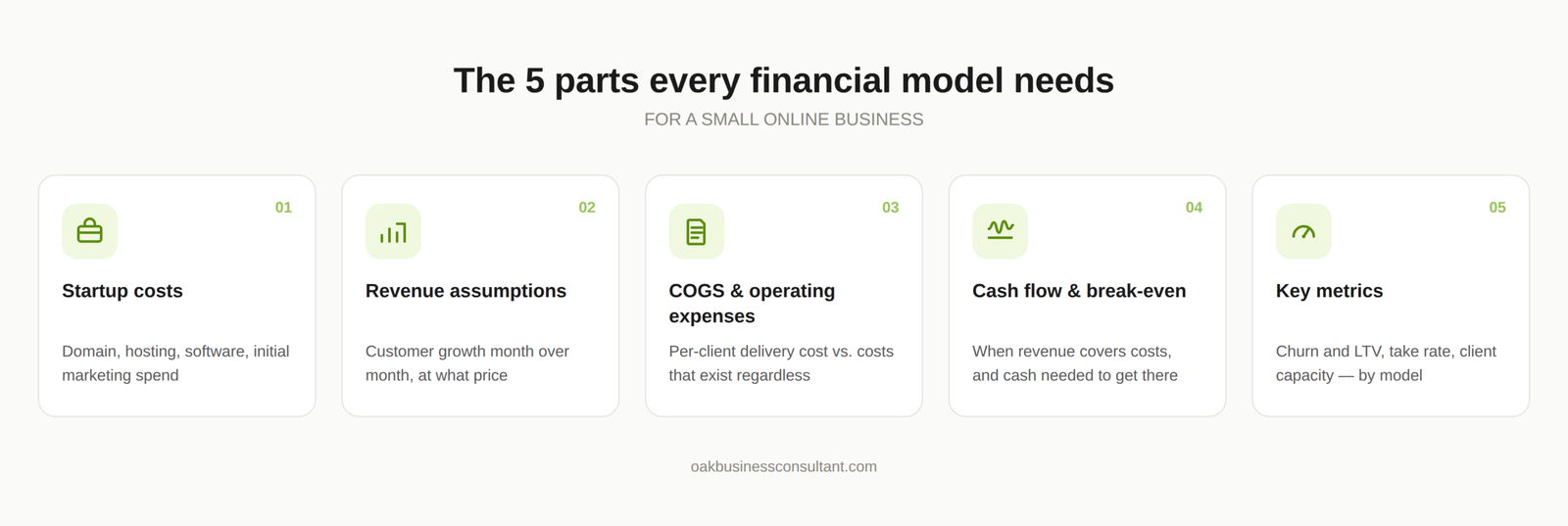
Regardless of what’s being sold, a workable financial model covers the same core pieces.
Startup costs. Domain, hosting, software subscriptions, any licensing or certification, and initial marketing spend. For most online service businesses this is a few hundred to a few thousand dollars. For anything involving inventory or a built product, it climbs fast.
Revenue assumptions. How many customers or clients in month one, how that grows month over month, and at what price point. This is the part founders tend to guess at optimistically, so it’s worth stress-testing with a slower growth scenario too.
Cost of goods sold (COGS) and operating expenses. COGS is whatever it costs to deliver one unit of the service, freelancer payments, software licensing per client, payment processing fees. Operating expenses are the costs that exist regardless of volume: hosting, subscriptions, insurance, your own time if you’re paying yourself a salary.
Cash flow and break-even. This is where the model earns its keep. A clear cash flow analysis shows the point at which revenue covers costs, and how much cash needs to be in the bank before that point arrives.
Key metrics. For a subscription or membership business, that’s churn and lifetime value. Additionally, for a marketplace, it’s take rate and transaction volume. For a service business, it’s client capacity and average project value. The metrics that matter depend entirely on the revenue model, which is why a generic template rarely fits well.
Startup costs by business type
| Business type | Typical startup cost | What drives the cost |
| Service-based (consulting, bookkeeping, freelance work) | $300 to $2,000 | Domain, hosting, software tools, minimal marketing |
| Content or subscription (courses, cooking classes, paid communities) | $500 to $5,000 | Platform fees, content production, initial marketing push |
| Online marketplace or platform | $5,000 to $25,000+ | Development, payment processing setup, initial supply-side recruitment |
| E-commerce or dropshipping | $500 to $10,000+ | Platform subscription, inventory or supplier setup, paid advertising |
These ranges shift quickly once paid advertising, contractors, or custom development enter the picture, which is exactly why a real financial model matters more than a rule of thumb.
A few small online businesses worth modeling out
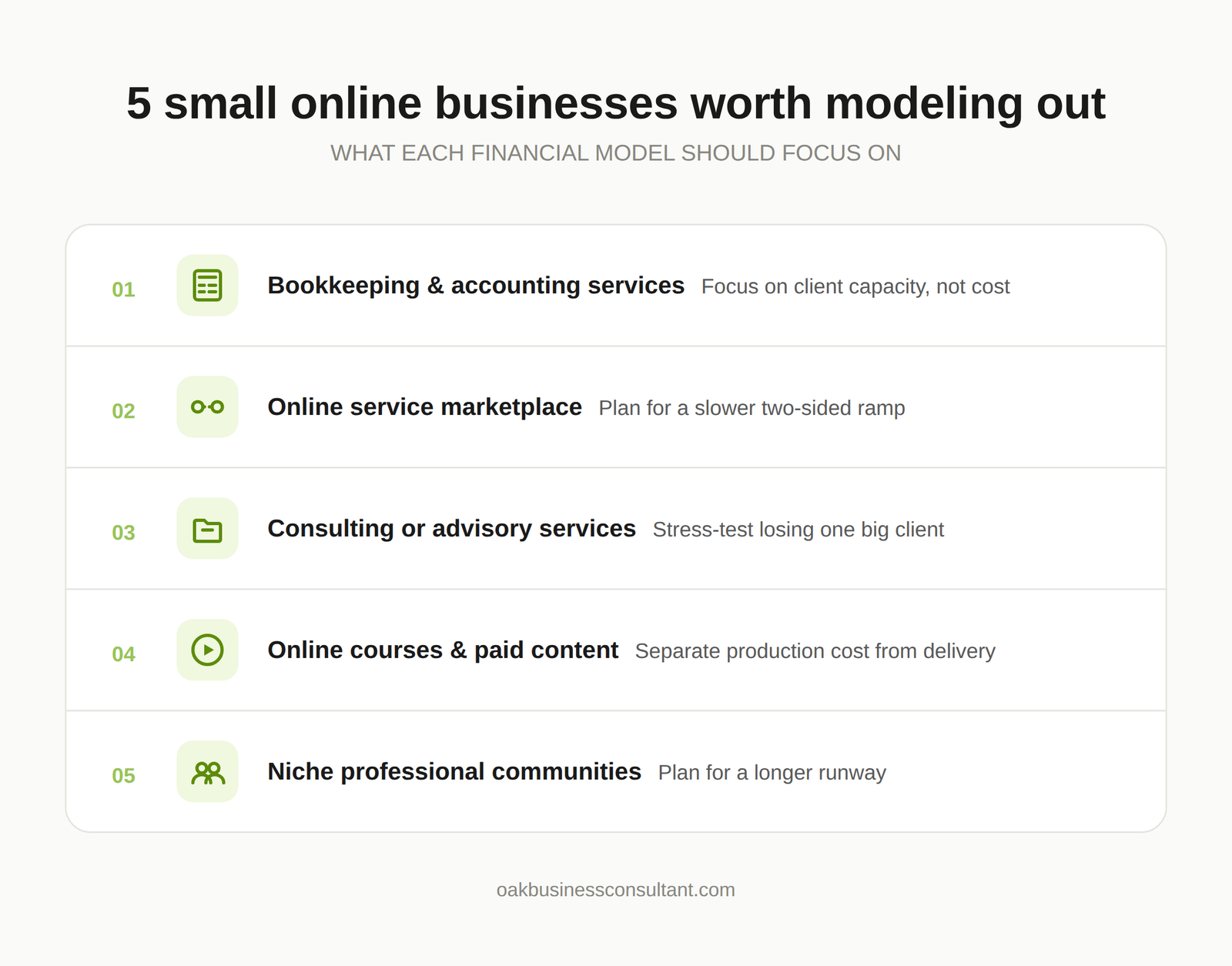
Bookkeeping or accounting services. Freelance bookkeepers can build a client base with almost no upfront cost, since the main expense is accounting software and a way to process payments. The financial model here should focus on client capacity: how many clients one person can realistically manage each month, and at what point it makes sense to bring on a second bookkeeper rather than turn away work.
Online service marketplace. Connecting freelancers or specialists with clients in a specific niche costs more to build than a solo service business, since there’s a platform to develop and both sides of the marketplace need to be recruited. The model needs to account for a slower ramp than most founders expect, since a marketplace only works once there’s enough supply and demand on both sides simultaneously.
Consulting or advisory services. A one-person consulting practice has low fixed costs and high margins once it has clients, but revenue tends to be lumpy, a few large retainers rather than steady monthly income. The model should stress-test what happens if one client leaves, since concentration risk is the biggest threat to a small consultancy’s cash flow.
Online courses or paid content. Cooking classes, skill-based courses, and niche newsletters all share the same financial shape: high upfront time investment to build the first version of the content, then a much lower cost to keep delivering it. The model needs to separate that one-time production cost from the ongoing cost of hosting and updating content, since conflating the two makes early months look far less profitable than they’ll actually be later.
Niche professional communities or platforms. A membership site or online community built around a specific profession can generate revenue through subscriptions, sponsorships, or advertising, but it usually takes longer to reach a sustainable size than a straightforward service business. A subscription-focused financial model should plan for a longer runway and treat early revenue estimates conservatively until there’s real usage data to work from.
Why a generic template usually falls short
A financial model built around a single, one-size-fits-all spreadsheet tends to miss the metric that actually drives each business. Churn matters enormously for a subscription business and barely at all for a one-time service. Client capacity matters for a consultancy and is irrelevant for an e-commerce store. Using the same template across all of them means tracking numbers that don’t actually predict whether the business will survive its first year.
This is also where a lot of first-time founders discover that “financial model” and “budget” aren’t the same thing. A budget tracks what’s being spent. A model projects forward: what happens to cash flow if growth is slower than expected, or if a big client churns, or if marketing costs rise faster than revenue. That forward-looking view is what actually prevents a cash shortfall instead of just documenting one after the fact.
Frequently Asked Questions
Do I need a financial model for a small online business, or is a budget enough?
A budget tracks current spending. A model projects forward and shows what happens under different growth or cost scenarios, which is what actually catches a cash problem before it happens rather than after.
What’s the minimum a financial model should include?
Startup costs, monthly revenue assumptions, cost of goods sold, operating expenses, and a cash flow projection that shows the break-even point. Everything beyond that is refinement.
How far out should a small online business project its finances?
Twelve to eighteen months is usually enough detail to plan around, with a lighter-touch projection for years two and three to judge longer-term viability.
Is a spreadsheet template enough, or do I need a custom model?
A template works for a straightforward, single-revenue-stream business. Anything with a mixed revenue model, multiple pricing tiers, or a marketplace structure with two-sided dynamics usually needs a model built around its specific mechanics.
What’s the biggest mistake founders make when building their first financial model?
Assuming the best-case growth scenario as the default case. Running a second, more conservative scenario alongside the optimistic one usually reveals how much cash cushion the business actually needs.
Conclusion
Picking the right small online business matters less than most lists suggest. What actually determines whether it survives is whether the founder had a clear, honest financial model before spending the first dollar, and kept checking it against reality afterward.
Oak’s startup financial model services build that model around the specific revenue mechanics of the business, whether that’s a subscription, a marketplace, a service practice, or an e-commerce store, rather than starting from a generic template. For businesses further along that need help translating the model into an actual business plan for funding or partnership conversations, that’s built directly on top of the same numbers.