UAE ESG Disclosure Rules Which of the Four Layers Actually Applies to You
UAE ESG Disclosure Rules: Four Layers, One Confusing Question
Ask five UAE consultants whether ESG reporting is mandatory, and expect five different answers. That is not because the consultants disagree. It is because the question itself is incomplete. ESG disclosure in the UAE is not one law. It is four separate regulatory layers, each with its own trigger, deadline, and penalty structure. A free zone trading company, a bank, and a company listed on the Dubai Financial Market can each answer “is ESG mandatory for me” differently, and all three would be right.
That is the gap this guide closes. Most coverage of UAE ESG rules explains one layer in depth and mentions the others in passing. Few map out which layer applies to which type of company, and what happens if that mapping goes wrong.
Why ESG stopped being optional
For most of the last decade, ESG reporting in the UAE was a reputational choice. Large companies published sustainability reports because investors expected it, not because a regulator required it. That changed between 2023 and 2025, when four different regulators moved, mostly independently of each other, to make disclosure mandatory within their own jurisdictions.
The result is not a single national ESG law. It is a patchwork. If your company sits inside more than one of these jurisdictions, say a mainland company with a free zone branch, or an ADGM entity that also exports into the EU, you can be subject to two or three layers at once, and they are not identical.
The four layers, mapped out
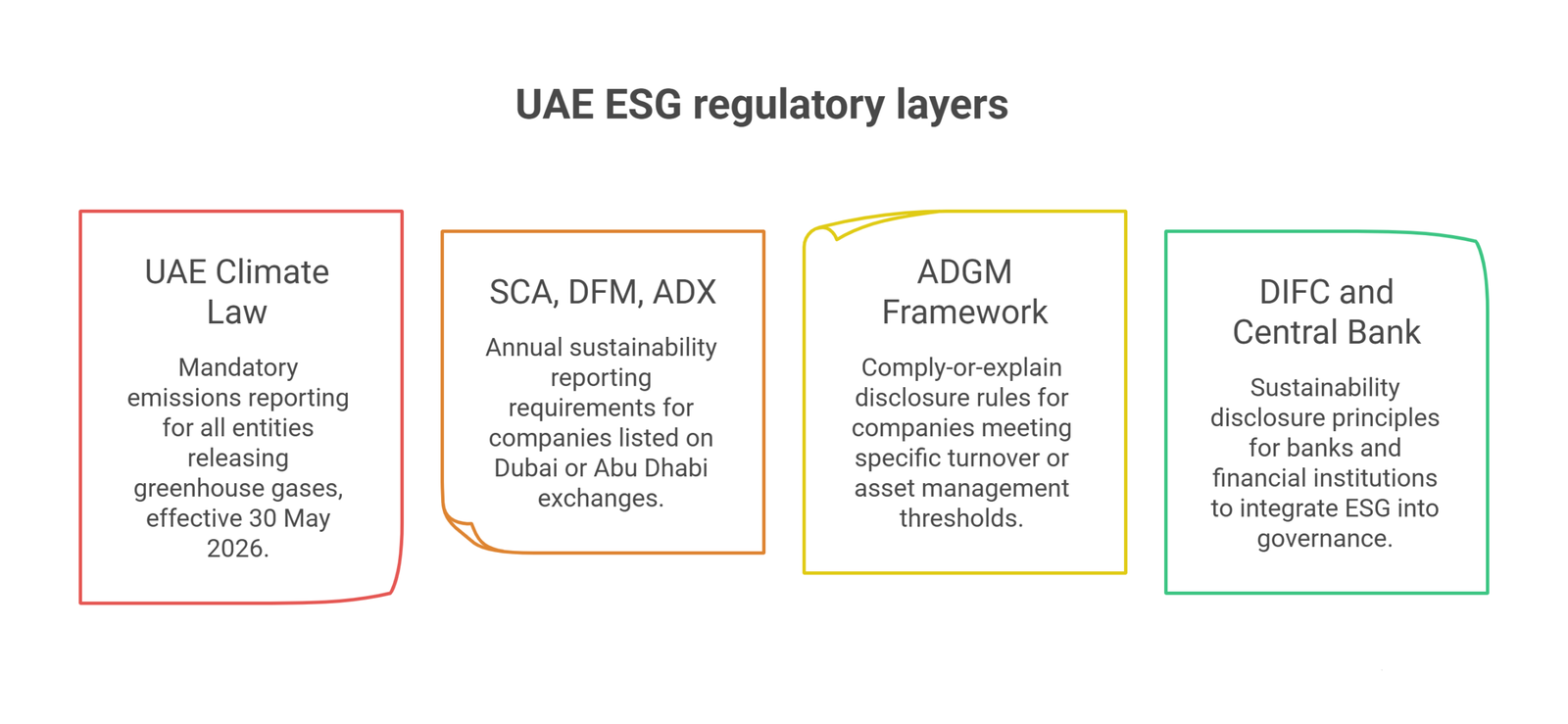
1. The UAE Climate Law: the broadest net
Federal Decree-Law No. 11 of 2024 on the Reduction of Climate Change Effects is the widest of the four layers. It applies to every public and private entity operating in the UAE whose activities release greenhouse gases, including free zone companies. There is no listing requirement and no size exemption written into the law itself.
The law came into force on 30 May 2025, with full compliance due by 30 May 2026, a deadline that has now passed. From that date, companies must measure and report their emissions through the Ministry of Climate Change and Environment’s monitoring, reporting, and verification (MRV) system. Non-compliance carries fines from AED 50,000 to AED 2,000,000 per violation, and repeat violations within two years can double that to AED 4,000,000. Severe or repeated non-compliance can extend to business suspension or exclusion from government procurement.
A companion rule, Cabinet Resolution No. 67 of 2024, adds a sharper edge for large emitters. Entities producing more than 0.5 million metric tons of CO2 equivalent a year must register in the National Register for Carbon Credits and meet stricter monitoring and verification standards. Most SMEs will fall well below that threshold, but the baseline obligation to measure and report Scope 1 and Scope 2 emissions, direct emissions from operations and indirect emissions from purchased energy, still applies broadly.
This is the layer most private, unlisted companies overlook, because it has nothing to do with being publicly traded. If operations emit greenhouse gases, and most operations involving fuel, vehicles, or manufacturing do, this law likely applies regardless of company size. The obligation sits inside the UAE’s wider Net Zero 2050 strategy, which the Climate Law is designed to help deliver.
2. SCA, DFM, and ADX: listed companies
If a company is listed on the Dubai Financial Market or the Abu Dhabi Securities Exchange, a second layer sits on top of the Climate Law. Under the Securities and Commodities Authority’s Corporate Governance Code, all listed public joint-stock companies must publish an annual sustainability report, filed within 90 days of financial year-end or before the annual general meeting, whichever comes first.
DFM and ADX have each published their own guidance to standardize what goes into that report. The DFM ESG Reporting Guide recommends 32 specific metrics aligned with the Global Reporting Initiative, the ISSB standards (IFRS S1 and S2), and the Task Force on Climate-related Financial Disclosures. ADX points listed companies toward the same international frameworks, with added sector-specific expectations for industries like energy and financial services.
3. ADGM: revenue-triggered, comply or explain
Companies registered in the Abu Dhabi Global Market face a third, separate framework. The ADGM ESG Disclosures Framework, in effect since June 2023, applies from a company’s third year of incorporation if it crosses roughly US68millioninturnover,ortoFSRA-licensedfundmanagerswithassetsundermanagementaboveUS6 billion.
Unlike the Climate Law, ADGM’s framework runs on a comply-or-explain basis. Qualifying companies can choose from any globally recognized standard, GRI, ISSB, TCFD, or CDP, and file their disclosure alongside their annual accounts.
4. DIFC and the Central Bank: financial institutions
The fourth layer sits with the Dubai Financial Services Authority in the DIFC and the Central Bank of the UAE for banks and financial institutions more broadly. Through the UAE Sustainable Finance Working Group, the Central Bank has issued sustainability disclosure principles for regulated financial institutions. These principles expect firms to fold ESG factors into governance, risk management, and lending decisions, even without a specific numeric threshold in place.
Which layer applies to you
| Layer | Who it applies to | Core requirement | Deadline or trigger |
| UAE Climate Law (Decree-Law No. 11 of 2024) | All UAE entities, including free zones, whose operations release greenhouse gases | Measure and report GHG emissions through MOCCAE’s MRV system | In force since 30 May 2025; full compliance from 30 May 2026 |
| SCA Corporate Governance Code | Public joint-stock companies listed on DFM or ADX | Annual sustainability report, aligned with DFM’s 32 metrics or ADX/GRI guidance | Within 90 days of financial year-end or before the AGM |
| ADGM ESG Disclosures Framework | ADGM companies above roughly US68mturnover,orFSRAfundmanagersaboveUS6bn AUM | Comply-or-explain disclosure using GRI, ISSB, TCFD, or CDP | From the company’s third year of incorporation |
| DIFC / Central Bank sustainable finance principles | DFSA-regulated firms and financial institutions | ESG integrated into governance, risk, and lending decisions | Ongoing regulatory expectation |
Large emitters under Cabinet Resolution No. 67 of 2024 sit inside the Climate Law row above but face the added National Register for Carbon Credits requirement once they cross the 0.5 million tonne CO2e threshold.
No single mandated reporting framework
One detail trips up companies preparing their first disclosure. There is no UAE-wide ESG reporting standard. Each layer points toward international frameworks rather than prescribing its own. DFM recommends 32 metrics aligned with GRI, ISSB, and TCFD. ADX and ADGM both accept GRI, ISSB, TCFD, or CDP. In practice, most companies preparing disclosure across more than one layer build a single GRI or ISSB-aligned dataset and adapt the presentation for each regulator, rather than running separate reporting systems side by side.
Why this reaches beyond compliance
Two pressures push ESG disclosure past a pure regulatory checkbox, even for companies not directly covered by one of the four layers above.
The first is supply chain pressure. Large UAE buyers increasingly ask smaller suppliers for ESG data before signing contracts, because a buyer’s own emissions reporting depends on data from everyone in its supply chain. A company with no direct regulatory obligation can still lose a contract for not having basic ESG data ready.
The second is trade pressure from outside the UAE. The EU’s Carbon Border Adjustment Mechanism entered its definitive regime on 1 January 2026, covering imports of cement, iron and steel, aluminium, fertilisers, electricity, and hydrogen. UAE exporters in these sectors now need verified emissions data to avoid CBAM certificate costs when selling into Europe.
There is also a recognition angle specific to the UAE. Majra, the UAE’s federal CSR fund, runs a separate but related track: the Impact Declaration and Impact Seal under the Companies for Good 2031 strategy. That framework sits outside the four ESG disclosure layers above, but it draws on much of the same underlying data, emissions figures, workforce policies, and governance practices. Companies preparing ESG disclosure often find they are most of the way to an Impact Declaration too.
What SMEs and private companies should do now
Most guidance on this topic targets listed companies with dedicated ESG teams. For a smaller private business, the practical starting point looks different.
First, confirm which of the four layers actually applies. Most SMEs are not listed and not ADGM-registered, which often narrows the question down to the Climate Law alone. Second, if operations release greenhouse gases, even indirectly through fuel, fleet vehicles, or energy use, start measuring and documenting now rather than waiting for a MOCCAE audit. Third, keep ESG data and compliance documentation in one place, since regulators expect a company’s licensing and tax record to line up with what it reports on emissions. Fourth, if a business exports to the EU, check whether its product falls under CBAM before that data is needed for a shipment.
Working out which of these four layers applies to a specific business is the first real obstacle most companies hit. Get it wrong, and a business either misses a legal obligation or spends time and budget preparing a disclosure it never needed. Oak’s regulatory compliance services map exactly which ESG, tax, and CSR obligations apply to a given license type and structure, so nobody is guessing.
If a company’s licensing setup isn’t fully documented, that groundwork needs fixing first. Otherwise, no disclosure will hold up under regulatory review. Oak already handles Economic Substance Regulation reporting and UBO registration for many clients, which puts that foundation in place before ESG data collection even starts, and coordinates directly with government entities during filing and verification.
ESG data collection touches the same financial systems as day-to-day reporting. Oak’s CFO advisory services can help build those data processes once, so they serve tax filings, ESG disclosure, and a future Majra Impact Declaration together, instead of three separate efforts.
Frequently Asked Questions
What happens if a company misses the Climate Law deadline?
Fines range from AED 50,000 to AED 2,000,000 per violation, with repeat violations within two years doubling that to AED 4,000,000. Severe or repeated non-compliance can extend to business suspension, license revocation, or exclusion from government procurement.
Do free zone companies have to comply with the UAE Climate Law?
Yes. The Climate Law applies to all UAE entities, including free zone companies, if their operations release greenhouse gas emissions. Free zone status does not exempt a company from this layer. Free zone companies also don’t have to file the Majra Impact Declaration, but that’s a separate filing under a different framework.
What counts as a large emitter under the Climate Law?
Entities producing more than 0.5 million metric tons of CO2 equivalent a year, under Cabinet Resolution No. 67 of 2024. These companies must register in the National Register for Carbon Credits and meet enhanced monitoring and verification requirements on top of the baseline reporting obligation.
Which ESG reporting framework should a company use?
There is no single UAE-mandated framework. The different layers all accept GRI, ISSB (IFRS S1 and S2), TCFD, and CDP. DFM also publishes a recommended set of 32 metrics for listed companies. Most companies build one dataset aligned with GRI or ISSB and adapt the presentation for whichever regulator they report to.
Is ESG disclosure the same as the Majra Impact Declaration?
No, they are separate systems run by different bodies for different purposes, though they draw on overlapping data. ESG disclosure is a regulatory requirement tied to the Climate Law, SCA, ADGM, or DIFC. The Impact Declaration is a CSR filing to Majra, connected to the Companies for Good 2031 strategy.
The mapping matters more than the paperwork
Most companies that struggle with ESG disclosure in the UAE aren’t struggling with the reporting itself. They’re struggling with knowing which of the four layers they actually sit inside, and finding that out after a deadline has passed is a far more expensive problem than finding it out now.
Not sure which layer applies to your business, or where to start on your first emissions measurement? Get in touch with Oak Business Consultant, and we will walk through your structure and flag exactly what’s required.