
Global Education Strategies for Future Business Leaders
Building Tomorrow’s Business Leaders Through Global Education
The world of business no longer operates within borders. Markets are interconnected, supply chains span continents, and the most influential companies are those that think and act globally from day one. For the next generation of business leaders, this reality presents both a challenge and an opportunity. The leaders who will shape tomorrow’s economy are not simply those with the highest grades or the most prestigious degrees. They are those who have cultivated a genuinely global mindset.
Global education is no longer a luxury or a resume embellishment. It has become a strategic necessity. Whether you are an ambitious undergraduate, a working professional pivoting into leadership, or a fresh graduate mapping your career trajectory, learning how to leverage international education, cross-cultural experience, and global networking is one of the most powerful investments you can make in your future.
Why Global Education Matters More Than Ever
The business landscape has shifted dramatically over the past two decades. Remote collaboration, multinational teams, and cross-border trade have become the norm. The skills most in demand among future business leaders now consistently include adaptability, cultural intelligence, and the ability to work across diverse environments.
Domestic education, while valuable, often provides a narrow lens through which students view business problems. A student who has only ever studied and worked in their home country may find it difficult to anticipate how a product launch will land in a different region, how to negotiate with international partners, or how to manage a team spread across multiple time zones. Global education closes that gap, both theoretically and experientially.
Universities across North America, Europe, and the Asia-Pacific have long attracted international students because they blend academic rigor with exposure to diverse perspectives. An international classroom is not just a learning environment. It is a reflection of the global economy itself, filled with future leaders from dozens of countries, each bringing a different way of thinking about markets, organizations, and leadership.
The Pillars of a Global Business Education
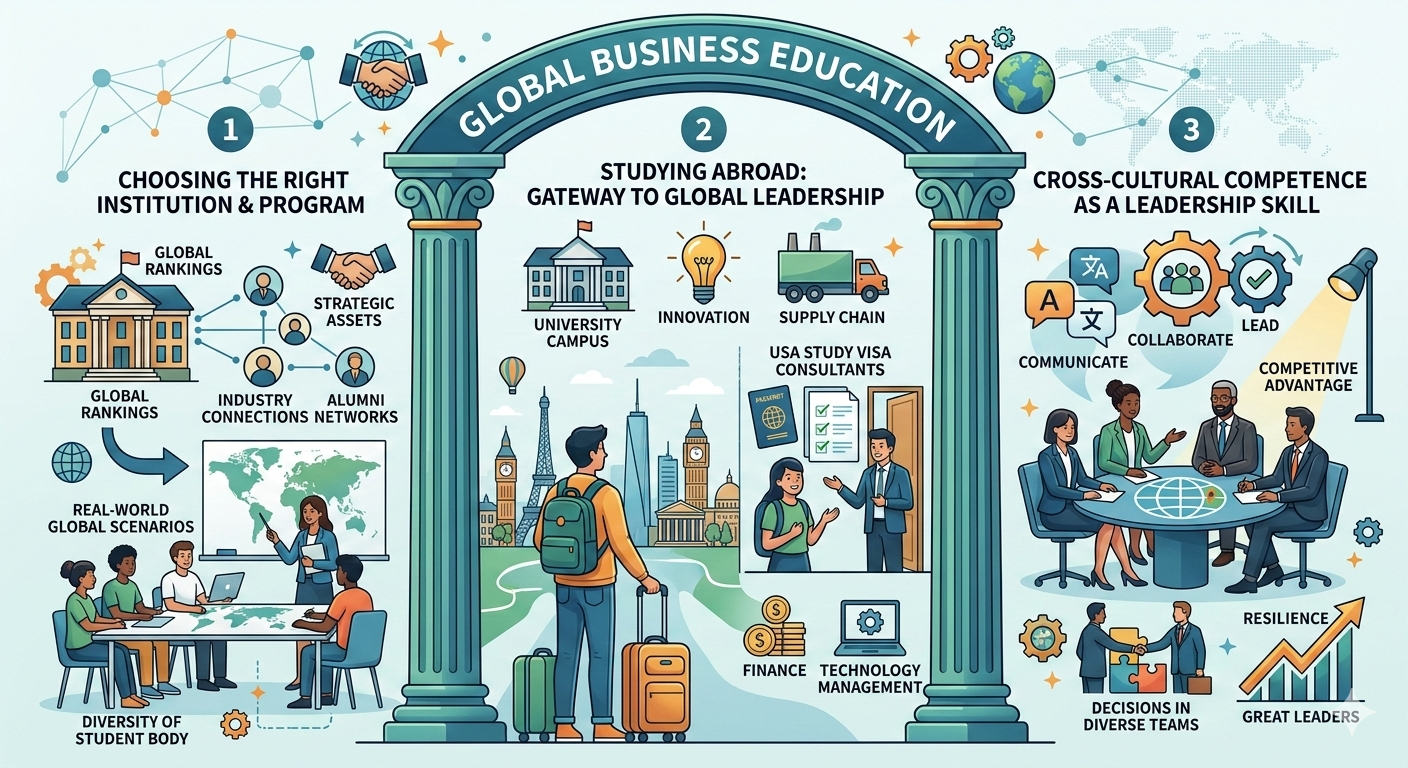
1. Choosing the Right Institution and Program
Not all international degrees are created equal. Future business leaders should look beyond rankings and consider factors such as industry connections, alumni networks, internship pipelines, and the diversity of the student body. Business schools that offer curricula rooted in real-world global scenarios give students tools that transfer directly into their careers.
Programs with strong international cohorts are particularly valuable. They provide not only academic credentials but lifelong networks that span industries and continents. When your classmate from your graduate cohort goes on to lead a company overseas, that relationship becomes a strategic asset for years to come.
2. Studying Abroad: A Gateway to Global Leadership
Studying in a foreign country remains one of the most formative decisions a future business leader can make. Countries with established higher education ecosystems offer access to innovation networks, internship opportunities, and a culture of entrepreneurship that is hard to replicate at home. Programs in business administration, finance, supply chain management, and technology management consistently rank among the world’s best at top international universities.
For students planning this path, the visa process is often the most stressful part of the journey. Many students find it helpful to seek guidance early, particularly for understanding documentation requirements and avoiding common application mistakes. Those applying to American institutions often look for USA study visa consultants who can walk them through the process step by step. Students who take the time to work with experienced USA study visa consultants tend to feel more prepared and submit stronger applications. Getting the paperwork right from the start avoids unnecessary delays and keeps the focus where it belongs: on choosing the right program and preparing for the move.
3. Cross-Cultural Competence as a Leadership Skill
One of the most underrated outcomes of studying abroad is the development of cross-cultural competence, which is the ability to communicate, collaborate, and lead effectively across cultural differences. This is not a soft skill. It is a real competitive advantage.
Research consistently shows that leaders with international exposure make better decisions in diverse teams, are more effective in global negotiations, and build stronger relationships across cultures. Organizations actively seek this profile when hiring for leadership roles.
Living abroad, even for a single academic year, challenges you to confront your own assumptions, develop empathy for unfamiliar perspectives, and build resilience in uncertain situations. These are exactly the qualities that distinguish good managers from great leaders.
Building a Global Network: Beyond the Classroom
Education is only part of the equation. The relationships you build during your international studies will often matter as much as what you learn in lectures.
Attend international business conferences. Global business summits and forums are increasingly accessible to students and young professionals. Many universities provide subsidized access to these events for enrolled students, making participation more achievable than most assume.
Join global professional associations. Industry-specific associations and young leadership networks have chapters across the world. Membership connects you to a community of professionals who share your ambitions and can open doors across sectors and geographies.
Use professional networking platforms thoughtfully. International alumni networks are among the most underused resources available to graduates. Reaching out to alumni working in your target markets with a specific, thoughtful message can open doors that cold applications rarely do.
Pursue internships in your target market. A placement in the country where you plan to build your career does more for your development than almost any other single experience. It builds local credibility and gives you the contextual knowledge that no textbook can provide.
Practical Steps to Prepare for Global Business Leadership
For students and professionals actively planning their international education journey, here is a practical roadmap:
- Start early. The most competitive programs have application deadlines 12 to 18 months in advance. Research your options at least two years before your intended start date.
- Strengthen your language profile. English language proficiency is the baseline for most programs. A second or third language expands your professional reach significantly in global markets.
- Prepare your finances. Scholarships, assistantships, and education loans are all viable funding routes. Many top universities offer merit-based aid specifically for international students.
- Build a compelling personal narrative. Admissions committees at top business schools are not just evaluating your academic record. They are evaluating your story. Articulate why global education matters to your specific goals and what perspective you bring to the cohort.
- Seek professional guidance early. From shortlisting universities to preparing visa documentation, support from experienced education consultants can make the entire process more manageable and less stressful. Then connect with USA study visa consultants.
The Role of Technology in Global Business Education
The rise of hybrid and online learning has opened up access to world-class business education in ways that were difficult to imagine a decade ago. Accredited online programs from leading universities are now available to students anywhere in the world, removing geographic and financial barriers that once made international education out of reach.
However, technology works best as a complement to in-person global education, not a replacement for it. The hallway conversation, the group project that requires you to navigate a cultural disagreement, the weekend that gives you a feel for an unfamiliar market: these experiences happen offline, and they shape how you lead in ways that online coursework simply cannot replicate.
The most effective approach combines both. Use online learning to build knowledge and credentials continuously, while prioritizing in-person international experiences for the depth of perspective they uniquely offer.
Frequently Asked Questions (FAQs)
What is the best country to study in for a global business career?
The best destination depends on your specific career goals. Some countries offer strong ecosystems for entrepreneurship and technology. Others are well known for finance, consulting, or access to emerging markets. Evaluate each option based on your industry, the post-study work rights available, and where you ultimately want to build your career.
Is studying abroad worth the financial investment?
For most business career paths, yes. International graduates consistently command higher salaries, access broader job markets, and move into leadership roles faster than their domestically educated peers. Scholarships, university funding, and education loans make the investment more accessible than many students initially realize.
How do I choose between an MBA and a specialized master’s degree?
An MBA is typically better suited for professionals with a few years of work experience who want to pivot industries or move into general management. A specialized master’s degree in finance, marketing, supply chain, or a related field is ideal for recent graduates seeking focused expertise. Both open strong career doors when obtained from a reputable international institution.
How difficult is the international student visa process?
The process requires careful preparation. Financial documentation, a strong statement of purpose, and a solid academic record are all important. Working with an experienced visa consultant who understands the requirements and the application timeline reduces the risk of delays or rejections considerably.
Can I build a global network without physically relocating?
You can build an international network remotely through professional platforms, virtual conferences, and online alumni communities, and this has real value. That said, the depth of relationships formed through shared in-person experiences is hard to replicate online. Wherever possible, complement your digital networking with in-person international exposure.
Conclusion
The world’s most effective business leaders share a common thread. They understand that great leadership is not culture-neutral. It is shaped by exposure, by curiosity, and by the willingness to step into unfamiliar environments and learn from them. Global education is the most structured way to develop that kind of leadership capacity early in your career.
Whether you are reviewing university shortlists, preparing visa documents, building a professional network across time zones, or simply deciding whether an international degree is right for you, investing in global education is rarely a decision people regret. The challenge is not in seeing its value. It is in taking the first step.
Take control of your finances today with the Personal Budget Tracker from Oak Business Consultant. Track your income, expenses, and savings effortlessly, and make smarter financial decisions with ease. Explore more financial tools designed to help you grow and manage your business successfully. Start optimizing your finances now and stay ahead with Oak’s suite of practical tools!