Distributor Cash Flow Stress Measurement Scale
Distributor Cash Flow Stress Measurement Scale: Step-by-Step Approach
Managing cash flow management as a distributor is not simple. You deal with supplier payment schedules, slow-paying customers, seasonal fluctuations, and unpredictable supply chain disruptions all at once. When any one of those forces hits hard, your entire operation can feel the strain within weeks.
That is exactly why every distribution business needs a distributor cash flow stress measurement scale. It gives you a structured way to measure how much financial pressure your business can absorb before things break down. This guide walks you through what it means, how to build one, and how to use it to protect your financial stability.
What Is a Distributor Cash Flow Stress Measurement Scale
A distributor cash flow stress measurement scale is a framework that helps you score and track cash flow risk across different stress levels. Think of it like a weather alert system. Instead of predicting storms, it predicts financial pressure points before they turn into real crises.
The scale works by combining your core cash flow KPIs, your cash reserve levels, your accounts payable obligations, and your revenue streams into a single view. When any of these areas shows signs of strain, your score moves up the scale. When everything is healthy, your score stays low.
This is not just a theory tool. It is a practical part of cash flow management that helps distributors survive market fluctuations, interest rate hikes, and sudden drops in customer demand.
Why Distributors Face Unique Cash Flow Stress
Distributors sit between manufacturers and retailers. That position creates a cash flow problem that most businesses do not face. You often pay suppliers before your customers pay you. That gap is called the cash conversion cycle and it is the root cause of most distributor cash flow stress.
Here is what makes distribution businesses especially vulnerable:
Raw material costs can spike without warning. Supply chain disruptions can freeze inventory for weeks. Seasonal fluctuations can wipe out months of margin. A single large customer paying late can push days sales outstanding far beyond acceptable limits.
Your cash flow statement may look fine on paper today. But without stress testing, you have no idea how it would look after a global market shock or a sudden loss of market share.
A distributor cash flow stress measurement scale gives you that insight before you need it most.
The Five Stress Levels Explained
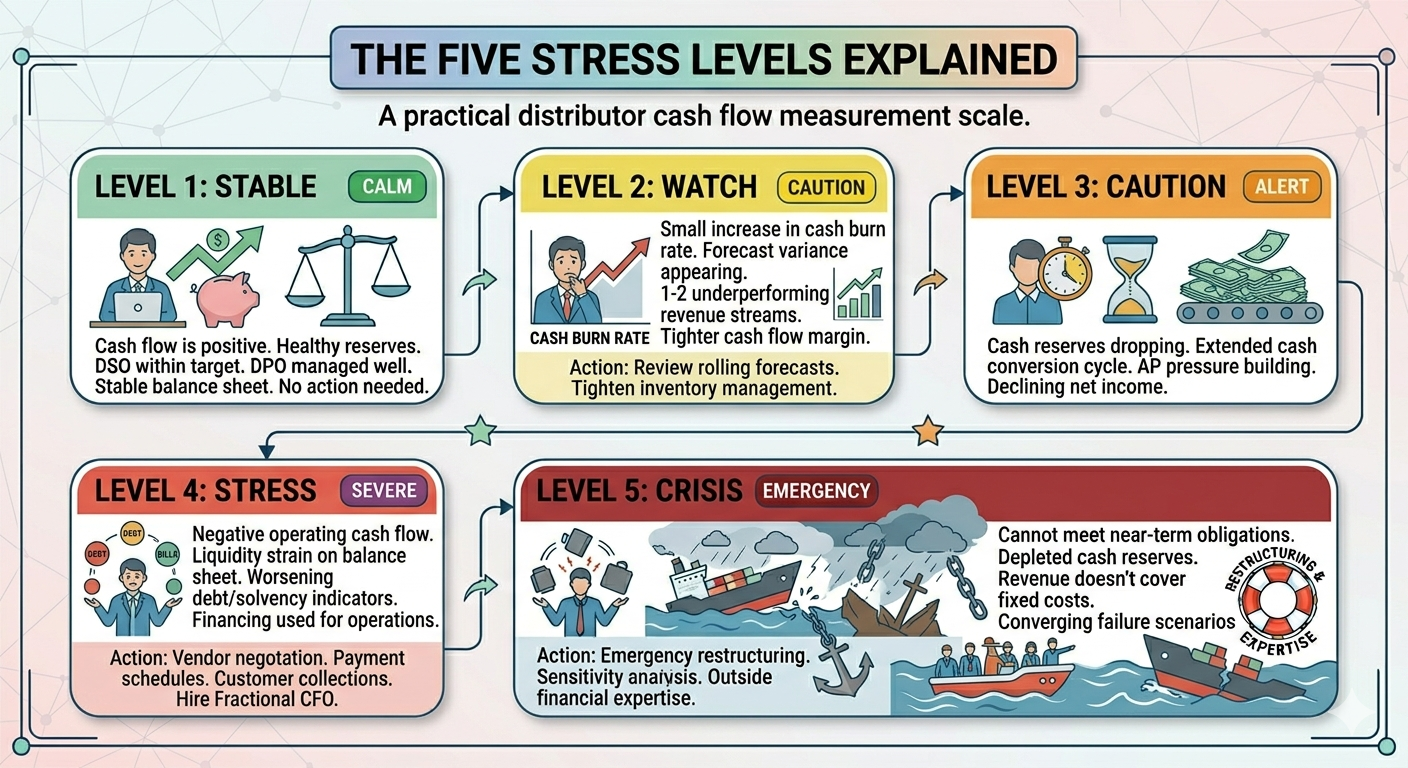
A practical distributor cash flow stress measurement scale uses five levels. Each level reflects a different state of financial health and requires a different response.
Level 1: Stable
Cash flow is positive. Cash reserves are healthy. Days sales outstanding is within your target range. Days payables outstanding is being managed well. Your balance sheet shows no red flags. No immediate action is needed.
Level 2: Watch
You notice a small increase in the cash burn rate. Forecast variance is starting to appear. One or two revenue streams are underperforming. Your cash flow margin is tighter than usual. This is the time to review rolling forecasts and tighten up inventory management.
Level 3: Caution
Cash reserves are dropping. The cash conversion cycle is extending. Accounts payable pressure is building. Net income is declining. You need active scenario planning and sensitivity analysis at this level. Look at which operating activities can be optimized quickly.
Level 4: Stress
Cash flow from operating activities is negative. The balance sheet is showing liquidity strain. Debt and solvency indicators are worsening. Financing activities are being used to cover operations. You need immediate action on vendor negotiation, payment schedules, and customer collections. This is where a fractional CFO becomes critical.
Level 5: Crisis
The business cannot meet near-term obligations without external support. Cash reserves are depleted. Revenue streams are not covering fixed costs. Reverse stress testing shows multiple failure scenarios converging. This level requires emergency restructuring and outside financial expertise.
Key Metrics That Feed the Scale
The power of a distributor cash flow stress measurement scale comes from the metrics you feed into it. Here are the most important ones.
Core Operating Cash Flow Metrics
Start with your cash flow statement. Look at cash from operating activities separately from investing activities and financing activities. A healthy distributor should fund operations entirely from operating cash flow.
Track your cash flow margin. This is operating cash flow divided by net revenue. A declining cash flow margin is one of the earliest warning signs of stress.
Liquidity and Working Capital KPIs
Days sales outstanding measures how long it takes customers to pay you. A rising DSO means cash is sitting in receivables instead of your account. Pair this with days payables outstanding to understand your net cash position in the cycle.
Your cash conversion cycle combines both of these with inventory turnover ratio. A longer cycle means more cash tied up in operations and less available for obligations.
Advanced Cash Flow Metrics
Forecast variance tells you how far your actual cash position is drifting from your projections. High variance means your rolling forecasts are unreliable and your stress scale readings may lag behind reality.
Cash burn rate is the speed at which you are consuming cash reserves. In a stress scenario, this number tells you how many weeks or months you have before reaching Level 5.
Receivables and Payables Metrics
Monitor accounts payable aging closely. Stretching payables too far harms supplier relationships. Letting receivables age too long starves your cash position.
Marketplace settlements, if you sell through third-party platforms, can create timing gaps that worsen the cash conversion cycle unexpectedly.
How to Run Sensitivity Analysis and Scenario Planning
A distributor cash flow stress measurement scale is most powerful when combined with sensitivity analysis. This means asking: what happens to my cash position if one variable changes?
Test these economic scenarios regularly:
What if your largest customer delays payment by 30 days? Moreover, what if raw material costs rise 15 percent? What if a supply chain disruption delays two weeks of shipments? What if interest rate hikes increase your financing cost by 2 percent?
Each scenario gives you a stress score. Plot those scores on your distributor cash flow stress measurement scale. Now you know your vulnerabilities before they become real problems.
Scenario analysis also helps with scenario planning for capital action. If a stress test shows you would reach Level 4 under a moderate demand drop, you can plan a credit facility or inventory reduction now instead of scrambling later.
Reverse stress testing goes one step further. Instead of asking what happens if conditions worsen, it asks: what combination of events would push us to failure? This is a more confrontational exercise, but it surfaces risks that forward-looking scenarios miss.
Building Your Own Distributor Cash Flow Stress Measurement Scale
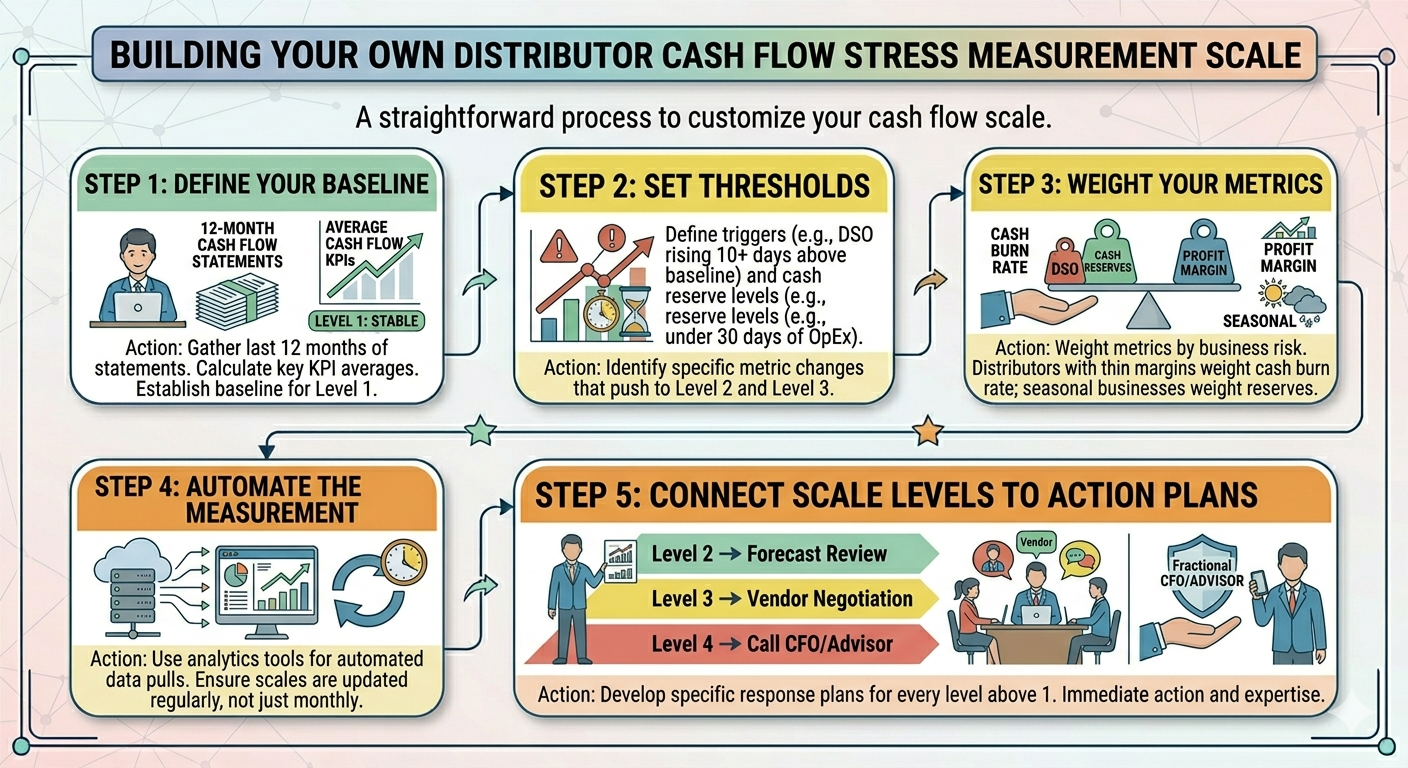
Here is a straightforward process to build your own scale.
Step 1: Define your baseline. Pull your last 12 months of cash flow statements. Calculate your average cash flow KPIs. Establish what Level 1 looks like for your specific business.
Step 2: Set thresholds for each level. Using your baseline, define what metric changes push you to each level. For example, DSO rising 10 days above baseline might trigger Level 2. Cash reserves dropping below 30 days of operating expenses might trigger Level 3.
Step 3: Weight your metrics. Not all metrics carry equal risk for your business. A distributor with thin margins should weight cash burn rate heavily. One with large seasonal fluctuations should weight cash reserve levels heavily.
Step 4: Automate the measurement. Use analytics tools or cash flow software to pull data automatically. The scale only works if you update it regularly. Rolling forecasts that refresh weekly are far more useful than monthly reports.
Step 5: Connect scale levels to action plans. Every level above Level 1 should trigger a specific response. Level 2 triggers a forecast review. Additionally, level 3 triggers vendor negotiation conversations. Level 4 triggers a call to your CFO or financial advisor.
The Role of Financial Stress Testing in Distribution
Financial stress testing is common in banking. The Federal Reserve uses supervisory stress tests to evaluate how banks would survive economic shocks. The Bank of England runs similar exercises for UK banks and building societies. These are known as supervisory models and they use tools like regression models, historical simulation models, and expected-loss frameworks.
Distribution businesses can apply the same logic at a smaller scale. You do not need a regulatory capital framework or post-stress capital ratios. But you do need a structured way to simulate bad outcomes and measure your resilience against them.
Your distributor cash flow stress measurement scale is your version of that supervisory stress test. It may not involve FR Y-14Q reports or loan categories, but it serves the same core function. It tells you whether your business can survive pressure before the pressure arrives.
Geopolitical conflicts, sudden shifts in interest income, changes in inventory management costs, and unexpected interest expense increases are all real threats to distributor cash flow. Stress testing for these scenarios is not overcaution. It is professional financial management.
How a Fractional CFO Can Strengthen Your Scale
Building and maintaining a distributor cash flow stress measurement scale requires financial expertise. Many distribution businesses do not have a full-time CFO. A fractional CFO brings that expertise without the full-time cost.
A fractional CFO can design the scale, set meaningful thresholds, run sensitivity analysis, and interpret your cash flow statement in the context of your specific business model. They can also connect your scale to your balance sheet, your debt and solvency indicators, and your broader financial stability goals.
When your scale moves to Level 3 or higher, having an experienced financial advisor already embedded in your business is the difference between a managed recovery and a financial crisis.
Frequently Asked Questions
What is a distributor cash flow stress measurement scale?
It is a structured scoring system that measures how much financial pressure a distribution business can handle. It combines cash flow KPIs, reserve levels, and scenario analysis into a single risk score that tells you your current stress level.
How often should I update my stress scale?
Weekly updates are ideal for high-volume distributors. Monthly is the minimum. Rolling forecasts should feed into the scale automatically so your stress score always reflects current conditions.
What is the most important metric in the scale?
The cash conversion cycle is usually the most important single metric for distributors. It captures the combined effect of days sales outstanding, days payables outstanding, and inventory turnover ratio in one number.
How does sensitivity analysis improve the scale?
Sensitivity analysis shows you how your stress score changes when one variable shifts. It helps you identify which risks matter most and where to focus your cash flow management efforts.
Can a small distribution business use this scale?
Yes. The scale is especially valuable for smaller distributors who have less buffer against unexpected shocks. The simpler your operations, the simpler your scale can be while still delivering meaningful insight.
What is the difference between scenario analysis and reverse stress testing?
Scenario analysis asks what your stress score would be if specific bad things happen. Reverse stress testing starts from the outcome of failure and works backward to find which combinations of events could get you there.
How does the scale connect to the balance sheet?
Your balance sheet shows your financial position at a point in time. The stress scale uses balance sheet data including cash reserves, accounts payable, and debt levels to calculate your current stress score and project where it is heading.
Conclusion
A distributor cash flow stress measurement scale is one of the most practical tools a distribution business can build. It turns scattered financial data into a clear, actionable risk score. It tells you when to act and what to do at each level of stress. Most importantly, it helps you protect the financial health and financial stability of your business before problems become crises.
If you want expert help building a distributor cash flow stress measurement scale tailored to your business, Oak Business Consultant’s fractional CFO services are designed for exactly this. Our team brings deep financial expertise to distribution businesses that need strategic cash flow management without the cost of a full-time CFO. Reach out today to learn how we can help you stress-test your finances and build a more resilient operation.