Who Needs a Virtual CFO USA: 12 Businesses That Must Have One
Who Needs a Virtual CFO USA: 12 Business Types That Can’t Afford to Miss Out
Most business owners think a chief financial officer is something you hire when you hit a certain revenue milestone or ring the bell on Wall Street. That assumption costs companies millions every year in missed opportunities, poor cash flow decisions, and financial strategies that never get off the ground.
The truth is, who needs a virtual CFO USA is a much broader group than most people realize. If you are running a business in America today and you do not have access to senior-level financial leadership, you are likely making decisions with incomplete information. A virtual CFO brings the kind of financial management, strategic oversight, and cash management expertise that used to be reserved for large enterprises, at a fraction of the cost.
This article breaks down the twelve types of businesses and business owners who genuinely need virtual CFO services right now, and explains why waiting is one of the most expensive mistakes you can make.
1. Startups That Have Moved Past the Idea Stage
The startup phase is exciting and chaotic at the same time. Founders are juggling product development, hiring, marketing, and customer acquisition all at once. Financial planning tends to get pushed to the back burner until there is a crisis.
That is exactly when things fall apart.
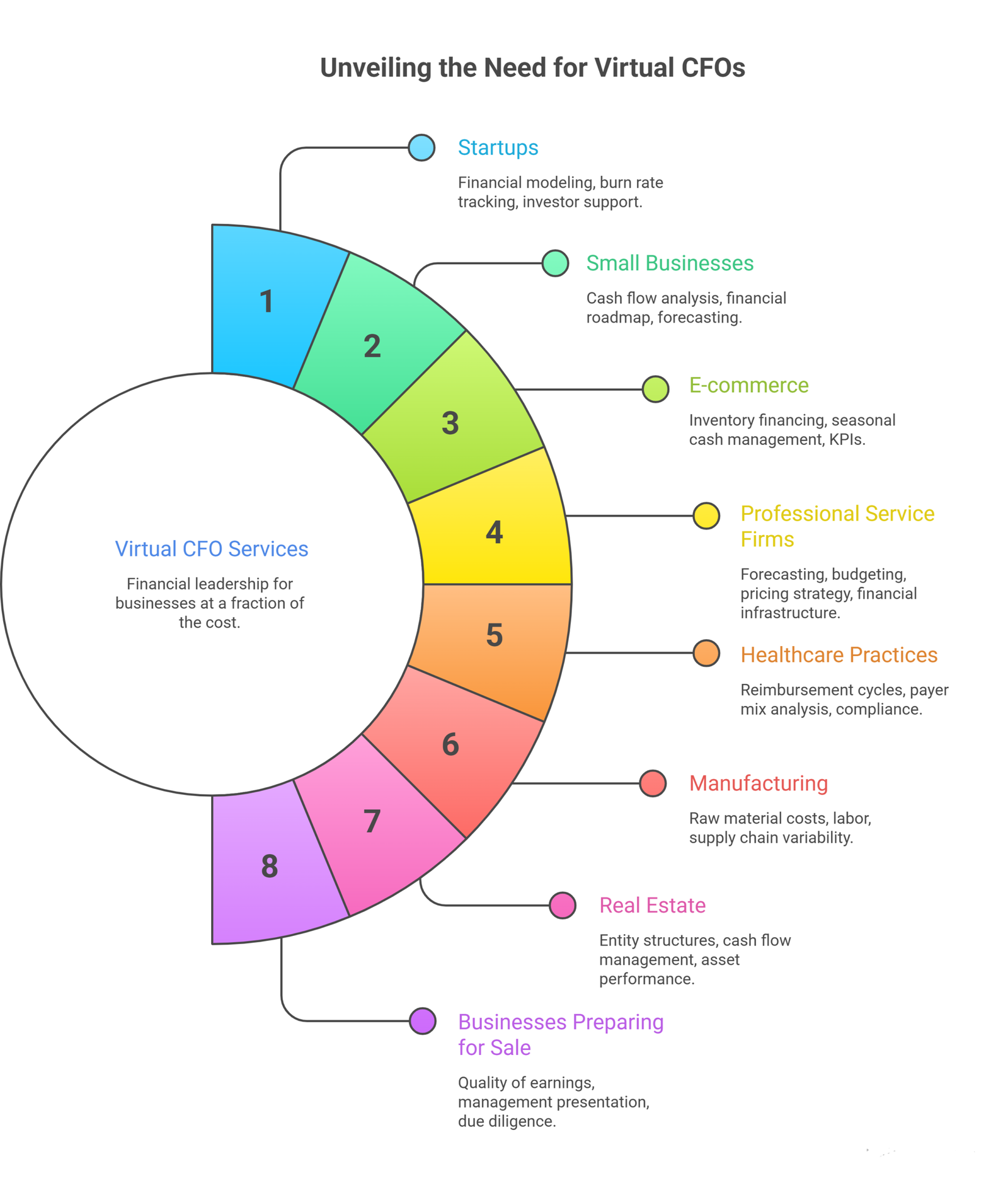
A virtual CFO helps startups build financial models from the beginning, track burn rate with precision, and create financial projections that actually hold up in front of investors. Fundraising and investor support is one of the most critical functions a virtual CFO provides during this stage. Investors do not fund good ideas. They fund well-organized, financially credible businesses, and a fractional CFO helps you become that.
If you are preparing for a seed round, Series A, or any kind of institutional capital, having a virtual CFO for startups in your corner is not optional. It is a prerequisite.
2. Small Businesses Hitting a Growth Wall
Growth is supposed to feel good. But for many small businesses, rapid growth creates a cash flow crisis that looks, from the outside, like success. More orders, more staff, more overhead, but somehow there is never enough money in the bank.
This is one of the clearest answers to who needs a virtual CFO USA. Small businesses that are scaling but struggling to maintain financial health need someone who can run cash flow analysis, build cash flow management systems, and create a financial roadmap that supports sustainable growth rather than just chasing revenue.
A virtual CFO does not just look backward at what happened. They look forward, using financial forecasting and dynamic forecasting to anticipate problems before they become emergencies.
3. E-commerce Companies Managing Complex Inventory
E-commerce sounds lean on paper. No brick-and-mortar overhead, direct to consumer, global reach. But the financial complexity behind a growing e-commerce operation is significant. Inventory financing, seasonal cash management, platform fees, return rates, and multi-channel revenue streams all need to be managed with precision.
Virtual CFO services for e-commerce help e-commerce operators build real-time visibility into their financial data, set up key performance indicators that track what actually matters, and create financial controls that prevent cash from leaking out through poorly managed costs.
Without this kind of financial leadership, e-commerce businesses often discover problems through their bank balance rather than through proactive financial management, which is usually too late to course-correct gracefully.
4. Professional Service Firms Ready to Scale
Law firms, consulting practices, marketing agencies, and similar professional service businesses often reach a point where the owner is doing everything. Client work, sales strategy, hiring, and somehow also trying to read financial statements and make sense of what the numbers mean.
This is not sustainable and it is not strategic.
An outsourced CFO gives professional service firms access to senior financial guidance without the cost of a full-time executive hire. They help with forecasting and budgeting, pricing strategy, profitability analysis by client or service line, and building the financial infrastructure needed to bring in a business partner or outside investor someday.
The cost of a virtual CFO in this context is almost always recovered through better financial decisions within the first few months of the engagement.
5. Healthcare Practices and Medical Groups
Healthcare is one of the most financially complex industries in the country. Reimbursement cycles, payer mix analysis, compliance requirements, credentialing costs, and the ongoing challenge of managing a business where revenue recognition can be months behind service delivery.
Healthcare practice owners who are asking who needs a virtual CFO USA need look no further than their own billing dashboard.
A virtual CFO with healthcare experience provides financial management tailored to the specific challenges of medical businesses. They help with cash flow management during slow reimbursement periods, build financial models for expansion decisions like adding a location or bringing on a specialist, and ensure that financial records are clean and audit-ready at all times.
6. Manufacturing and Product-Based Businesses
Manufacturing companies carry significant financial complexity. Raw material costs, labor, equipment depreciation, supply chain variability, and the constant tension between production capacity and customer demand all require sophisticated financial oversight.
Financial modeling and variance analyses are not nice-to-haves in manufacturing. They are survival tools. A virtual CFO helps manufacturing businesses track cost of goods with precision, identify margin leakage across the production process, and build financial strategies that account for capital expenditure planning and debt management.
For product-based businesses looking to enter retail or expand distribution, a virtual CFO also helps prepare the financial documentation and financial projections needed to negotiate with buyers and secure supply chain financing.
7. Real Estate Investors and Property Management Companies
Real estate is fundamentally a financial business dressed up as a property business. Every acquisition decision, refinancing choice, and portfolio management call is a financial decision with long-term consequences.
Real estate investors and property management companies that are growing their portfolios need more than a bookkeeper and a tax accountant. They need an outsourced CFO who can build entity structures, manage cash flow across multiple properties, track performance by asset, and create the financial statements needed for lender presentations.
For operators working in development or value-add strategies, a virtual CFO for real estate provides the strategic financial planning needed to model project returns, manage construction draws, and prepare for exit.
8. Businesses Preparing for a Sale or Acquisition
If you are planning to sell your business in the next one to three years, a virtual CFO is one of the most valuable investments you can make right now.
Buyers pay for certainty. They pay premium multiples for businesses with clean financial records, strong financial controls, and well-documented financial data that tells a coherent story. A virtual CFO helps you get there, often adding far more value to your exit price than the cost of their engagement.
Beyond cleaning up financials, a virtual CFO helps with quality of earnings preparation, management presentation development, and navigating the financial due diligence process. If you are considering private equity, board reporting and investor interactions become critical, and this is precisely where fractional CFO services shine.
9. Nonprofits and Social Enterprises
Nonprofits are businesses. They have cash flow, payroll, grant compliance requirements, audit support needs, and the ongoing challenge of financial sustainability. They also tend to be dramatically under-resourced when it comes to financial leadership.
A virtual CFO who understands the nonprofit sector brings financial management capabilities that most nonprofits cannot otherwise afford. They help with grant reporting, fund accounting, budget development for board approval, and building financial models that support program expansion.
For social enterprises navigating both earned revenue and philanthropic income, a virtual CFO helps create financial strategies that align the organization’s financial health with its mission, not against it.
10. International Businesses Entering the US Market
Foreign companies setting up US operations face a specific and serious set of financial challenges. US entity setup and compliance, US GAAP reporting requirements, US tax codes, cross-border taxation, and the challenge of managing financial operations across time zones and currencies all require expert financial guidance.
Who needs a virtual CFO USA in this context is obvious: any international business trying to establish a credible American presence without a local finance team.
Virtual CFO services for international companies provide entity structuring and licensing guidance, help establish accounting management systems that satisfy US compliance requirements, and create the financial infrastructure needed to operate professionally in the American market from day one.
11. Companies Going Through Rapid Change
A merger, an acquisition, a leadership transition, a major pivot in business model, or a sudden spike in growth. Any of these events creates a period of elevated financial complexity that most existing teams are not equipped to handle alone.
During periods of rapid change, a virtual CFO acts as a stabilizing financial force. They bring systems development expertise to quickly assess what financial tools and processes are needed, establish reporting cadence and communication workflows that keep leadership informed, and ensure that financial controls do not break down during the chaos of transformation.
The value of financial leadership during periods of change is not just in the numbers. It is in the confidence it gives decision-makers to move quickly without flying blind.
12. Any Business Owner Who Has Outgrown Their Accountant
There is a moment in every growing business when you realize that your accountant is great at tax planning and financial record maintenance but cannot help you think through a major strategic decision, evaluate an acquisition, or model the financial impact of a new product line.
That is not a criticism of accountants. It is simply a recognition that accounting and financial leadership are different disciplines, and that as a business owner you eventually need both.
A virtual CFO fills this gap without requiring you to hire a full-time executive. They bring financial guidance at the strategic level, working alongside your existing accountant or bookkeeping team to elevate the entire financial function of your business.
If you find yourself making major financial decisions based on gut instinct rather than financial models and data, that is the moment you need a virtual CFO.
What Does a Virtual CFO Actually Do?
For business owners who have never worked with one, it is worth understanding the scope of what virtual CFO services actually cover.
At the core, a virtual CFO provides strategic financial planning and financial management at the executive level. This includes building and maintaining financial models, developing financial projections for planning and fundraising, running cash flow management processes, and providing financial forecasting that helps leadership make better forward-looking decisions.
Beyond the numbers, a virtual CFO helps establish financial controls and internal policies that protect the business, supports tax planning in coordination with your tax advisors, provides audit support when needed, and can represent the business in investor interactions or lender negotiations.
For many small and medium-sized businesses, the engagement also includes helping select and implement financial tools and ERP solutions that improve visibility and reduce the manual effort of managing financial data.
The cost of a virtual CFO is typically a fraction of what a full-time chief financial officer would cost, making fractional CFO services accessible to businesses that could never justify a full-time executive hire but genuinely need that level of financial leadership.
Frequently Asked Questions
At what revenue level does a business need a virtual CFO?
There is no magic number. Complexity matters more than revenue. If your finances are keeping you up at night, you probably need one already.
What is the difference between a virtual CFO and a bookkeeper or accountant?
Your bookkeeper records what happened. Your accountant handles taxes. A virtual CFO tells you what to do next.
How much does a virtual CFO cost compared to a full-time CFO?
A full-time CFO costs $200K to $400K a year before benefits. A virtual CFO gives you the same strategic firepower for a fraction of that, usually a few thousand dollars a month.
Can a virtual CFO help with fundraising?
Absolutely. They build the financial models, shape the investor narrative, and make sure your numbers can survive scrutiny in any due diligence process.
How do I know if my business is ready for a virtual CFO?
If you are growing but feel financially reactive rather than in control, that gap between where you are and where you want to be is exactly what a virtual CFO closes.
Conclusion
Who needs a virtual CFO USA is not a niche question with a narrow answer. It applies to startups trying to survive their early years, established small businesses trying to scale responsibly, professional service firms looking to build real enterprise value, healthcare operators navigating complex reimbursement environments, and international companies trying to crack the American market.
If your business is growing, facing complexity, or making decisions that carry real financial risk, the question is not whether you need a virtual CFO. The question is how long you can afford to go without one.At Oak Business Consultant, we provide virtual CFO services designed for businesses at every stage of growth. Whether you need strategic financial planning, cash flow management, fundraising support, or help building the financial infrastructure your business has been missing, our team is ready to help. Contact us now and find out what senior financial leadership can do for your business.