Dropshipping in UAE: Benefits, Challenges, and How to Get Started
Dropshipping in the UAE: a founder’s guide to licensing, tax, and staying profitable
Most people who search for dropshipping in the UAE already know the pitch: no inventory, low startup cost, ship what you sell after someone pays for it. What trips founders up is not the model. It is the paperwork that sits underneath it. Selling through a Shopify store without a valid trade licence is illegal commercial activity in the UAE, and the fines start at levels that wipe out a first year of profit. This guide covers the licence decision, the tax rules, the supplier and payment setup, and the operational choices that separate a dropshipping business that survives its first year from one that does not.
Why the UAE works for dropshipping
The UAE has one of the highest rates of internet and smartphone penetration in the world, and most online spending now happens on mobile. That matters for dropshippers because it means a well-built mobile storefront reaches nearly the entire addressable market without a separate app.
The country is also home to a large expatriate population from well over a hundred nationalities, alongside a high-income local base. That mix supports niche products that would struggle to find enough buyers in a smaller, less diverse market: imported foods, region-specific fashion, or hobby goods tied to a particular home country.
Add a business-friendly regulatory environment, competitive import routes through Jebel Ali and Dubai’s ports, and free zones built specifically for e-commerce activity, and the UAE remains one of the more accessible dropshipping markets in the region for a foreign founder to enter without a local partner.
Is dropshipping legal in the UAE?
Yes, but only under a registered business entity with a valid trade or e-commerce licence. Federal Law No. 1 of 2006 on Electronic Commerce and Transactions treats commercial selling through a website, Instagram, or WhatsApp the same way it treats a physical shop: it requires a licence issued by the Department of Economic Development (DED) for mainland businesses, or by the relevant free zone authority.
Operating without one is not a grey area. It is classified as illegal commercial activity under UAE Commercial Companies Law, and the Department of Economy and Tourism can fine an unlicensed operator, block the website, and order the business closed. Get licensed before you take your first order, not after your first sale proves the niche works.
Choosing your legal structure and licence
Your licence decision shapes three things: how much of the business you own, whether you can sell directly to mainland UAE customers, and how fast you can open a bank account. Three structures cover almost every dropshipping founder.
A free zone e-commerce licence gives 100% foreign ownership with no local sponsor required, and it is the standard choice for expat founders running a pure online store. The catch is that a free zone entity cannot sell directly to mainland UAE consumers without a distributor or a dual licence, so most free zone dropshippers route mainland delivery through a logistics partner rather than selling to mainland customers directly under their own entity.
A mainland DED licence costs more to set up but removes that restriction. Since the 2021 ownership reforms, most commercial and trading activities also allow 100% foreign ownership on the mainland, so the old requirement for a local Emirati partner holding 51% no longer applies to most e-commerce activities.
An e-trader licence, available through Dubai’s DED, is the cheapest option but is restricted to UAE and GCC nationals selling through social media only. It is not an option for most foreign founders, though it is worth knowing about if you are structuring a business with a local partner.
| Licence type | Foreign ownership | Sells to mainland customers | Typical starting cost |
| Free zone e-commerce | 100% | Only via distributor or dual licence | From around AED 6,000 to 12,000 |
| Mainland DED | 100% for most activities | Directly | From around AED 15,000 to 20,000 |
| E-trader (Dubai) | UAE/GCC nationals only | Social media only | From around AED 1,000 |
Business setup consultants can register either structure end to end, which matters more than it sounds: choosing the wrong free zone for your niche, or missing an activity code your bank later asks about, is one of the most common reasons a new dropshipping entity gets stuck for weeks before it can open an account.
What a UAE dropshipping business actually costs to launch
The licence fee is the headline number, but it is not the total bill. A realistic first-year budget on a free zone setup also needs to cover an establishment card, a residency visa if you want one, a UAE corporate bank account minimum balance (commonly AED 25,000 or more depending on the bank), and basic accounting and compliance support.
Put together, most free zone dropshipping launches land somewhere between AED 25,000 and AED 40,000 in the first year, before Shopify subscription fees, advertising spend, and supplier sampling. Mainland setups tend to run higher because of the additional licensing and, in some cases, office requirements.
It is worth building this out as an actual cash flow projection rather than a rough estimate, since dropshipping margins run tighter than many founders expect (commonly 15% to 20%, well below the 30% to 40% margins typical of businesses that hold their own stock). A proper e-commerce-specific financial model forces you to see exactly how much order volume you need before the business breaks even, which is a very different exercise from guessing at a launch budget.
Opening a bank account and setting up payments
A UAE corporate bank account is required before any payment gateway will onboard you, and it is often the slowest step in the launch sequence. Digital-first banks tend to approve straightforward e-commerce accounts faster than traditional banks, which can take several weeks and ask for more documentation. Either way, you will need your trade licence and standard KYC paperwork ready before you apply.
Once the account is open, most UAE dropshippers run a mix of a card gateway (commonly Stripe or a UAE-focused processor), Apple Pay and Google Pay for mobile checkout speed, and a buy-now-pay-later option such as Tabby or Tamara. BNPL is not a nice-to-have here: on orders above roughly AED 300, it measurably lifts average order value, because UAE shoppers use it heavily for exactly that price bracket.
VAT and corporate tax obligations for dropshippers
Two separate tax obligations apply to a UAE dropshipping business, and founders regularly confuse them.
VAT is charged at 5% on taxable supplies, and registration becomes mandatory once your annual taxable revenue crosses AED 375,000. Voluntary registration is available from AED 187,500, which lets you reclaim VAT on business expenses even before you are required to charge it on sales. Returns are filed quarterly with the Federal Tax Authority, and you need to keep records for five years.
Corporate tax sits on top of VAT, not instead of it. It is charged at 9% on taxable profit above AED 375,000 under Federal Decree-Law No. 47 of 2022. Below that threshold, the rate is 0%. If you are operating through a free zone entity, check separately whether your dropshipping income qualifies as “qualifying income” under the free zone corporate tax regime, since that can keep you on the 0% rate even as revenue grows. This determination depends on your specific business activity, so get it confirmed by a registered tax consultant rather than assuming it applies.
Get VAT registration and corporate tax set up from day one, even while you are under the threshold. Retrofitting tax compliance after a business has scaled past AED 375,000 in revenue is a much larger project than registering early and filing nil or low returns while you are small.
Sourcing suppliers that actually work for the UAE market
The instinct for most new dropshippers is to go straight to AliExpress. That works for testing a niche cheaply, but it is usually the wrong long-term sourcing strategy for the UAE specifically, because a 15-day shipping window from China collides badly with how UAE shoppers behave.
Source in priority order. Look first at local UAE stock through B2B platforms built for exactly this purpose, which typically deliver same-day to 48 hours and produce far better outcomes on cash-on-delivery orders. Next, look at regional warehouses in Dubai’s free zones, which still ship within the region in a few days. Only fall back to global suppliers on AliExpress, Alibaba, DHgate, or similar platforms when local or regional stock genuinely does not exist for your product.
Before listing anything, order a sample to your own UAE address. Test the actual delivery time to more than one emirate, not just Dubai, since delivery performance can vary noticeably between Dubai, Abu Dhabi, and the northern emirates. Confirm the supplier can restock, not just fulfil a one-off batch, and get their return policy in writing. UAE consumer protection law holds you, the seller, fully responsible to the customer regardless of whose fault a defect or delay actually was, so your own return policy needs to match what your supplier will actually accept back.
The cash-on-delivery decision
Cash on delivery still accounts for roughly a third of UAE e-commerce order volume, and turning it on typically increases total orders. The trade-off is a materially higher return-to-origin rate: UAE-wide data puts COD returns at around 20%, compared with roughly 6% for prepaid orders. That gap is the real economics of the COD decision, not a footnote.
A few practical steps bring that failure rate down without switching COD off entirely: an address verification call before dispatch, same-day dispatch once an order is confirmed, a small discount or free-shipping nudge for customers who pay upfront instead, and a courier agreement that allows more than one delivery attempt before an order is written off. None of this eliminates the RTO problem, but it moves the rate meaningfully in your favour.
Because COD payment also arrives later than a card payment, usually after the courier’s remittance cycle clears, cash flow planning matters more for a COD-heavy store than most new founders expect. This is one of the areas where clean bookkeeping built for e-commerce pays for itself: it is easy to look profitable on paper while actually running short on cash because two weeks of COD remittances are still in transit.
Logistics and fulfilment partners
Your courier relationship affects both delivery speed and, indirectly, your RTO rate, since faster, more reliable delivery reduces the number of failed COD attempts. National couriers with broad coverage across all seven emirates and established COD remittance processes are the standard choice for most stores. For same-day or two-hour delivery within Dubai on premium or impulse-purchase categories, a specialist last-mile courier can be worth the extra cost. For cross-border shipments coming directly from an international supplier, an international express carrier is usually more reliable than a regional one.
Whichever couriers you choose, confirm they integrate with your storefront platform for order routing and tracking sync before you commit. Manual order processing works fine at low volume and breaks down quickly once you are handling more than a handful of orders a day.
Staying compliant with UAE consumer protection law
Federal Law No. 15 of 2020 on Consumer Protection applies to every online seller, dropshippers included, and it is worth reading properly rather than skimming. The law holds you responsible to the customer even when a supplier caused the problem. Your store needs to display return and refund policies, delivery timelines, seller identity, and warranty terms clearly, and customers have a statutory right to return an online purchase within seven days of receipt. Your own store policy cannot restrict that right, no matter what your supplier’s return terms say.
Choosing a niche worth building around
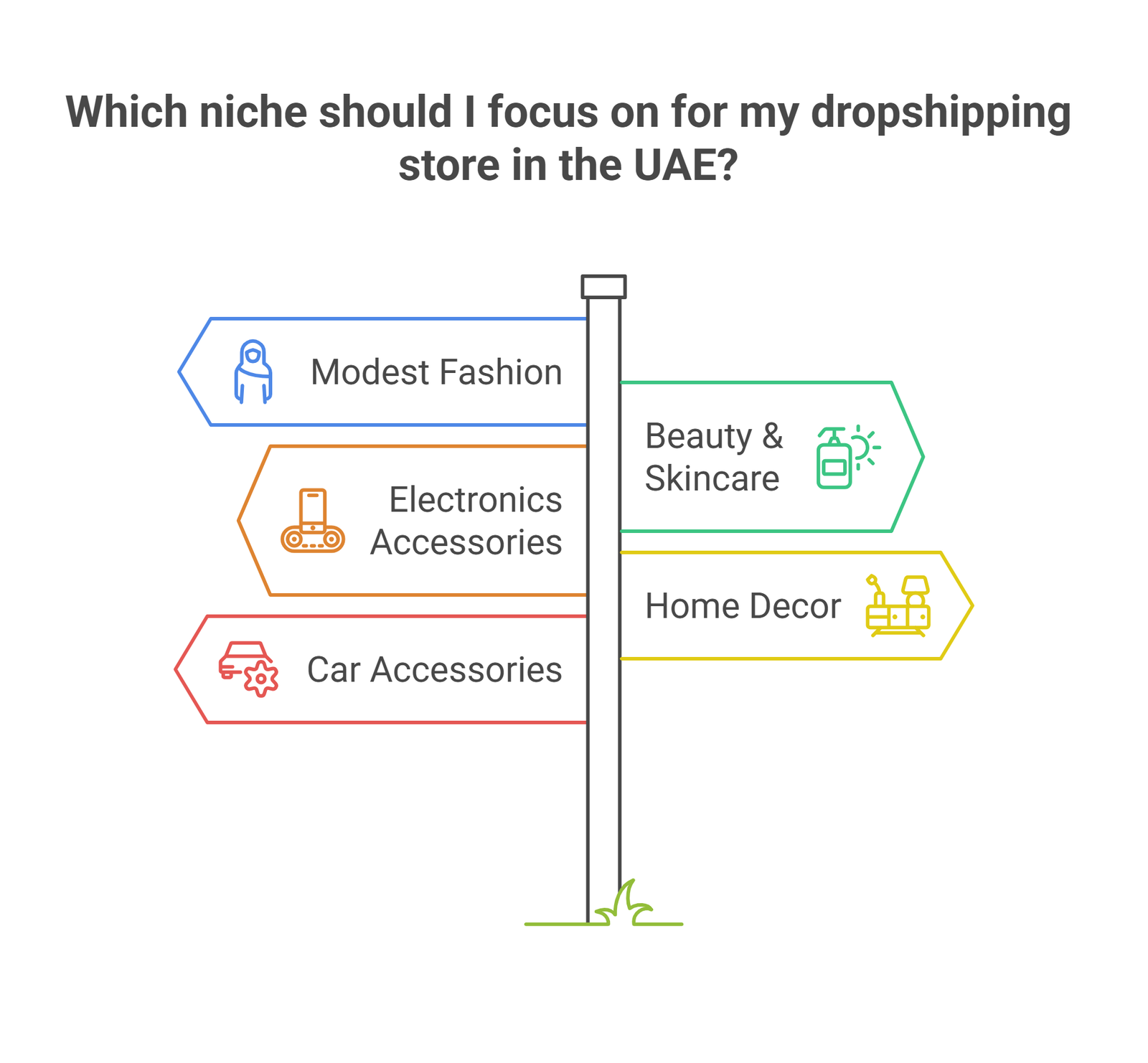
Pick a niche before you build the store, not after. Check search demand for your product category with a UAE geographic filter, browse bestseller rankings on major local marketplaces, and look at hashtag volume for the category on TikTok among UAE accounts. If a product category shows no traction across any of those three signals, the audience is probably too thin for a solo launch to reach profitably.
A few categories consistently perform well for UAE dropshippers, though the reasons differ by category. Modest fashion and abayas benefit from a large, steady buyer base and predictable seasonal peaks around Ramadan and Eid, but sizing-related returns need a clear exchange policy. Beauty and halal-certified skincare has fast-growing demand, though some products need municipality registration before they can be listed. Electronics accessories and home decor tend to carry lower return rates than apparel, which makes them easier to run profitably at a small scale. Car accessories do well given how high UAE car ownership rates are, provided listed dimensions are accurate enough to avoid fitment-related returns.
Running proper market research before committing to a niche and a supplier relationship is worth the time. Pivoting a Shopify store is easy. Unwinding a licence, a supplier contract, and a batch of paid ads that targeted the wrong audience is not.
Marketing your store
Instagram and TikTok short-form video tends to carry the largest share of a UAE dropshipping marketing budget, and it does the heaviest lifting on cold awareness and first purchase. Arabic-language creative generally outperforms English-only ads for the Emirati segment specifically, and UAE-based micro-influencers with a modest but engaged following often beat paid reach on cost per conversion.
Google Shopping tends to work best for the customers already close to buying, since a search like “buy Dubai” signals someone near the bottom of the funnel rather than someone browsing. Round out the mix with WhatsApp Business broadcast lists and email for retention: UAE audiences respond to WhatsApp at rates that consistently beat email open rates, and it is worth building that channel from your very first order rather than treating it as an afterthought.
Frequently Asked Questions
Is dropshipping legal in the UAE?
Yes. It must operate under a valid trade or e-commerce licence from a free zone authority or the mainland DED. Selling without one is illegal commercial activity and can carry fines, website blocking, and forced closure.
What licence do I need to start dropshipping in the UAE?
Most founders need a free zone e-commerce licence or a mainland trading licence. Free zone options offer 100% foreign ownership with no local sponsor, which is why most expat founders choose them over the mainland route.
Do I need to charge VAT on my UAE dropshipping sales?
Yes, once your annual taxable revenue passes AED 375,000. Voluntary registration is available from AED 187,500 if you want to reclaim VAT on expenses earlier. Returns are filed quarterly with the Federal Tax Authority.
Should I offer cash on delivery?
COD drives a meaningful share of UAE orders and increases total order volume, but it also carries a much higher return-to-origin rate than prepaid orders. Most stores keep COD on but pair it with address verification calls and same-day dispatch to reduce failed deliveries.
Can I dropship on Amazon.ae or Noon?
Yes, provided you hold a valid trade licence and follow each marketplace’s own dropshipping and fulfilment policies. Both platforms give you access to an existing UAE customer base without building a standalone store first.
Can a foreigner own 100% of a UAE dropshipping business?
Yes. Free zone e-commerce licences allow full foreign ownership with no requirement for a local partner, and the 2021 ownership reforms extended that to most mainland commercial activities as well.
Conclusion
The dropshipping model itself is simple. What separates a UAE dropshipping business that lasts from one that folds within a year is almost always the setup work most founders try to skip: the right licence for how you actually plan to sell, VAT and corporate tax handled before they become a scramble, suppliers chosen for UAE delivery realities rather than the lowest unit price, and a COD strategy that accounts for its real return rate instead of just its order-volume boost.
Get the structure right before you spend a dirham on advertising. Oak Business Consultant can handle your UAE company registration end to end, including the free zone versus mainland decision, and guide you through VAT and corporate tax setup so you can focus on building the store and finding customers. Contact us to get started.