What if I Miss Company Tax Deadline
What to do if You Miss Tax Deadline?
The corporate world moves at a lightning pace. Between managing teams, closing deals, and refining your product, the calendar can sometimes slip away from even the most organized founders. If you’ve just realized the filing date has passed and you are asking yourself, what if I miss company tax deadline, the first thing to do is take a deep breath. You aren’t the first business owner to find yourself in this position, and you certainly won’t be the last.
However, once that breath is taken, you must act with a sense of urgency. The Internal Revenue Service operates on a very specific, automated clock. Once a deadline passes, penalties and interest begin to compound daily. Missing a business tax deadline isn’t just a paperwork error; it’s a financial event. But if you understand the Internal Revenue Code and the pathways available for remediation, you can get back on track without sinking your business.
The Immediate Reality: Why Filing Matters More Than Paying
When business owners realize they can’t pay their full tax bill, they often make the mistake of not filing at all. This is a costly error. If you are wondering what if I miss company tax deadline, the most important distinction to learn is the difference between failure-to-file penalties and failure-to-pay penalties.
The Internal Revenue Service treats these as two separate “sins.” The penalty for Failure to File is significantly harsher, usually 5% of the unpaid taxes for each month the tax return is late, capping at 25%. In contrast, the Failure to Pay penalty is only 0.5% per month.
The lesson? Even if your bank account is empty, you should still file your taxes immediately. By submitting your income tax return on time (or as close to the deadline as possible), you eliminate the most expensive failure-to-file penalties entirely.
Breaking Down the Forms: Which Clock is Ticking?
The severity of missing the date often depends on how your business is structured and which specific form you missed.
C-Corporations (Form 1120)
For C-Corps, the business tax deadline is generally the 15th day of the fourth month after the fiscal year ends. If you miss this, the IRS calculates penalties based on the tax liability shown on your Form 1120.
Partnerships and S-Corps (Form 1065 and Form 1120-S)
These are “pass-through” entities. While the business itself might not owe income tax, the penalty for a late Form 1065 is calculated per partner, per month. For a firm with ten partners, a few months of delay can result in a staggering tax bill before you’ve even looked at the actual taxes owed. Partnership returns are notorious for racking up these “per-head” penalties quickly.
Sole Proprietors (Form 1040 and Schedule C)
If you are a freelancer or a one-person shop, your business income goes on your personal Form 1040 via Schedule C. Missing the April deadline means you are dealing with individual filing deadlines, but it also impacts your estimated tax requirements for the following year.
Information Returns (Form 1099-NEC and Form 1099-MISC)
Don’t forget the “small” forms. Failing to report nonemployee compensation via Form 1099-NEC carries its own set of fines. If you didn’t get a Form W-9 from your contractors early on, you might find yourself scrambling to meet 1099 deadlines at the last minute.
What if I Miss Company Tax Deadline? The Step-by-Step Recovery
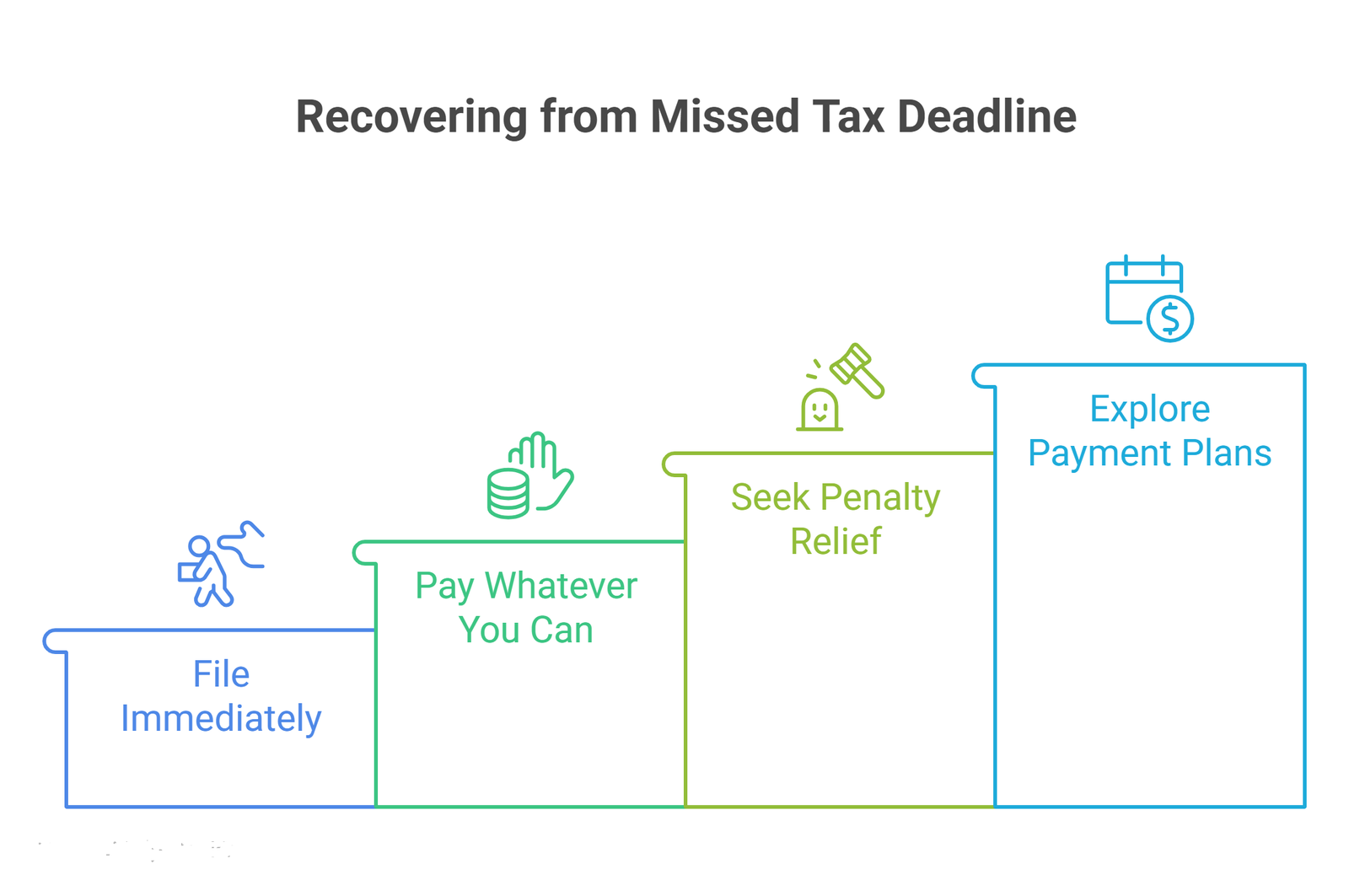
If the date has already passed, looking backward won’t help. Here is your proactive tax compliance strategy to minimize the damage and avoid long-term legal consequences.
1. File Immediately (Don’t Wait for the IRS)
The longer you wait, the more it looks like willful neglect rather than an honest mistake. Use the IRS e-File system to get your documentation in as fast as humanly possible. Even if you missed the window for tax extension options, getting the data in stops the clock on filing penalties.
2. Pay Whatever You Can
Even a partial payment reduces the total unpaid taxes that the Internal Revenue Service uses to calculate interest. Every dollar sent now is a dollar that isn’t gathering interest charges later.
3. Seek Penalty Relief
The government isn’t entirely heartless. If you have a clean history, you can request Penalty Abatement. This is often granted under “First-Time Abate” policies. If you had a legitimate crisis, a natural disaster, a major health issue, or records destroyed, you can claim reasonable cause. To do this officially, you’ll likely use IRS Form 843.
4. Explore Payment Plans
If the tax liability is too high to pay at once, don’t hide. The IRS offers several payment options:
- Installment Agreement: A standard monthly IRS repayment plan.
- Offer in Compromise: If you are facing genuine financial hardship, you can use Form 656 to propose a settlement for less than the full amount.
- Payment Plans: Various short-term and long-term structures are available to help you manage back tax solutions.
Beyond the IRS: State Taxes and Business Risks
When asking what if I miss company tax deadline, remember that the federal government isn’t your only “partner.” State comptrollers are often even more aggressive.
Many states have unique rules, such as accelerated remittance for sales tax or specific adjustments for state furlough days. If you fail to address these, you could face a tax lien, which is a public claim against your business property. This can destroy your ability to get a bank loan or even lease office space.
Furthermore, the Internal Revenue Code contains responsible party laws. This means if you fail to pay payroll taxes (money withheld from employees), the IRS can come after the owners personally through Trust Fund Recovery Penalties. Your corporate veil won’t protect you here.
How to Make This the Last Time You Miss a Deadline
Consistency is the best defense. To avoid ever asking what if I miss company tax deadline again, you need a system that works while you’re busy running the company.
- Synchronize Your Calendars: Put your tax calendar into Google Calendar with 30-day and 7-day warnings.
- Understand Prepayment Requirements: Most businesses must pay estimated tax quarterly. If you wait until the end of the year to think about your tax obligation, you’ve already missed four smaller deadlines.
- Keep an “Amended” Mindset: It is better to file a return you know might need a small adjustment later via Form 1040-X (an amended return) than to not file at all.
- Leverage Modern Tools: The Tax Cuts and Jobs Act and the Inflation Reduction Act changed many deductions. Using modern accounting software ensures you are taking advantage of current laws and staying within United States tax regulations.
Frequently Asked Questions
Can I get an extension after the deadline has passed?
No. You must file for an extension (like Form 4868 or Form 7004) on or before the original due date. However, checking for IRS Disaster Relief might reveal that your specific area was granted an automatic extension due to local emergencies.
What is the “Failure to Pay” penalty rate?
It is generally 0.5% of the unpaid taxes for each month it remains unpaid, up to a maximum of 25%.
How do I handle back tax solutions if I’ve missed several years?
You should look into a Voluntary Disclosure program or an Installment Agreement. The IRS is much more lenient with those who come forward voluntarily than those they have to hunt down.
Do I need a lawyer for an IRS notice?
Not necessarily for a standard late notice. However, if you are facing significant legal consequences or a large tax lien, consulting a professional is highly recommended.
Is it better to put my tax bill on a credit card?
Sometimes. While credit card interest is high, it might be lower than the combined IRS penalties and interest. However, an IRS repayment plan is usually the more professional route for a business.
Conclusion
Missing a deadline is a setback, not a death sentence. The keys to survival are transparency and speed. By addressing your unpaid taxes now and setting up a robust tax compliance strategy for the future, you protect the business you’ve worked so hard to build.
Staying on top of these moving parts, from Forms 1099-NEC to partnership returns, is a full-time job. Many successful business owners find that they eventually outgrow “doing it themselves.”This is where professional oversight makes all the difference. Expert CFO services provide the high-level financial strategy you need to ensure your tax calendar is handled, your cash flow is optimized for tax payments, and you never have to worry about what if I miss company tax deadline again. If you’re ready to move from reactive stress to proactive growth, contact Oak Business Consultant today. Our CFO services are designed to give you back your time while we handle the complexities of the Internal Revenue Service.