The Process of Selling a Business: A Step-by-Step Guide
Selling Your Business: From Valuation to Closing – Everything You Need to Know
Selling a business is one of the most significant financial decisions a business owner will ever make. Whether you are retiring, pivoting to a new venture, or simply capitalizing on years of hard work, understanding the full process of selling a business can mean the difference between a smooth, profitable exit and a costly, stressful ordeal.
This guide walks you through every major stage, from early preparation to closing day, so you can approach the sale of your company with confidence and clarity.
Why the Process of Selling a Business Demands Serious Preparation
Most business owners underestimate how long and complex the sale process actually is. On average, selling a business takes anywhere from six months to two years from the moment you decide to sell to the day funds transfer. Rushing the process almost always leads to a lower sale price, missed deal opportunities, or legal complications after closing.
The earlier you start preparing, the stronger your position at every stage. Buyers, Private Equity Groups, and Investment Groups all conduct extensive research before making an offer. They want a business that is clean, well-documented, and growing. Your job is to make sure that is exactly what they find.
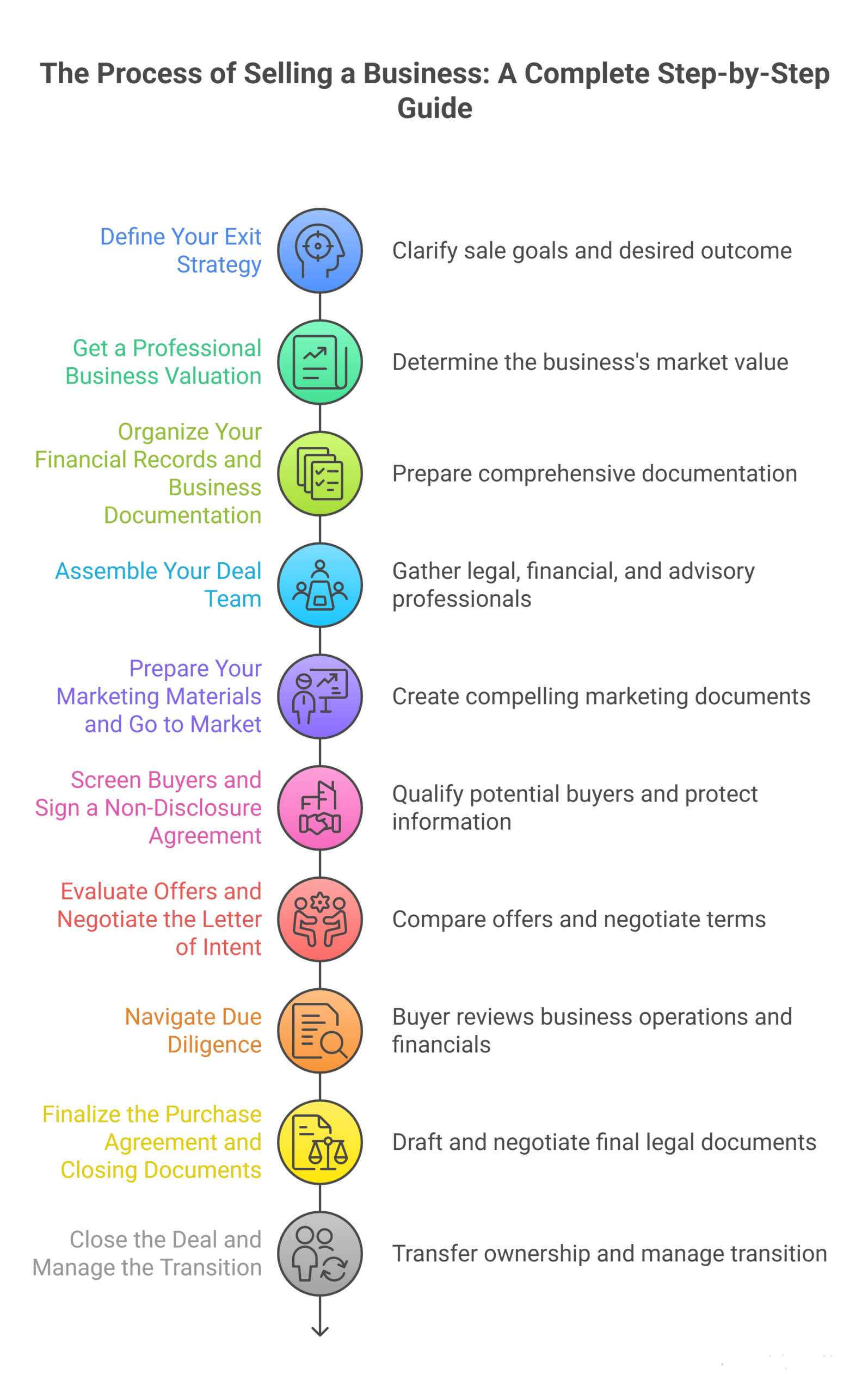
Step 1: Define Your Exit Strategy
Before anything else, a business owner needs to be clear on why they are selling and what a successful outcome looks like. This is where exit strategy planning begins.
Ask yourself:
- What sale price do you need to meet your financial goals?
- Are you open to seller financing arrangements?
- Do you want to stay involved during a transition period, or exit completely?
- Is succession planning an option, perhaps transferring the business to a family member or key employee?
Your answers will shape every decision that follows, from how you value the business to what type of buyer you pursue. Financial advisors and a financial planner can be invaluable at this stage to help you map out the tax implications and post-sale financial picture.
Step 2: Get a Professional Business Valuation
You cannot price what you have not measured. A proper business valuation is the foundation of the entire sale process.
There are several business valuation methods commonly used:
- Income-based methods look at your earnings, cash flow, and profit and loss statements to project future returns for a buyer.
- The market approach compares your business to similar companies that have recently sold, benchmarking your value against real transactions in your industry.
- The assets approach calculates the net value of your tangible and intangible assets minus liabilities, which is especially relevant for asset-heavy businesses including real estate holdings.
A Certified Valuation Analyst or Business Certified Appraiser can prepare a formal valuation report that you can present to buyers with credibility. Some business owners also use a Business Valuation Calculator for a private estimate before engaging a professional. However, a formal report carries far more weight in negotiations.
Your valuation will factor in net working capital, recurring revenue, customer concentration, growth trends, and the overall economic climate at the time of the sale. Market conditions matter significantly. A business sold during a period of strong buyer demand will typically command a much higher multiple. One sold into a weak market will usually achieve a lower multiple.
Step 3: Organize Your Financial Records and Business Documentation
Buyers will scrutinize everything. Before you even approach the market, you need to get your financial records and all pertinent business documentation in order.
This means having at minimum three years of clean, accurate financial statements, including income statements, balance sheets, and cash flow statements. Your profit and loss statements should be professionally prepared or at least reviewed by a CPA.
Beyond financial information, buyers will also want to review:
- Your Employer Identification Number and corporate documents including articles of organization
- Real estate lease agreements and any owned property deeds
- An employee manual and key employment contracts
- Environmental assessments if your business involves physical facilities
- Any existing legal documentation, contracts with suppliers and customers, and pending legal issues
If your business is structured as a corporation, you should also confirm that shareholder approval requirements are understood before entering into any sales agreement.
The goal is to compile what the M&A world calls a Virtual Data Room, a secure digital repository where qualified buyers can review documents during due diligence. An organized, complete Data Room signals to buyers that your business is professionally run and that you are a serious seller.
Step 4: Assemble Your Deal Team
Selling your business is not a solo project. The most successful transactions happen when the business owner has the right professionals working alongside them.
Your deal team should typically include:
- A business broker or M&A advisor who understands your industry, has relationships with qualified buyers, and can manage the sales process from start to finish. For larger transactions, a sell side M&A Advisory firm brings deep expertise in structuring deals, negotiating terms, and navigating the M&A process with institutional buyers.
- Legal counsel who specializes in business transactions. This is not the time to use a generalist attorney. You need legal experts who understand purchase agreements, disclosure schedules, and the specific risks involved in your type of transaction.
- A CPA or financial advisors who can help you understand the tax impact of different deal structures, whether an Asset Purchase Agreement or a stock sale, and ensure your financial statements are presentation-ready.
Some sellers also engage a financial planner early in the process to coordinate how the proceeds from the sale will be invested or deployed post-closing.
Step 5: Prepare Your Marketing Materials and Go to Market
Once your valuation is complete and your documentation is organized, it is time to create the materials that will be presented to potential buyers.
The centerpiece of your marketing effort is the confidential information memorandum, often called a CIM. This is a detailed document that presents your business to prospective buyers in the most compelling way possible. It covers your business history, financial performance, market position, company culture, operational strengths, and growth opportunities.
Your business broker or M&A advisor will also prepare a teaser, a brief anonymous summary used in early outreach before any confidentiality agreement is signed. This teaser becomes part of your broader sales portfolio and marketing documents used to attract the right buyers.
Finding a buyer requires both targeted outreach and broad exposure to the right networks. Your advisor will typically approach strategic buyers in your industry, Private Equity Groups, Investment Groups, and in some cases individual buyers qualified through platforms recognized by the Small Business Administration and business broker networks such as those affiliated with the International Business Broker Association.
Step 6: Screen Buyers and Sign a Non-Disclosure Agreement
Not every interested party is a qualified buyer. Before sharing any sensitive financial information or granting access to your Data Room, every prospect should sign a non-disclosure agreement, also called an NDA or confidentiality agreement.
This legally binding document prevents buyers from sharing your confidential business information with competitors or using it for any purpose other than evaluating the potential acquisition. It is a non-negotiable step in any responsible sale process.
After the NDA is signed, qualified buyers will receive the confidential information memorandum and may request Facility Tours to assess operations in person. Your deal team plays a critical role in managing this process to ensure you continue running your business without unnecessary disruption.
Step 7: Evaluate Offers and Negotiate the Letter of Intent
Serious buyers will submit a Letter of Intent, commonly referred to as an LOI. The Letter of Intent is not a final binding contract, but it outlines the key terms of the proposed deal including the proposed sale price, deal structure, any seller financing arrangements, and the expected timeline.
Receiving multiple Letters of Intent is ideal because it creates competitive tension and gives you leverage in negotiations. Your M&A advisor or business broker will help you compare offers not just on price, but on terms, contingencies, and the buyer’s financing capability.
Key things to evaluate in a Letter of Intent include:
- Whether the deal is structured as an asset purchase or stock purchase
- How much of the purchase price will be paid at closing versus over time through seller financing or an escrow account
- The proposed closing date and transition period requirements
- Any conditions tied to bank debt financing, shareholder approval, or third party consents
Once you have negotiated and signed the Letter of Intent, you move into due diligence.
Step 8: Navigate Due Diligence
Due diligence is the period during which the buyer, their legal counsel, financial advisors, and sometimes specialized consultants conduct a thorough review of your business. This is the most intensive stage of the entire sale process.
Buyers will examine your financial statements, tax returns, contracts, real estate holdings, legal issues, intellectual property, employee agreements, and much more. They are essentially verifying that everything you represented about the business is accurate.
Some sellers choose to conduct Reverse Due Diligence before going to market, proactively identifying and resolving any issues that a buyer might discover. This significantly reduces the risk of a deal falling apart or a price renegotiation late in the process.
Your Virtual Data Room needs to be fully stocked and well-organized before due diligence begins. Buyers who encounter missing documents or inconsistent financial records lose confidence quickly, and that lost confidence directly threatens your sale price and deal terms.
Be prepared to respond to detailed information requests promptly. Delays during due diligence frustrate buyers and can jeopardize the transaction entirely.
Step 9: Finalize the Purchase Agreement and Closing Documents
Once due diligence is complete and both parties are satisfied, your legal counsel will begin drafting the final purchase agreement. Depending on the deal structure, this will be either an Asset Purchase Agreement or a stock purchase agreement, sometimes referred to as an Asset/Stock Purchase Agreement or Agreement of Sale.
The purchase agreement is a comprehensive legal document that covers every detail of the transaction including the final sale price, payment terms, representations and warranties, indemnification clauses, disclosure schedules, non-compete agreements, and the specific conditions that must be met before closing.
Your legal experts will negotiate this document carefully, often going through multiple rounds of revisions. Transaction expenses, including legal fees, advisory fees, and any title insurance costs, are also addressed at this stage.
Other closing documents may include dissolution documents if any entities are being wound down as part of the transaction, and various consents and approvals required from third parties, including in some cases the Secretary of State depending on your state of formation.
Step 10: Close the Deal and Manage the Transition
The closing is the final step in the process of selling a business. At closing, all documents are executed, the purchase price is transferred, often through an escrow account to ensure both parties fulfill their obligations simultaneously, and ownership formally transfers to the buyer.
After closing, many sellers are required to remain involved for a defined transition period to help the buyer understand operations, introduce key customers and vendors, and ensure business continuity. The length and terms of this transition period are negotiated as part of the purchase agreement.
A well-managed transition protects the value you fought hard to preserve throughout the entire sale process and sets the new owner up for success.
Common Mistakes That Derail the Sale Process
Even experienced business owners make avoidable mistakes when selling a business. The most common include:
Waiting too long to prepare. The best time to start preparing for a sale is two to three years before you plan to go to market. This gives you time to clean up financial records, grow revenue, and address any operational weaknesses.
Overpricing or underpricing the business. An accurate business valuation is essential. Pricing too high drives away qualified buyers; pricing too low leaves significant money on the table.
Neglecting confidentiality. Employees, customers, and competitors learning about a potential sale before it is complete can seriously damage your business. A proper confidentiality agreement and controlled information release process are critical.
Failing to assemble the right deal team. Trying to navigate the M&A process alone or with advisors who lack transaction experience leads to costly mistakes in negotiation, structuring, and legal documentation.
Losing focus on running the business. Deals collapse most often when a business’s financial performance deteriorates during the sale process. Keep your business running at full strength until the closing date.
Frequently Asked Questions
How long does the process of selling a business typically take?
Most business sales take between 6 and 24 months from the decision to sell through to closing. Highly complex transactions or businesses in niche markets can take longer. Proper preparation significantly shortens the timeline.
What is the difference between an asset sale and a stock sale?
In an asset sale, the buyer purchases specific assets and liabilities of the business. In a stock sale, the buyer acquires the ownership shares of the company directly. Each structure has different tax implications for both buyer and seller, which is why experienced legal counsel and financial advisors are essential.
What documents do I need to prepare for due diligence?
At minimum, you should have three years of financial statements, tax returns, legal contracts, lease agreements, employee records, corporate documents including your articles of organization, and a detailed operations overview organized in a Data Room before due diligence begins.
How is the sale price determined?
The sale price is based on the business valuation, which uses methods including income-based analysis, the market approach, and the assets approach. Market conditions, growth potential, customer concentration, and the economic climate all play a role in the final number.
What is seller financing?
Seller financing is when the business owner agrees to finance a portion of the purchase price, allowing the buyer to pay over time rather than in a lump sum at closing. It can make deals happen that might not otherwise be financeable through traditional bank debt.
When should I start planning for the sale of my business?
Ideally two to three years before you want to close. Early planning through proper exit strategy development, financial cleanup, and business evaluation gives you the best chance of maximizing your sale price.
Conclusion
Navigating the full process of selling a business requires more than good intentions. It requires clean financials, strategic positioning, and expert guidance at every stage. If you are beginning to think about selling your business and want to ensure your financial records, valuations, and business documentation are positioned for the strongest possible outcome, the CFO services team at Oak Business Consultant can help. From preparing your financial statements to supporting the full sale process, we bring the financial expertise that serious sellers need. Reach out today to start the conversation.