How Might a Company Reduce Its Variable Expenses?
What Strategies Can a Company Use to Lower its Variable Expenses?
Running a business means dealing with two kinds of costs. Some costs stay the same no matter what. Others go up and down with your business activity. The ones that move are called variable costs, and they are often where smart companies find real savings.
If you have ever asked how might a company reduce its variable expenses, you are asking the right question. These costs are flexible by nature. That means they can be managed, negotiated, and optimized in ways that fixed costs often cannot.
This guide walks through practical, proven ways to bring variable expenses down and protect your profit margins.
What Are Variable Expenses?
Variable expenses are costs that change based on how much your business produces or sells. When sales volume goes up, these costs go up. When output slows down, they come down too.
Common examples include:
- Raw materials and direct materials used in production
- Direct labor tied to output
- Shipping costs and packaging
- Sales commissions paid to your team
- Utility expenses that scale with production
- Transaction fees on payment processing
- Cost of goods sold
These are different from fixed expenses like lease and rent payments, property tax, management and administrative salaries, or fixed overhead costs. Fixed costs stay largely the same regardless of how much you produce.
Understanding the difference matters because your approach to reducing each type is completely different.
Why Reducing Variable Costs Matters
Every dollar you cut from your variable costs goes straight to your bottom line. It improves your contribution margin, the amount left from each sale after covering variable costs. A higher contribution margin means you reach your break-even point faster and keep more from every sale.
It also frees up cash flow. Tight cash flow is one of the most common reasons businesses struggle. Reducing variable expenses gives you more liquid funds to reinvest, handle unexpected costs, or weather seasonal fluctuations.
Over time, effective cost reduction also improves your operating leverage. This means your profits grow faster than your revenue as you scale, which is a powerful position to be in.
10 Ways a Company Can Reduce Its Variable Expenses
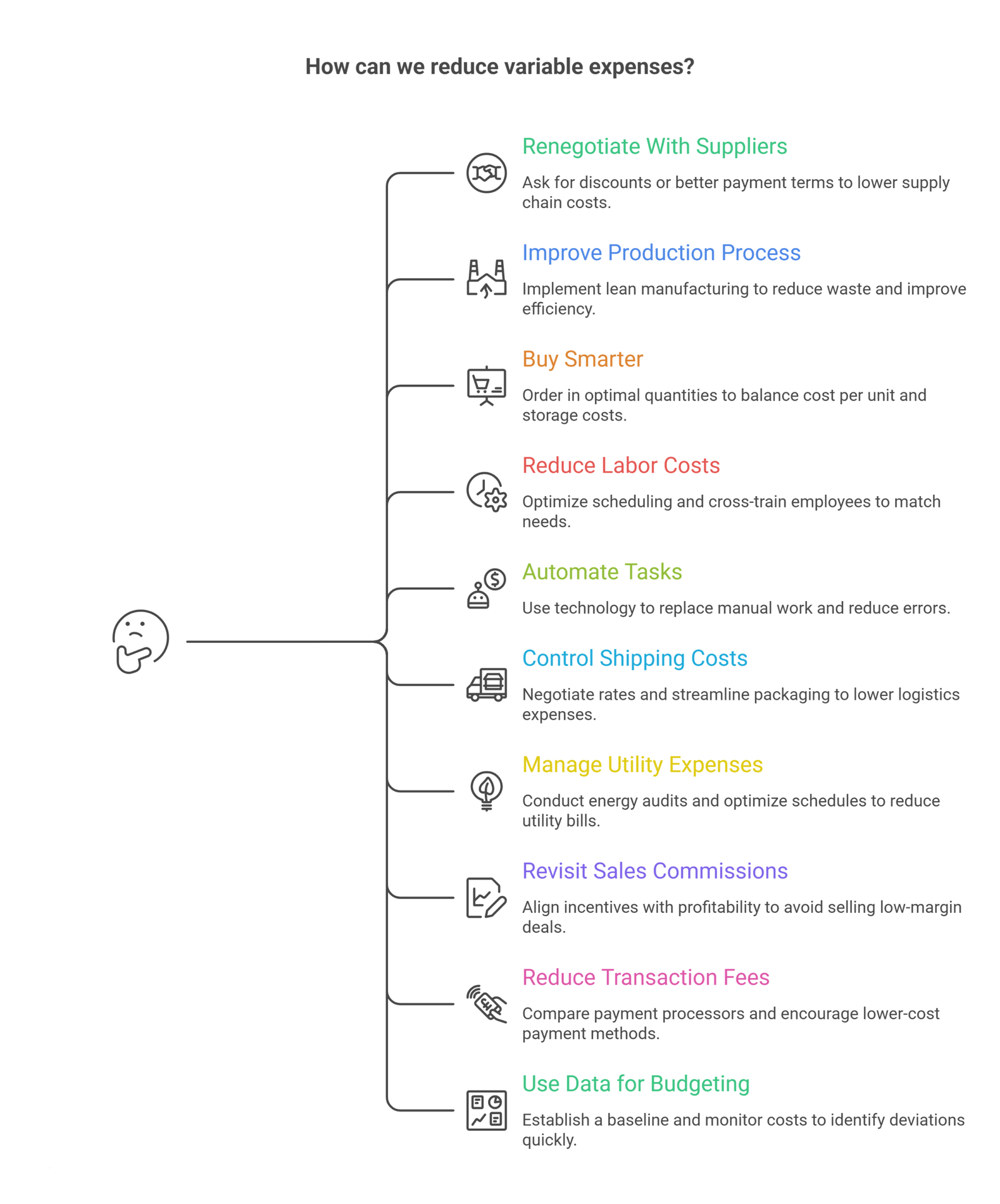
1. Renegotiate With Suppliers
Your supply chain is one of the biggest sources of variable costs. Raw materials, direct materials, and other inputs from supply and service vendors often have more pricing flexibility than you think.
Start by auditing what you currently pay. Then approach your top suppliers and ask for volume discounts, better payment terms, or loyalty pricing. Consolidating purchases with fewer vendors can also give you more leverage.
When supply chain disruptions happen, companies with strong vendor relationships tend to come out ahead. Building those relationships before you need them is smart business.
2. Improve Your Production Process
Waste in the production process drives up production costs without adding value. Every inefficiency in your production output costs you money.
Lean manufacturing principles are designed for exactly this. They focus on reducing waste, shortening lead times, and improving quality at every step. Even small improvements in how you manage your production process can meaningfully reduce your total cost of materials and total cost of labor.
Look at where materials are being wasted, where labor is sitting idle, or where rework is happening. These are your highest-value targets.
3. Buy Smarter and in Better Quantities
Sometimes the issue is not the price per unit but how much you are buying and when. Ordering raw materials in larger quantities can reduce your cost per unit through bulk pricing. But over-ordering ties up cash and increases storage costs.
The goal is to find the right inventory levels for your business. Too little means paying rush premiums. Too much means dead stock and wasted capital.
Review your Average Variable Cost Per Unit across different order sizes. The data usually makes the right choice obvious.
4. Reduce Labor Costs Through Better Scheduling
Direct labor is one of the most significant variable costs for many businesses. But it is also one of the most manageable.
Better scheduling means matching your workforce to your actual production needs. Overstaffing drives up your total cost of labor without increasing output. Understaffing creates bottlenecks and rushed work that leads to errors.
Cross-training employees is another strong move. It gives you more flexibility when demand shifts without having to bring in extra help at a premium.
Also review overtime carefully. Management bonuses and overtime pay can quietly inflate your labor costs in ways that are easy to miss until you look closely.
5. Automate Repetitive Tasks
Technology is one of the most effective tools for reducing variable expenses over the long term. Financial automation software, AP automation tools, and ERP systems can replace manual work that currently costs you labor hours.
An ERP system gives you visibility into your production costs, inventory levels, and operating expenses in real time. That visibility alone helps you spot waste and respond faster.
Automation also reduces errors. Errors in billing, inventory tracking, or financial reporting create costs that are hard to see but very real.
Advanced business technology and technological processes are no longer just for large enterprises. Many solutions are now accessible and affordable for businesses of all sizes.
6. Control Shipping and Fulfillment Costs
Shipping costs are a significant variable expense for product businesses. As sales volume grows, so do these costs, unless you actively manage them.
A few approaches that work well:
- Negotiate volume rates with carriers. If you ship regularly, you likely qualify for better pricing than standard rates.
- Review your packaging. Shipping and packaging can often be streamlined without affecting the customer experience. Lighter or smaller packaging reduces dimensional weight charges.
- Evaluate your cost of distribution. Are you using the most efficient shipping routes and carriers for each region? Small optimizations here compound quickly.
Also consider whether fuel-efficient vehicles or route optimization tools can reduce your logistics spend.
7. Manage Utility Expenses
Utility expenses are semi-variable costs. They have a base component but also scale with activity. This makes them worth targeting.
Energy audits are a practical starting point. They often reveal quick wins like switching to more efficient equipment, adjusting HVAC schedules, or replacing lighting.
For manufacturers, optimizing production schedules to avoid peak energy pricing can reduce utility costs without changing output. Switching to natural gas where applicable may also lower energy costs depending on your location.
These savings are not dramatic individually, but they add up meaningfully over a year.
8. Revisit Sales Commissions and Incentive Structures
Sales commissions are a direct variable expense. They rise with revenue, which is by design. But how you structure them matters.
If your commission structure rewards revenue without considering profitability, your team may be selling deals with thin margins that eat into your gross profit margins. A structure that ties commissions to margin or contribution margin better aligns incentives.
You do not want to eliminate the motivation to sell. You want to align what your sales team chases with what actually benefits the business.
9. Reduce Transaction Fees and Payment Costs
Transaction fees add up, especially for high-volume businesses or e-commerce sites. Every payment processed through a card network or payment platform carries a cost.
Review your current payment processors and compare rates. Negotiating with your processor or switching providers can reduce these fees. Virtual payment cards and spend management platforms also offer better visibility and control over spending.
Some businesses also benefit from encouraging customers to pay via lower-cost methods like ACH transfers, which typically carry much lower fees than credit cards.
10. Use Data to Drive Your Budgeting Process
Many companies have variable expense problems because they are not measuring them well. Without visibility, you cannot manage what is going wrong.
A strong budgeting process gives you a baseline. You know what your variable costs should be at different levels of business activity. When costs deviate from that baseline, you can spot it quickly and act.
A spend management dashboard or financial management programs can make this much easier. They centralize data, surface anomalies, and give your team the information they need to make better decisions.
Tying your budgeting strategy to real data also helps you with break-even volume analysis. You can model the impact of cost changes on your break-even point and make more confident decisions.
The Connection Between Variable and Fixed Costs
Reducing variable expenses is important, but it should always be viewed alongside your fixed expenses and overhead costs. The relationship between the two determines your overall cost structure.
A business with high fixed overhead costs and low variable costs has high operating leverage. Profits scale well when revenue grows, but the risk is higher if revenue drops.
A business with low fixed expenses but high variable costs is more flexible but may struggle to scale profitably.
Understanding where you sit on this spectrum helps you set the right cost reduction priorities. It also helps you understand your marginal cost at different output levels and price your products or services correctly.
Tracking Progress With the Right Metrics
As you work to reduce variable expenses, track these core metrics:
Contribution margin shows how much each unit of sale contributes to covering fixed costs and generating profit.
Break-even point tells you how much you need to sell to cover all costs. Reducing variable costs lowers this number.
Gross profit margins reflect the efficiency of your core operations. Improving this number is a direct result of managing production costs and cost of goods sold well.
Cash flow gives you the operational picture. Lower variable costs mean more cash staying in the business.
Sales revenue versus total cost trends over time reveal whether your cost reduction efforts are working or not.
Return on equity improves when you generate more profit from the same asset base. Reducing variable expenses is one of the most direct ways to move this number.
Common Mistakes to Avoid
Cutting costs in ways that hurt quality. Reducing variable costs should never come at the expense of the product or customer service experience. Short-term savings that damage your reputation cost far more in the long run.
Ignoring the human side. Labor cost reductions need to be handled thoughtfully. The goal is efficiency, not simply cutting people. Poorly executed cuts damage morale and productivity.
Failing to reinvest savings. Cost reduction that frees up cash should be directed somewhere useful, whether that is growth, debt reduction, or building reserves.
Making cuts without a plan. Random cost-cutting is less effective than a structured approach. Start with your highest variable expense categories and work systematically.
Frequently Asked Questions
What is the difference between variable costs and fixed costs?
Variable costs change with your level of production or sales. Fixed costs stay the same regardless of output. Examples of fixed costs include lease and rent payments and property taxes. Examples of variable costs include raw materials and sales commissions.
How do variable expenses affect profit margins?
When variable expenses decrease, more revenue flows through to profit. This improves your gross profit margins and contribution margin. It also lowers your break-even point, which gives your business more stability.
Can a company convert variable costs to fixed costs?
Yes, and this is sometimes a smart strategy. For example, switching from per-unit outsourcing to an in-house team converts variable labor costs to fixed costs. This can improve margins at higher volumes but increases risk if sales volume drops.
What are semi-variable costs?
Semi-variable costs have both a fixed and a variable component. Utility expenses are a good example. There is a base charge each month, plus a variable component based on consumption. Direct labor can also behave this way when there is a base salaried workforce plus hourly or contract staff that scales with demand.
How often should a company review its variable expenses?
Quarterly reviews are a good baseline for most businesses. High-growth or high-volume businesses may benefit from monthly reviews. The budgeting process should always include a review of variable cost trends against actual business activity.
How do shipping costs fit into variable expense management?
Shipping costs are a significant variable expense for product-based businesses. They can be reduced through carrier negotiations, packaging optimization, and better logistics planning. As sales volume increases, leveraging that volume for better rates becomes increasingly important.
Conclusion
Managing variable expenses well is one of the most impactful things a business can do to strengthen its financial position. It improves profitability, stabilizes cash flow, and gives you more room to grow.
But knowing the strategies is one thing. Implementing them consistently and measuring their impact is another.
If your business needs expert support building and executing a cost reduction strategy, Oak Business Consultant’s CFO services can help. Our team works alongside business owners and finance leaders to identify where variable costs are running too high, build better financial processes, and put the right metrics in place to drive lasting improvement.
Reach out to us to learn how our CFO services can help your business control costs and grow with confidence.