Forecasting in Accounting: The Complete Business Guide
Forecasting in Accounting: Techniques Every Business Needs
Every business makes decisions about the future. Some guess. Others plan. The difference between the two often comes down to forecasting in accounting.
When done right, financial forecasting gives you a clear picture of where your business is headed. It turns raw numbers into a roadmap. It helps your management team make smarter calls, protect cash flow, and build a stronger business plan.
This guide covers everything you need to know: what forecasting in accounting actually means, the forecasting methods available, how to use pro forma financial statements, and how modern tools like AI algorithms are changing the game.
What Is Forecasting in Accounting?
Forecasting in accounting is the process of using historical financial data and current market conditions to estimate future financial results. It gives your business a forward-looking view of its income statement, balance sheet, and cash flow statement.
Think of it as a financial compass. It does not guarantee exact outcomes. But it narrows down the uncertainty. It helps you prepare for what is likely, not just hope for the best.
Good forecasting in accounting pulls together your financial accounting records, current market research, and knowledge of your own operations. The result is a set of projections that your team can actually use.
Why Financial Forecasting Matters
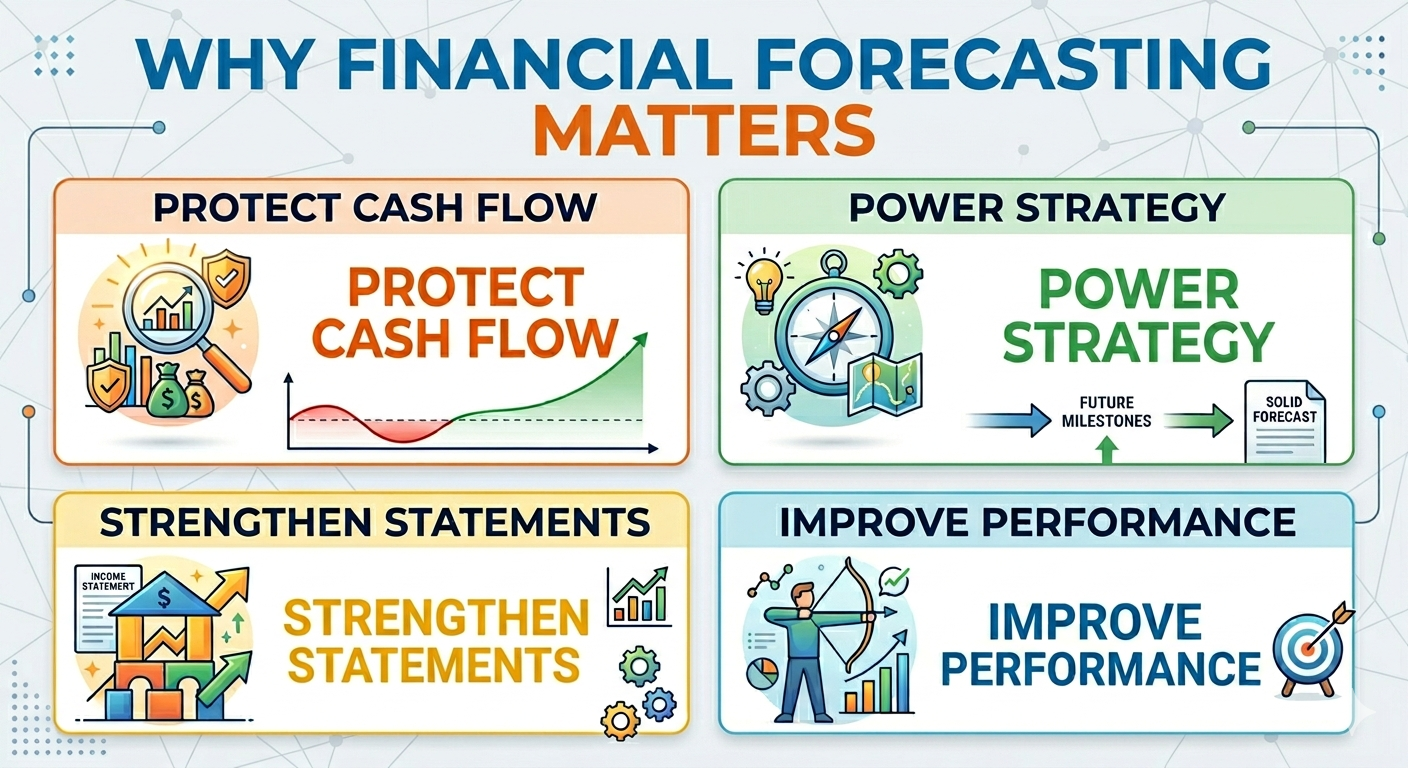
Businesses that skip financial forecasting tend to react. Businesses that invest in it tend to lead. Here is what strong financial forecasting actually does for you.
It Protects Your Cash Flow
Cash flow problems are one of the top reasons businesses fail. Even profitable companies can run out of cash if they do not see problems coming. Financial forecasting lets you spot cash shortfalls weeks or months before they happen, giving you time to act.
Whether it is a slow season, a delayed invoice, or a large expense coming up, your cash flow statement projections will show the gap before it becomes a crisis.
It Powers Strategic Planning
Strategic planning without numbers is just wishful thinking. Financial forecasting connects your strategy to reality. Want to hire more people? Open a new location? Launch a product? Your financial projection will show whether your numbers can support that move.
This is especially critical when working with investors or lenders. They want to see a business plan backed by solid forecasting, not just ideas.
It Strengthens Your Income Statement and Balance Sheet
Forecasting helps you project what your income statement and balance sheet will look like over the coming months or years. This kind of visibility is essential for financial health. It helps you manage debt, plan capital spending, and track whether you are growing or just staying afloat.
It Improves Business Performance
When your team knows the targets, they can work toward them. Forecasting creates accountability. It benchmarks business performance against realistic expectations. If results deviate from forecasts, that is valuable information that helps you adjust quickly.
Types of Forecasting Methods
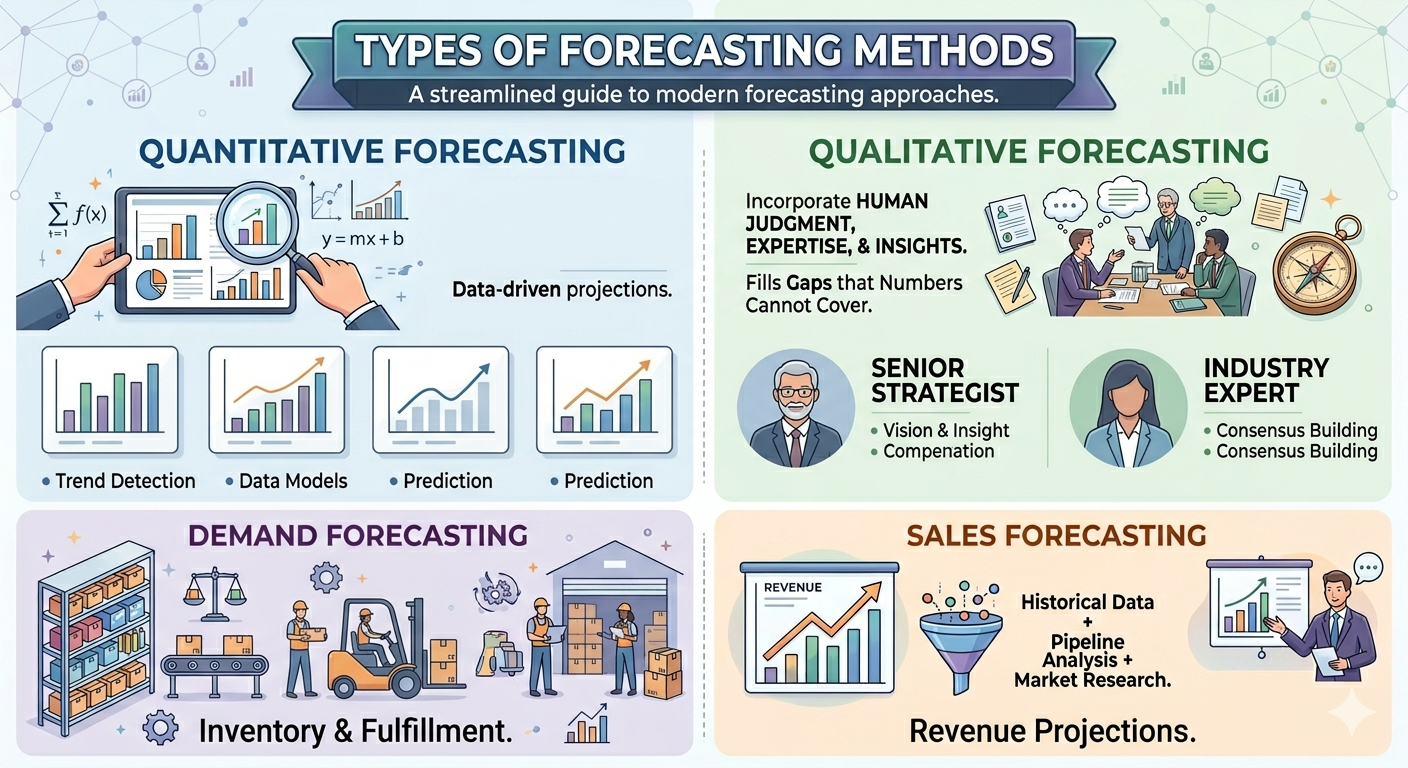
There is no single way to forecast. Different businesses, different industries, and different questions call for different forecasting methods. Here is a breakdown of the main approaches.
Quantitative Forecasting
Quantitative forecasting relies on numbers. It uses historical data and statistical models to produce quantitative forecasts. If you have solid financial data going back a few years, quantitative forecasting can give you highly reliable projections.
The most common quantitative forecasting techniques include:
- Moving average smooths out short-term fluctuations by averaging data over a set period. A 3-month moving average adds the last three months of revenue and divides by three. It is simple, easy to apply in Microsoft Excel or Google Sheets, and useful for spotting trends.
- Linear regression finds the statistical relationship between two variables, such as time and revenue. Linear regression is powerful for identifying whether a trend is consistent and projecting it forward. It handles more complexity than a basic moving average.
- Exponential smoothing is similar to moving average but gives more weight to recent data. This makes it more responsive to shifts in business conditions.
- Time series analysis looks at your data over time to identify patterns, seasonality, and cycles. It is great for businesses with predictable demand shifts, like a spike during the holiday season.
- Quantitative forecasting works best when you have clean, consistent historical data. Data accuracy is everything here. Garbage in, garbage out.
Qualitative Forecasting
Not every important factor shows up in a spreadsheet. Qualitative forecasting brings in human judgment, expertise, and qualitative insights to fill the gaps that numbers cannot cover.
Qualitative forecasting methods include:
Expert opinion means asking experienced people in your industry or management team what they expect. A seasoned accounting professional often spots trends that raw data misses.
The Delphi method gathers insights from multiple experts independently, then shares and refines until a consensus forms. This is common in industries with high uncertainty.
Market research uses surveys, interviews, and focus groups to understand what customers are likely to do. Market research is especially valuable when entering a new market or launching a new product.
Scenario analysis builds multiple versions of the future. What happens in the best case? Worst case? Most likely case? Scenario analysis helps your business prepare for a range of outcomes.
Qualitative forecasting is often combined with quantitative methods. The two complement each other well.
Demand Forecasting
Demand forecasting is a specific type of financial forecasting focused on predicting future customer demand. It is especially important in retail, manufacturing, and supply chains.
Accurate demand forecasting models help you manage inventory management, plan production forecasts, optimize staffing, and improve customer satisfaction. Overestimate demand and you tie up cash in excess stock. Underestimate it and you miss sales.
During uncertain periods marked by economic volatility, demand forecasting models need to be updated more frequently. Past patterns may not hold when market conditions shift.
Sales Forecasting
Sales forecasts project how much revenue your business will bring in over a set period. They feed directly into your income statement projections and drive nearly every financial decision downstream.
Strong sales forecasts combine historical sales data, pipeline analysis, market research, and input from your sales team. They should be revisited regularly, not just once a year.
Pro Forma Financial Statements: The Output of Forecasting
The main deliverable from financial forecasting is a set of pro forma financial statements. These are forward-looking versions of your three core financial reports.
Pro Forma Income Statement
The pro forma income statement projects your revenue, expenses, and profit over the forecast period. It shows whether your business is on track to hit profitability targets and where cost pressure may be building.
Pro forma statements like this are essential for business plan presentations and investor conversations. They show that your numbers are grounded in realistic assumptions, not optimism.
Pro Forma Balance Sheet
The pro forma balance sheet projects what your assets, liabilities, and equity will look like at a future date. It is critical for understanding your long-term financial health and whether your capital structure can support your growth plans.
Lenders and investors pay close attention to the balance sheet. It tells them whether you are building equity or just spinning your wheels.
Pro Forma Cash Flow Statement
The pro forma cash flow statement is often the most important of the three. It shows the actual movement of cash in and out of your business. Unlike the income statement, it captures the timing of payments, which is where most cash flow crises begin.
Pro forma financial statements work together as a system. Changes in one statement ripple through the others. That interconnectedness is what makes financial forecasting powerful.
Common Challenges in Forecasting in Accounting
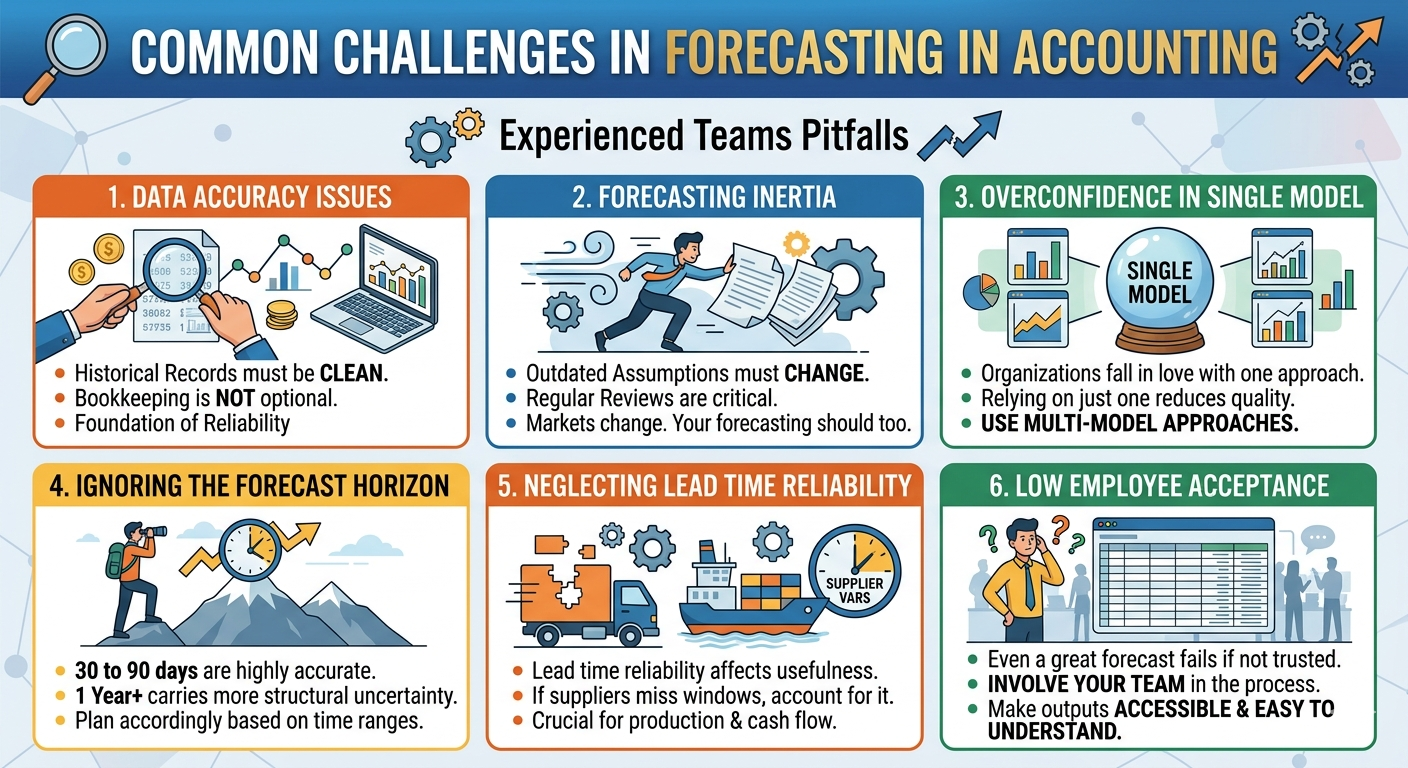
Even experienced teams run into problems with forecasting. Knowing the pitfalls helps you avoid them.
Data Accuracy Issues
Data accuracy is the foundation of every reliable forecast. If your historical records are inconsistent, incomplete, or improperly categorized, your projections will be off. Investing in solid accounting information systems and clean bookkeeping is not optional. It is the price of good forecasting.
Forecasting Inertia
Forecasting inertia happens when teams keep using outdated assumptions because it is easier than updating them. Markets change. Your forecasting should change with them. Build a process for regular reviews, especially when market conditions shift.
Overconfidence in a Single Model
No single prediction model is perfect. The model selection pitfall is real: organizations fall in love with one approach and stop questioning it. Multimodel approaches, where you run several forecasting methods and compare results, tend to produce better forecast quality than relying on just one.
Ignoring the Forecast Horizon
The forecast horizon matters. Short-term forecasts of 30 to 90 days can be highly accurate. Long-term forecasts covering a year or more carry more structural uncertainty. Be honest about confidence levels at different time ranges and plan accordingly.
Neglecting Lead Time Reliability
In businesses that deal with suppliers or inventory, lead time reliability affects how useful your forecasts are. If suppliers frequently miss delivery windows, your production forecasts and cash flow models need to account for that variability.
Low Employee Acceptance
Even a great forecast fails if the people who need to use it do not trust it. Employee acceptance matters. Involve your team in the forecasting process. Explain the assumptions. Make the outputs accessible and easy to understand. A forecast that sits in a spreadsheet nobody looks at adds no value.
Technology and the Future of Financial Forecasting
The tools available for financial forecasting have changed dramatically. Here is how technology is reshaping the forecasting function.
AI Algorithms and Machine Learning
AI algorithms and machine learning are now being applied to financial forecasting in ways that were not practical even five years ago. Tech giants in the financial software space have built tools that can process enormous datasets, identify patterns humans would miss, and generate more accurate quantitative forecasts automatically.
Artificial intelligence does not replace human judgment. But it significantly improves data accuracy, reduces manual work, and allows your forecasting function to run with near real-time updates. This is especially valuable for large businesses with complex operations.
Accounting Information Systems
Modern accounting information systems connect your financial accounting data directly to your forecasting tools. Instead of manually pulling numbers from different sources, your forecast updates as new data comes in. This reduces errors and keeps your projections current.
Cloud Tools and Accessibility
Most businesses today can run solid financial forecasting from tools like Microsoft Excel and Google Sheets. For more advanced needs, cloud-based platforms offer features like scenario modeling, real-time updates, and multi-user collaboration. The gap between enterprise forecasting and small business forecasting has narrowed considerably.
Building a Forecasting Process That Works
A strong forecasting process is not a one-time project. It is an ongoing discipline. Here is how to build one.
Start With Clean Data
Before you forecast anything, make sure your financial accounting records are accurate and up to date. Data accuracy is non-negotiable. Work with an accounting professional if needed to get your books in order.
Choose the Right Forecasting Methods
Match your forecasting methods to your business model. A product-based business with seasonal demand needs demand forecasting models and moving average techniques. A service business might rely more on sales forecasts and qualitative forecasting from client pipeline data.
Build Your Pro Forma Statements
Once you have your inputs, build out your pro forma financial statements: income statement, balance sheet, and cash flow statement. These should be connected so that a change in one flows through the others automatically.
Review and Update Regularly
Set a schedule. Monthly reviews are ideal for most businesses. Quarterly at minimum. Compare your financial results against your forecasts. Understand the gaps. Use those gaps to improve your forecasting function over time.
Involve the Right People
Good forecasting is a team sport. Your management team, finance function, and operational leads all have information that improves forecast quality. Create a process where input flows in from multiple sources and employee acceptance is built from the start.
Forecasting Across Different Industries
Forecasting in accounting looks different depending on your industry. A few accounting use cases that highlight this:
Retail and e-commerce relies heavily on demand forecasting and inventory management. Holiday season sales forecasts can make or break annual financial results.
Manufacturing uses production forecasts to drive capacity planning, supply chain decisions, and working capital needs. Operational constraints and lead time reliability are key inputs.
Professional services businesses rely on sales forecasts and utilization rates to drive revenue projections. Qualitative insights from client relationships often matter as much as historical data.
Startups and growth companies need detailed financial projections for fundraising. Investors expect pro forma statements that reflect realistic assumptions about growth and market conditions.
Non-profits and public sector organizations use financial forecasting to feed directly into strategic planning, grant applications, and budgeting processes. The stakes of poor forecasting are high here too.
No matter the industry, the fundamentals are the same: use good data, apply the right forecasting methods, and review your financial results against your forecasts regularly.
Frequently Asked Questions
What is the difference between forecasting and budgeting?
Budgeting sets a target. Forecasting predicts what will actually happen. A budget is your plan. A forecast is your best estimate of reality, which may be different from the plan. Good businesses use both together.
How often should we update our financial forecasts?
Most businesses benefit from monthly updates to their short-term forecasts, with quarterly reviews of longer-range projections. The right frequency depends on how fast your market conditions change and how much economic volatility your business faces.
What are pro forma financial statements?
Pro forma financial statements are projected versions of your income statement, balance sheet, and cash flow statement. They show what your financial results are expected to look like in the future, based on your assumptions and historical trends.
Is qualitative forecasting reliable?
Qualitative forecasting is valuable when historical data is limited or when you are dealing with new products, new markets, or significant uncertainty. It is most reliable when it draws on experienced experts and structured processes like the Delphi method. Combining qualitative forecasting with quantitative methods improves forecast quality.
What tools are best for forecasting in accounting?
It depends on your size and complexity. Many small to mid-sized businesses can do effective forecasting in Microsoft Excel or Google Sheets. Larger businesses often use dedicated financial planning software that connects to their accounting information systems for real-time updates. AI algorithms are increasingly being embedded in these platforms.
What causes poor forecast quality?
The most common causes are data accuracy problems, forecasting inertia, model selection pitfalls, and low employee acceptance of the forecasting process. Fixing these requires both better tools and better habits.
Conclusion
Forecasting in accounting is one of the highest-value activities any business can invest in. It transforms your financial data into forward-looking intelligence that drives better decisions, stronger performance, and real confidence in your numbers.
But doing it well takes expertise, the right processes, and the right tools. If your business is ready to build a forecasting function that actually drives results, the team at oakbusinessconsultant.com can help. Our CFO services are designed to bring institutional-level financial forecasting to growing businesses: from pro forma financial statements and cash flow modeling to strategic planning support and financial analysis your team can act on.
Contact us today to learn how our CFO services can strengthen your financial forecasting, sharpen your business plan, and set your business up to grow with confidence.