Real Estate Financial Model Case Study: From Risk to Return
Client Overview
A U.S.-based real estate leasing and investment firm approached us to assess the viability of its leasing model. The firm operated in U.S. dollars but held loans in multiple foreign currencies, creating cash flow challenges. Our team developed a dynamic real estate financial model to analyze revenue projections, optimize loan structures, and improve profitability. Our solution enabled the client to evaluate different leasing strategies and make data-driven financial decisions.
Challenges Faced by the Client in Real Estate Financial Planning
The U.S.-based real estate leasing and investment firm came to us facing several structural and operational inefficiencies that were hindering the scalability and profitability of their business. These issues were rooted in an outdated real estate financial model, fragmented capital structure, lack of scenario planning, and the absence of advanced forecasting and valuation tools. Our analysis revealed the following critical challenges:
1. Currency Mismatch in Real Estate Debt Financing
The client’s portfolio was funded through a multi-currency loan structure—borrowing in Botswana Pula, U.S. Dollars, and Euros—while all incoming rents and lease-related revenues were strictly USD-denominated. This mismatch introduced substantial foreign exchange risk, impairing both cash flow projections and debt service stability. The client lacked any form of foreign currency swap model or hedging strategy, putting them at risk of unpredictable outflows and long-term capital inefficiency in real estate investments.
2. Unprofitable Leasing Operations and Weak ROI
Despite having an active portfolio of commercial property types including office, multifamily, and retail assets, the leasing operations were not yielding profits. The company had no mechanism to determine its break-even point, no visibility on IRR hurdles, and no insight into unlevered cash flow performance. Without a viable roadmap for net income, operating margins, or real estate pro formas, they could not optimize rental yields or evaluate potential investment outcomes.
3. Absence of a Dynamic Real Estate Financial Model
The client lacked a flexible, Excel-based real estate financial modeling tool capable of performing stress testing or adjusting assumptions. There was no infrastructure for modifying lease durations, escalation clauses, construction costs, capital improvements, or debt terms. The absence of model templates that integrate various investment types left the firm unable to perform scenario analysis or accommodate different commercial property types and financing options.
4. Inefficient Loan Structuring and Capital Allocation
The firm had no formal capital structure model in place. Their loan portfolio lacked optimized debt allocation and failed to analyze debt-to-equity ratios, capitalized interest, or cost of capital across different asset classes. Without a tailored Waterfall model, they couldn’t measure partnership-level cash flows or evaluate outcomes under various financing terms, such as construction loan vs. permanent loan structures. This limited their ability to understand the impact of acquisition equity or leverage scenarios.
5. Incomplete Revenue Modeling and Expense Attribution
The client’s income streams—comprising lease initiation fees, fund management charges, and administration fees—were not backed by a granular revenue build methodology. There was no clarity on variable vs. fixed operating expenses, especially with respect to non-operating cash flows like interest payments and consultant salaries. The absence of a fully segmented real estate model made it difficult to forecast monthly cash inflows or align expenses with asset performance.
6. No Long-Term Cash Flow Projections or Liquidity Strategy
The client did not possess a 5-year cash flow projection model to assess funding requirements, liquidity reserves, or timing mismatches. Without proper forecasting of operating activities, capital expenditures, or debt repayments, they were blind to potential liquidity crunches. A complete cash flow statement aligned with working capital needs and timeline trackers was essential to ensure operational continuity.
7. Absence of Business Valuation and Investor Readiness
The firm lacked a cohesive valuation model to calculate Net Present Value (NPV), Internal Rate of Return (IRR), or Weighted Average Cost of Capital (WACC). These metrics are essential for preparing business plans, securing funding, and attracting real estate investors or potential investors. Without these, the company could not demonstrate long-term viability or engage in joint ventures or institutional firm collaborations.
8. Lack of Automated KPI Monitoring and Financial Diagnostics
There were no built-in dashboards or diagnostic tools to track real-time Key Performance Indicators (KPIs) such as EBITDA, interest coverage ratio, ROI, or profitability by asset class. Without such systems, internal decision-making was delayed, and financial reporting lacked consistency. Our solution needed to include an advanced dashboard that could dynamically present real estate interview modeling data, operational metrics, and financing scenarios.
9. No Strategic, Regulatory, or Environmental Analysis
Operating within a highly regulated and policy-sensitive environment, the client lacked any strategic framework to assess economic, legal, or environmental risks tied to their portfolio. No PESTEL analysis had been conducted, nor was there a mechanism for updating assumptions as capital markets, construction regulations, or taxation policies evolved. This severely limited their ability to adapt to macroeconomic shifts and make informed strategic real estate investment decisions.
Features of the Provided Real Estate Financial Model

Assumptions and Capital Structure Planning
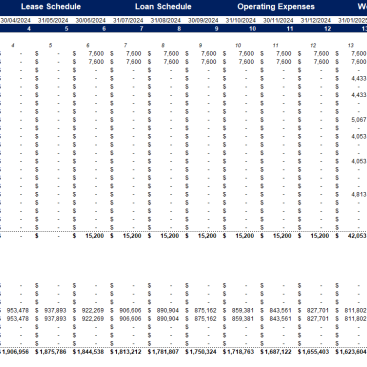
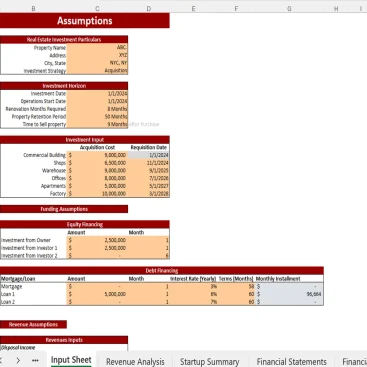
We began by developing a comprehensive assumptions sheet, which accounted for multi-currency borrowings and variable interest rate projections. The client’s loan exposure spanned USD, GBP, and Botswana Pula, requiring a sophisticated foreign currency swap model and enhanced understanding of leverage. The model included fully integrated construction loan and permanent loan modules, supporting the evaluation of different investment types, capital sources, and risk profiles.
Operating Expenses and Capital Improvements
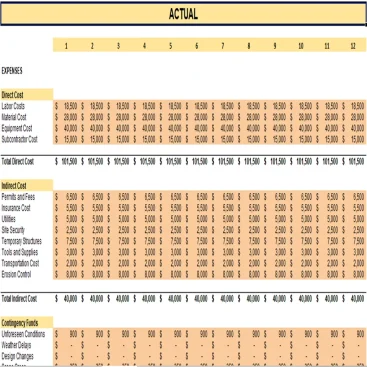
We structured detailed operating expense projections derived from historical profit and loss data. Fixed expenses—including salaries and consulting fees—were modeled with inflation-linked growth. Variable non-operating cash flows and anticipated capital improvements were factored in for long-term asset maintenance and development scenarios. This ensured that the client could properly evaluate their cash flow projections and working capital cycles over a 60-month forecast.
Lease Revenue Modeling and Property Types
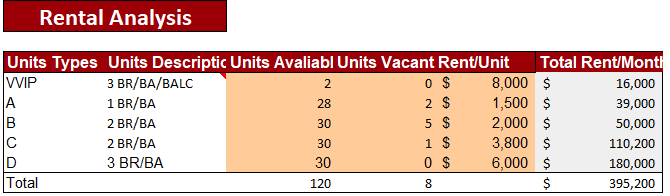
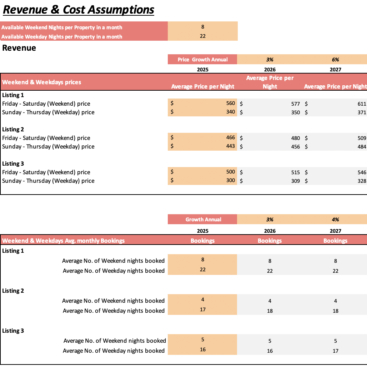
The real estate model captured all relevant revenue streams: fund management, lease initiation, and monthly administration fees. These were mapped to expected incoming rents based on targeted leasing across different property types. The model provided high-resolution forecasting for various scenarios using well-formatted and extensive models. Our approach allowed for dynamic inputs to reflect lease turnover, rent escalations, and partnership-level cash flows.
Financial Projections and Pro Forma Statements
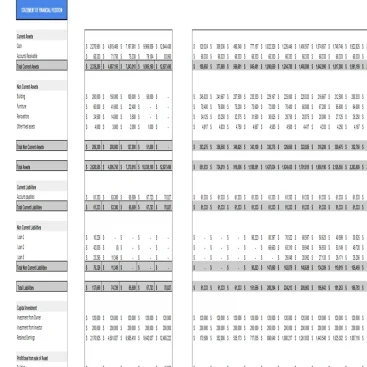
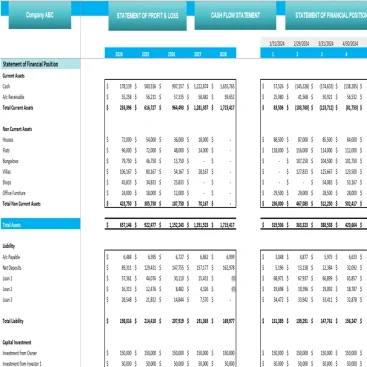
We created monthly and annual real estate pro formas, including pro forma income statements, cash flow projections, and balance sheets. These forward-looking statements included both unlevered cash flow and levered cash flows to accommodate IRR calculations, NPV analysis, and debt coverage evaluations. This gave both the real estate investor and potential lender a clear view of debt service capacity and potential investment returns.
Break-Even and Cash Flow Waterfall Model
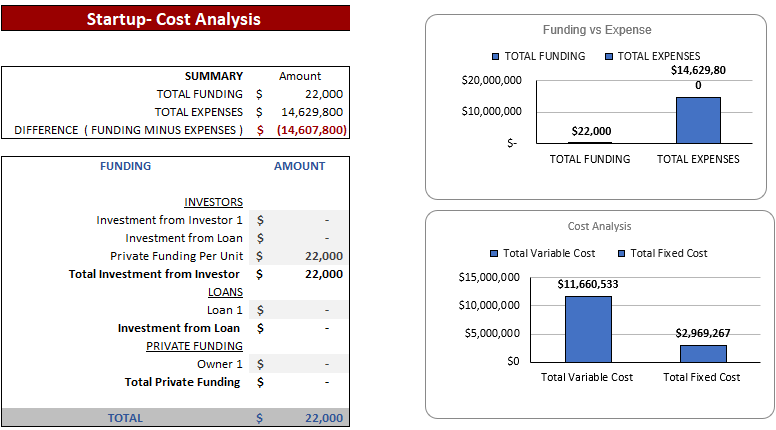
Our team built a granular Waterfall model to simulate IRR hurdles, cash flow splits, and capitalized interest across multiple financing structures. These tools were aligned with venture & waterfall key terms and covered both model layout and model flow dynamics. In parallel, we developed a detailed break-even analysis based on fixed and variable costs, enabling the client to pinpoint when operations would become profitable under varying lease-up rates.
Business Valuation and Investor Metrics
Utilizing discounted cash flow (DCF) methodology, we estimated enterprise value, WACC, and investor returns. Both equity and debt holders were modeled using realistic return thresholds, supporting acquisition decisions and personal investment strategy evaluation. The model’s outputs also supported investor pitches and business plans to attract potential equity partners and financiers.
Diagnostic Tools and Financial Ratio Analysis
We incorporated a built-in diagnostic sheet for calculating key ratios, including liquidity, solvency, and operational performance—benchmarked against institutional firm standards. Our tools helped analyze expenses (with tags compatible with Argus outputs) and aligned with industry-standard templates.
Dashboard and Timeline Tracking
All KPIs were summarized in a dynamic dashboard that included visualized forecasts, profitability timelines, lease performance, and funding needs. A dedicated timeline tracker allowed for project phase planning and investment monitoring. The dashboard helped management and investors review investment cycles, lease expiration schedules, and joint venture structuring with clarity.
Outcome
The client now operates with a comprehensive financial system that supports both short-term operations and long-term planning. It includes detailed monthly and annual cash flow projections, integrated valuation models like NPV, IRR, and WACC, and dynamic KPI dashboards.
They gained full visibility into unlevered cash flow, capital improvements, and partnership-level cash flows. This allowed them to engage more effectively with potential investors, restructure their construction loan and permanent loan facilities, and improve liquidity forecasting.
With this enhanced real estate financial modeling framework, the client transitioned from operational uncertainty to data-driven confidence. They are now better positioned to scale across multiple commercial property types with stronger profitability and reduced financial risk.
What’s In It for You?
Whether you’re a real estate developer, investor, or asset manager, navigating complex capital structures, foreign currency exposures, and varied property types demands more than just spreadsheets—it requires strategic financial clarity. Without a robust real estate financial model, you may be exposed to:
- Cash Flow Volatility due to mismatched currency inflows and outflows.
- Inaccurate Forecasting across different asset classes, lease terms, and financing structures.
- Poor Capital Allocation stemming from unclear debt-equity ratios and investment thresholds.
- Limited Investor Appeal without transparent IRR, NPV, or Waterfall distribution metrics.
- Operational Blind Spots from missing KPI dashboards, break-even analysis, and long-term liquidity projections.
At Oak Business Consultant, we deliver dynamic, Excel-based real estate models tailored to your specific leasing strategy, loan profile, and investment objectives. Our models help you:
- Structure Debt Effectively and mitigate FX risk across multi-currency portfolios.
- Model Leasing Scenarios and optimize property-level cash flows.
- Forecast Accurately with monthly and annual financial statements and performance metrics.
- Support Capital Raising with investor-ready insights on returns, break-even, and cash flow waterfalls.
- Drive Strategic Growth through scenario analysis, timeline tracking, and partnership-level visibility.
Ready to future-proof your real estate investments?
Contact us to build a real estate financial model that brings precision to your planning, confidence to your decision-making, and clarity to your investor presentations.
Frequently Asked Questions
What is a real estate financial model?
A real estate financial model is a structured spreadsheet, typically in Excel, used to project financial performance of a real estate asset or portfolio. It includes revenue assumptions, operating expenses, capital improvements, loan structuring, and return metrics like IRR and NPV.
Why is real estate financial modeling important?
It enables real estate investors and developers to assess feasibility, manage risk, evaluate cash flow projections, and support decision-making for acquisitions, leasing, development, or refinancing strategies.
Can the model handle different property types?
Yes, our real estate financial models are designed to accommodate commercial property types such as multifamily, office, and retail. Each asset class has unique revenue and cost drivers, which our models incorporate.
What is the purpose of a Waterfall model in real estate?
The Waterfall model distributes profits among stakeholders based on IRR hurdles and preferred return tiers. It’s vital for structuring joint ventures and aligning equity incentives between sponsors and investors.
How do you manage construction costs and loans in your models?
Our models track construction costs and incorporate both construction loan and permanent loan structures. Capitalized interest, draw schedules, and cost-to-complete monitoring are included to ensure full project visibility.
Conclusion
We delivered a robust, dynamic real estate financial model tailored to the client’s strategic and operational needs. The solution resolved key inefficiencies in their leasing and investment framework by integrating detailed cash flow projections, construction costs, waterfall structures, and real estate pro formas. Designed for flexibility and forward-looking planning, the model empowered the client with clearer visibility into capital structure, revenue forecasts, and investment decisions. Looking to elevate your real estate financial planning? Contact us today to build a customized, investor-ready financial model.