The Business Plan Sections Investors Actually Scrutinize
Business Plan Sections That Earn Investor Trust
Most business plan guides treat every section as equally important. They aren’t. An investor skims your company description in seconds. They read your financial plan line by line. Knowing which sections get scrutinized, and which just need to exist, changes how you should spend your time writing this document.
A business plan has two jobs. It forces you to think through your business before you spend money on it. It also convinces someone else, a bank, an investor, a co-founder, that the thinking holds up. Most founders write for the first job and forget the second one entirely.
Traditional plan or lean plan: pick one first
Before you write a single section, decide which format you actually need. A traditional plan runs 20 to 40 pages. It includes full market research, detailed financials, and multi-year forecasts. A lean plan is one to two pages. It captures your core assumptions and revenue model at a glance.
| Traditional plan | Lean plan | |
| Length | 20-40+ pages | 1-2 pages |
| Best for | Bank loans, investor funding, complex operations | Early-stage validation, internal alignment |
| Level of detail | Full market research, financials, forecasts | Core assumptions, key metrics only |
| Typical audience | Lenders, investors, board members | Founders, co-founders, small teams |
If you’re seeking outside funding, write the traditional version. If you’re still testing whether the idea works, start lean. You can always expand it later.
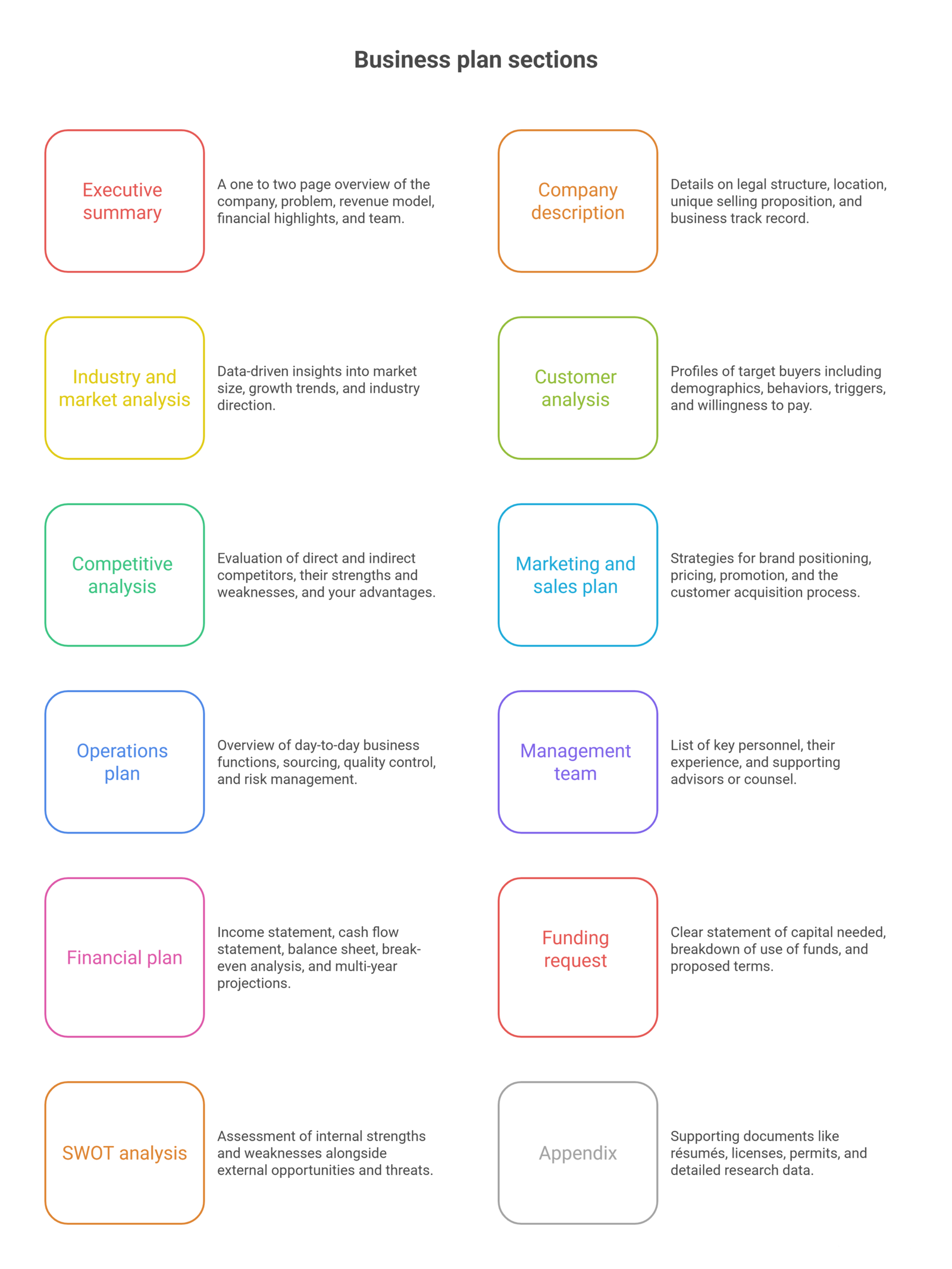
Executive summary: write it last, place it first
The executive summary sits at the front of the document. It should be the last section you write. You need the rest of the plan finished before you can summarize it accurately.
Keep it to one page. Two pages only if you run multiple product lines or locations. Include:
- Your company name and what it does
- The problem you solve and for whom
- Your revenue model in one or two sentences
- Key financial highlights: projected revenue, funding needed, use of funds
- Why now, and why you’re the right team
Investors often decide whether to keep reading based on this page alone. Every sentence needs to earn its place. Oak builds these summaries for clients who need an investor-ready executive summary that survives that first thirty seconds of attention.
Company description
This section expands on what you touched on in the summary. State your legal structure. State where you operate. Explain your unique selling proposition, what makes a customer choose you over the next option.
If your business already has a track record, include it here. Real revenue, real customers, and real traction do more to build credibility than any projection can.
Industry and market analysis
This section proves you understand the space you’re entering. Include your market size, industry growth trends, and where the industry is headed. Cite real data. A market analysis without numbers reads as an opinion, not research.
Investors are checking two things here. First, is the market big enough to matter. Second, do you actually understand it, or are you guessing.
Customer analysis
Describe who buys from you. Use demographics, but go further. Describe their behavior, their buying triggers, and what they’re currently doing instead of using your product. State how much they’re willing to pay, and why.
A vague customer description signals a founder who built a product first and found customers second. That order raises questions investors will ask directly.
Competitive analysis
List your direct competitors and your indirect ones. A direct competitor sells something similar. An indirect competitor solves the same problem a different way. Streaming services compete directly with each other but also compete indirectly with cable.
For each competitor, note their strengths and weaknesses. Then explain your advantage plainly. Vague claims like “better customer service” don’t hold up. Specific claims like “same-day delivery in a market where competitors average three days” do.
Marketing and sales plan
Your marketing plan explains how people find out you exist. Your sales plan explains how that awareness turns into revenue. These are related but distinct, and plans that blur them tend to be vague about both.
Cover your brand positioning, your pricing strategy, and your promotional channels. Then walk through your actual sales process. How does a lead become a customer? What does your sales cycle look like? How do you retain the customers you win?
Operations plan
This section shows the reader how the business runs day to day. Where do you operate from. How do you source materials or deliver your service. What are your quality control steps. What happens when something goes wrong, a supplier delay, a staffing gap, a seasonal spike.
Investors read this section looking for blind spots. A plan that only describes the best case will get questioned harder. A plan that names its own risks, and shows a plan for them, earns more trust.
Management team
List your key people and their relevant experience. Be specific about who owns what. If you’re a solo founder without a full team yet, name your advisors, your accountant, your legal counsel. Investors want to know who they’d be calling if something went wrong.
Financial plan: the section that gets read closely
This is where most business plans lose credibility, and where a genuinely strong one earns it. You need three statements: an income statement, a cash flow statement, and a balance sheet.
A simple income statement example:
- Revenue: $250,000
- Cost of goods sold: $75,000
- Gross profit: $175,000
- Operating expenses: $120,000
- Net income: $55,000
That structure shows a profitable model with room to grow. Investors will check whether your assumptions behind those numbers are realistic, not just whether the math is correct.
Include a break-even analysis. This tells the reader when your revenue covers your costs. The formula is straightforward:
Fixed costs ÷ (price per unit − variable cost per unit) = break-even units
If your fixed costs are $60,000, your price is $100, and your variable cost per unit is $40, the math is simple. You need to sell 1,000 units to break even. That single number tells an investor more about your business model than a page of narrative.
Project 12 months in detail. Summarize years two and three at a higher level. Base your assumptions on real data, industry benchmarks, or your own historical numbers if you have them. This is precisely where a professional financial model earns its cost. A generic template with plausible-looking numbers gets caught in the first serious diligence conversation. Getting your forecast assumptions right the first time matters more than most founders expect. Oak’s guide on how CFOs measure forecast accuracy walks through exactly what that scrutiny looks like from the other side of the table.
Funding request
If you’re raising capital, state the amount clearly. State what it funds: inventory, equipment, hiring, marketing. Break it down by category so the reader can see where every dollar goes.
Then explain your terms. If it’s a loan, state your preferred repayment structure. If it’s equity, be ready to discuss valuation and what you’re offering in return. Investors want to see that you’ve thought through the mechanics, not just the amount.
This section is also where a founder’s inexperience shows fastest. A vague ask, “we need around half a million,” reads very differently from a specific one. A specific ask is backed by a cost breakdown and a milestone timeline. Oak’s startup fundraising consultants build that specificity into the plan before it ever reaches an investor’s inbox.
SWOT analysis
A SWOT analysis is short, but it does real work. It shows you’ve thought honestly about your own business, not just its upside.
- Strengths: what you do better than competitors right now
- Weaknesses: where you’re genuinely behind, and why
- Opportunities: market gaps or trends you’re positioned to capture
- Threats: competitive, regulatory, or economic risks that could hurt you
Skipping the weaknesses and threats sections is a common mistake. Investors read a plan with no weaknesses as a plan that hasn’t been stress-tested, not as a plan with no problems.
Appendix and supporting documents
The appendix holds everything that supports your plan without cluttering the main sections. That includes résumés, licenses, permits, market research data, letters of intent, and detailed financial projections.
Keep it organized. Use a table of contents if the appendix runs more than a few pages. Group documents by category: legal, financial, operational. Label each item clearly so a reader can find what they need in under a minute. If any of it is confidential, say so with a short confidentiality statement on the appendix’s first page.
A well-organized appendix builds quiet credibility. A messy one undoes some of the trust the rest of the plan built. If your plan is heading into an investor pitch, pair it with a pitch deck built from the same numbers. That way the two documents never contradict each other.
Frequently Asked Questions
Which section should I write first?
Whichever one you understand best. Many founders start with products and services, since that’s usually the clearest part of the idea. Write the executive summary last, once every other section is finished.
Do I need a full business plan if I’m a solo founder with no funding needs?
Not a 30-page one. A lean, one-to-two-page plan still forces you to define your customer, your pricing, and your revenue model before you spend money testing them. If you ever apply for a loan or bring on a partner, you’ll likely need to expand it.
How long should a business plan be?
A traditional, investor-ready plan usually runs 20 to 40 pages, including the appendix. A lean plan is one to two pages. Length should match your audience’s expectations, not a fixed rule.
How often should I update my business plan?
At least once a year. Update it sooner after a major shift, such as a new product line, a funding round, a significant change in your target market, or a new competitive threat.
What do banks look for that investors don’t?
Banks weigh creditworthiness, cash flow, and collateral more heavily, since they’re assessing repayment risk rather than growth potential. Investors weigh market size and growth trajectory more heavily, since they’re assessing return potential. Both read your financial plan closely, just for different signals.
Is a SWOT analysis really necessary?
It’s short, but it’s one of the fastest ways to show an investor you’ve thought critically about your own business. Skipping the weaknesses and threats sections is more noticeable than including them.
The plan is a tool, not a formality
A business plan that only lists ten headings and fills them with generic language reads exactly like what it is: a template. A plan that names its own weaknesses reads like a business someone has actually thought through. So does one that backs its financials with a real break-even calculation, and asks for funding with a specific breakdown.
Oak Business Consultant builds investor-ready business plans for founders who need the second kind, the kind that holds up once someone starts asking questions.