
The 13 Week Cash Flow Model Everything You Need to Know
13-Week Cash Flow Planning: Tips, Tricks, and Essentials
Most finance guides treat the 13 week cash flow model like it is some exotic tool reserved for companies in crisis. That is a mistake. Whether your business is thriving or under pressure, having a clear, rolling picture of your cash over the next fiscal quarter is one of the smartest things a finance team can do. This article breaks down exactly what this model is, why it matters, how to build one, and what separates the teams that get real value from it versus the ones who just go through the motions.
What Is the 13 Week Cash Flow Model?
A 13 week cash flow model is a short-term cash forecast that maps out your expected cash inflows and cash outflows week by week over a 13-week period, which equals one fiscal quarter. It sits somewhere between daily cash management and the kind of annual income statement planning most FP&A teams spend their time on.
The number 13 is not arbitrary. Thirteen weeks is roughly three months, which covers one complete reporting cycle and gives leadership enough visibility to make meaningful financial decisions without getting lost in the noise of longer-range forecasts. It is practical, tight, and actionable.
You build it using the direct method, meaning you track actual cash moving in and out of your bank accounts rather than working backward from an accrual-based income statement. That distinction matters a lot in practice.
Why 13 Weeks and Not Some Other Time Horizon
A lot of businesses run a monthly forecast or a rolling 12-month plan. Those have their place. But monthly forecasts miss the week-to-week volatility that kills cash balance, and annual plans are too blurry to help you decide whether to delay payroll or push a vendor payment.
Thirteen weeks hits a sweet spot across several time horizons:
Short-term forecasts of one to four weeks are good for daily cash management but lack strategic context. A 5-year forecast gives you a long-term plan but cannot tell you if you will have enough cash to cover debt service in six weeks. The 13 week cash flow model gives you precision where it counts most, which is the near future, while still covering enough runway to spot liquidity issues before they become a financial crisis.
During turnaround situations, lenders, restructuring advisors, and boards almost always ask for a 13 week cash forecast specifically because it is short enough to be credible and long enough to show whether a business has a path forward.
When Businesses Actually Use This Model
You will see the 13 week cash flow model come up in a few common scenarios:
When a company is in financial distress and needs to show creditors it understands its cash position, this model becomes the primary reporting document. It is used in DIP (Debtor-in-Possession) financing, covenant compliance conversations, and debt restructuring negotiations.
During turnaround situations where senior leadership is trying to stabilize operations, the 13 week cash forecast becomes the operating backbone. It tells the finance team where cash reserves stand, what obligations are coming, and where there is room to maneuver.
But it is not only for struggling businesses. Seasonal businesses, retailers managing inventory turnover, and any company with lumpy revenue cycles use this model during high-stakes planning windows. A retail business heading into the holidays, for example, needs to know its cash position with far more precision than a monthly forecast can provide.
Startups managing runway, businesses going through acquisitions, and companies navigating macroeconomic conditions like the supply chain shortages seen during the COVID-19 pandemic have all used the 13 week cash flow model as their financial north star.
What Goes Into the Model: The Core Components
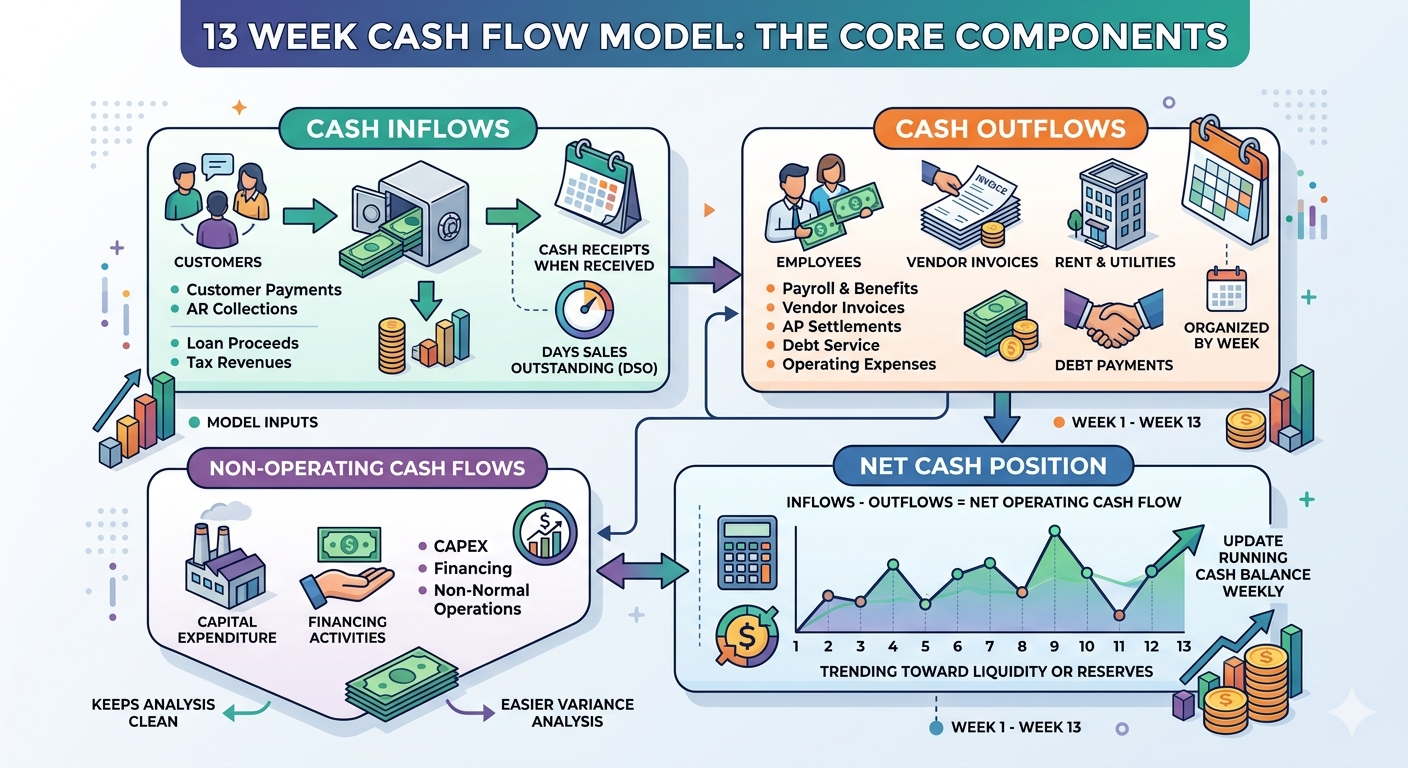
Building a solid 13 week cash flow model comes down to getting the right inputs and organizing them consistently. Here is what the model needs to cover:
Cash Inflows
Cash receipts typically include customer payments, collections on accounts receivable, loan proceeds, tax revenues, and any other source of cash hitting your bank accounts. The key is tracking when cash actually lands, not when revenue is recognized. That means your cash conversion cycle and days sales outstanding matter a lot here.
Cash Outflows
Cash disbursements cover everything going out: payroll and benefits, vendor invoices, accounts payable settlements, debt service payments, loan or bond payments, rent, taxes, and operating expenses. Organizing these by week gives you a clear picture of when cash peaks and valleys occur.
Net Cash Position
Each week, you calculate net operating cash flows (inflows minus outflows), then carry that forward to update your running cash balance. Watching this number move across 13 weeks tells you whether you are trending toward liquidity shortfalls or building healthy cash reserves.
Non-Operating Cash Flows
This includes items like financing activities, capital expenditure, and anything outside normal operations. Separating these from operating cash flows keeps your analysis clean and makes variance analysis easier.
Building the Model: A Practical Walkthrough
Here is a straightforward approach to building your 13 week cash flow model in Excel or any financial modeling tool:
- Set up your structure. Create columns for each of the 13 weeks (Week 1 through Week 13), with rows organized by cash inflow category, cash outflow category, net cash flow, and ending cash balance.
- Pull your starting cash balance. This comes from your bank accounts or general ledger. It is the anchor for every calculation that follows.
- Forecast cash receipts. Work with your accounts receivable aging report to estimate when customer payments will arrive. Factor in your cash conversion cycle and any known large payments.
- Forecast cash disbursements. Go line by line through accounts payable, payroll schedules, debt service obligations, and other commitments. Use your general ledger and accounts mapping to make sure nothing falls through the cracks.
- Layer in non-operating items. Add financing options you are pursuing, any expected loan proceeds, and capital spending.
- Build your variance analysis. As each week passes, track actuals versus forecast. Variance reports are where the real learning happens and where your finance team improves forecast accuracy over time.
- Update weekly. The rolling nature of the 13 week cash flow model is what makes it valuable. You drop the completed week and add a new week 13 each time, keeping the window fresh.
The Direct Method vs. The Indirect Method
Most long-term financial models are built using the indirect method, starting from net income and adjusting for non-cash items. The 13 week cash flow model almost always uses the direct method instead.
The reason is simple: the direct method shows actual cash movement, which is what you need when you are managing liquidity week by week. An accrual-based cash flow statement can look fine even when a business is running out of cash. The direct method eliminates that blind spot.
This is also why the 13 week cash flow model is separate from the balance sheet and income statement in most reporting. It is its own document, updated on its own cycle, focused entirely on cash.
Common Mistakes That Make the Model Useless
A few things consistently undermine the value of a 13 week cash flow model:
Treating it as a one-time deliverable rather than a living document. If you build it once for a bank presentation and never update it, you have wasted your time. The value is in the weekly rhythm.
Over-engineering the inflow assumptions. Using highly optimistic accounts receivable collection timelines or failing to account for slow-paying customers inflates your cash balance projections and leads to nasty surprises.
Ignoring debt covenants and seasonal patterns. If your business has debt service coverage ratio requirements or significant inventory turnover swings, those need to be baked into the model from Week 1.
Not building contingency plans. A good 13 week cash flow model includes at least one downside scenario so you know what your cash position looks like if customer payments slow down or a major expense hits early.
Leaving it in finance and not sharing it with leadership. This is a strategic document, not just a finance team artifact. The people making decisions about hiring, capital spending, and vendor negotiations need to understand what it says.
What the Model Tells You Beyond the Numbers
The most underrated thing about the 13 week cash flow model is what it reveals about how your business actually operates. Consistent variance between forecast and actual cash receipts tells you something is wrong with either your collections process or your revenue recognition timing. Repeated cash outflow surprises point to weak accounts payable controls or poor cash planning discipline.
Done well, the model becomes a diagnostic tool for financial health. It surfaces liquidity issues early, forces better communication between operations and finance, and gives leadership real visibility into the cash conversion cycle in a way that quarterly reporting simply cannot.
How Technology Fits In
Excel templates are still the most common way teams build and maintain the 13 week cash flow model, and a well-designed Excel template gets the job done effectively. But enterprise resource planning systems and dedicated FP&A platforms can automate data pulls from the general ledger, reduce manual error, and speed up the weekly refresh cycle considerably.
The choice of tool matters less than the discipline of using it consistently. Automation helps, but the judgment calls around assumptions, scenarios, and contingent scenarios still require human expertise.
Frequently Asked Questions
Is the 13 week cash flow model only used in financial distress?
No. While it is a standard tool in turnaround situations and restructuring, it is equally useful for seasonal businesses, companies managing rapid growth, and any organization that needs tighter cash planning than monthly reporting provides.
How often should the model be updated?
Weekly, without exception. The rolling nature of the model is what makes it credible. Updating it weekly also forces your finance team to confront variances quickly and improve forecast accuracy over time.
What is the difference between the 13 week cash flow model and a regular cash flow statement?
A standard cash flow statement is typically backward-looking and built using the indirect method from financial statements. The 13 week cash flow model is forward-looking, uses the direct method, and is updated weekly to track actual versus projected cash movement.
How detailed should the line items be?
Detailed enough to be meaningful, simple enough to be maintainable. You want to capture the major categories of cash receipts and cash disbursements accurately without creating a model so complex that no one updates it. Most good models have 15 to 30 line items.
Can this model help with lender negotiations?
Absolutely. Lenders, especially in restructuring or DIP financing situations, often require a 13 week cash forecast because it demonstrates that management has a credible handle on liquidity. A well-maintained model with clean variance reporting builds far more confidence than a static projection.
Conclusion
The 13 week cash flow model is one of those tools that looks straightforward on the surface but rewards serious attention. Building it well takes more than filling in formulas. It takes discipline around assumptions, honest conversations about collections and payment timing, and a commitment to updating it every single week.
If your business is navigating complexity, whether that means debt covenants, rapid growth, financial distress, or simply the need for tighter cash management, working with an experienced CFO can make a significant difference. The team at Oak Business Consultant offers CFO services designed to bring this level of financial rigor to businesses that need it without the overhead of a full-time hire. If cash flow forecasting and short-term planning are gaps in your current financial operations, that is exactly the kind of support worth exploring.