Smart Business Decisions Through Cost Value Analysis
Cost vs Value: Smarter Business Choices
Every business, at some point, faces the same pressure: limited resources, competing priorities, and the constant need to prove that spending is justified. Whether you are running a health care facility, managing a supply chain, or overseeing a large capital project, the ability to evaluate cost against real value is what separates good decision makers from great ones.
Cost value analysis is the framework that makes this possible. It is not just a financial tool. It is a thinking system that helps organizations spend smarter, allocate resources more effectively, and build a stronger case for every major decision they make.
This guide walks you through everything you need to know, from the core concepts to practical applications, including how an external CFO can help your organization put this framework to work.
What Is Cost Value Analysis?
Cost value analysis is the process of evaluating what something costs relative to the benefit or value it delivers. It asks a simple but powerful question: is what we are getting worth what we are paying?
This sounds straightforward, but in practice it involves careful measurement, honest assumptions, and a structured methodology. Organizations use cost value analysis to compare options, justify investments, allocate scarce resources, and make trade-offs when budgets are tight.
It sits at the intersection of several related disciplines, including cost-benefit analysis, cost-utility analysis, and economic evaluation. While each has its own focus and terminology, they all share the same fundamental goal: helping decision makers understand value, not just cost.
The Core Methods You Need to Know
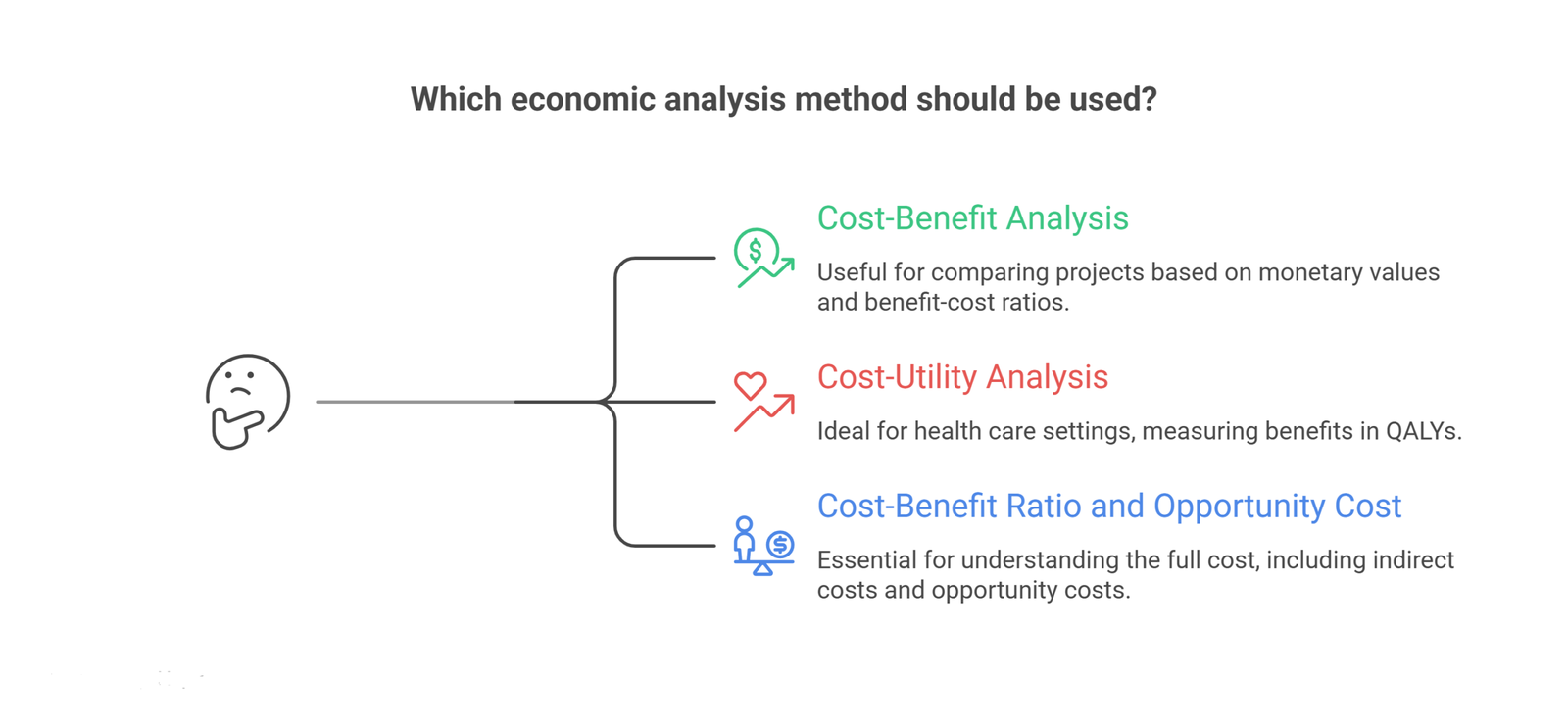
Cost-Benefit Analysis
Cost-benefit analysis converts all costs and benefits into monetary values so they can be directly compared. The result is typically expressed as a benefit-cost ratio or net present value.
If a project costs $500,000 and delivers $1.2 million in measurable benefits over five years, the benefit-cost ratio is 2.4. That tells you that for every dollar spent, you are getting $2.40 back. Decision makers use this to prioritize investments, approve budgets, and justify spending to boards and stakeholders.
Discount rates matter here. A dollar received three years from now is worth less than a dollar today. Applying the right discount rates to future benefits and costs gives you a more accurate picture of the true net present value of any investment.
Cost-Utility Analysis
Cost-utility analysis is widely used in health economics and health care settings. Instead of converting everything to dollars, it measures benefits in terms of quality-adjusted life years, or QALYs.
A quality-adjusted life year, or QALY, combines length of life with health-related quality of life into a single number. One QALY represents one year lived in perfect health. Medical interventions are then evaluated by their costs per QALY gained, which helps health care allocation decision makers compare very different treatments on a consistent scale.
For example, if a treatment costs $80,000 and generates two QALY gains, the cost per QALY is $40,000. Decision makers can then weigh this against other health interventions and determine whether the investment reflects willingness to pay thresholds set by health authorities.
The International Society for Pharmacoeconomics and Outcomes Research has developed widely used guidelines for conducting this type of economic evaluation, and many health care systems rely on these standards when making coverage and reimbursement decisions.
Cost-Benefit Ratio and Opportunity Cost
Every decision carries an opportunity cost. When you spend resources on one thing, you are choosing not to spend them on something else. A rigorous cost value analysis always asks: what are we giving up?
Overhead costs, indirect costs, and fixed costs all factor into this calculation. A project that looks profitable when only direct costs are counted may look very different when indirect costs are included. Good analysis captures the full picture.
Why Cost Value Analysis Matters Across Industries
Health Care
In health care, cost value analysis is not optional. It is essential. With limited budgets and growing demand, health care facility leaders must constantly decide which health interventions to fund, which treatments to prioritize, and how to allocate resources across competing needs.
Clinical evidence is the foundation of this process. Decision analytic models combine clinical evidence with economic data to estimate costs and outcomes across different scenarios. Sensitivity analysis tests how conclusions change when key assumptions are varied, which builds confidence that the results are robust.
Public concerns also play a role. Decisions about health care allocation affect real people, and equity weights and societal values can influence how benefits are measured. A treatment that delivers modest QALY gains for a large population may be valued differently than one that delivers significant gains for a small group with severe illness.
Supply Chain
In supply chain management, cost value analysis helps organizations evaluate supplier contracts, assess the total cost of procurement decisions, and identify opportunities for product standardization that reduce complexity and cost.
A project manager overseeing a procurement initiative might use cost value analysis to compare three supplier options across factors like price, quality, delivery reliability, and long-term relationship value. The cheapest option on paper may carry regulatory risks, quality risks, or supply disruption risks that make it more expensive in practice.
Public procurement teams use similar frameworks, sometimes guided by standards from bodies like the NIGP-CPP and aligned with public sector contracting principles. Federal grant funds, cooperative purchasing programs, and job order contracting agreements all benefit from rigorous cost value analysis at the contract negotiation stage.
Project Management
In project management, cost value analysis shows up most directly through earned value analysis and earned value management. These are structured methodologies that track how much work has been completed relative to how much has been spent.
Key metrics in earned value management include cost variance, schedule variance, schedule performance index, and the performance measurement baseline. These metrics tell a project manager whether a project is on track, over budget, behind schedule, or some combination of all three.
The ANSI/EIA Standard 748 provides a formal framework for earned value management that is used by organizations including the Project Management Institute, the National Defense Industrial Association, and the Defense Acquisition University. Government contractors and defense programs frequently require compliance with this standard as part of their project scope requirements.
Cost variance tells you the difference between planned costs and actual costs. Schedule variance tells you whether work is being completed at the planned rate. Together with the schedule performance index, these metrics give decision makers an early warning system for projects that are drifting off course before problems become crises.
How to Run a Cost Value Analysis: A Practical Process
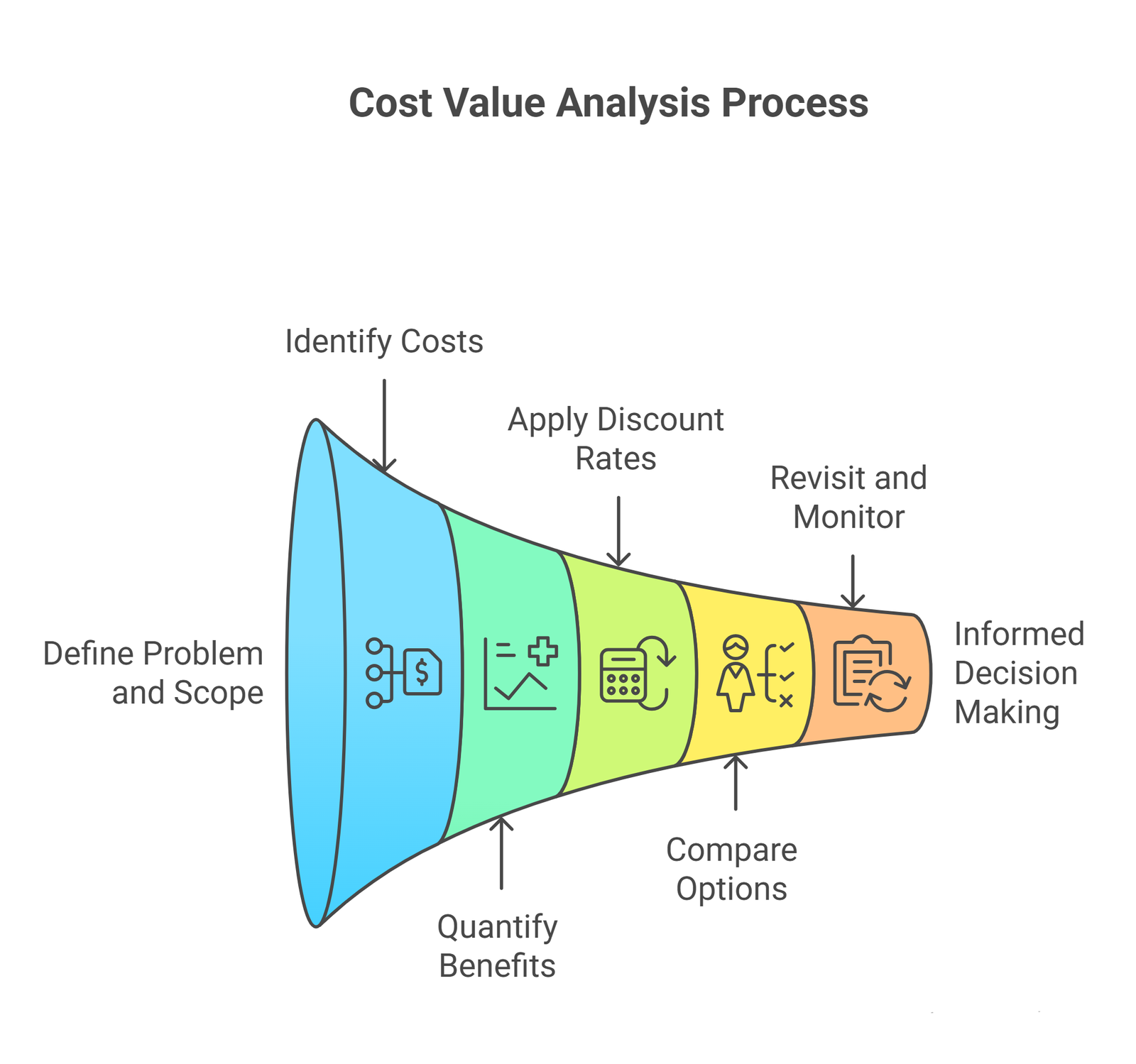
Step 1: Define the Problem and Project Scope
Start with clarity. What decision are you trying to make? And, what are the boundaries of the analysis? What counts as a cost, and what counts as a benefit? Without a clear project scope, analyses can expand endlessly and lose their usefulness.
Step 2: Identify All Costs
Work through every category. Direct costs, indirect costs, overhead costs, fixed costs, and project costs all need to be captured. In health care settings, this often requires regression modeling to separate patient-level cost data from aggregate financial reports. In project management, it means reviewing purchase orders, labor records, and control account data.
Step 3: Quantify the Benefits
Benefits should be measured in the most appropriate unit for the context. In health economics, that may be QALY gains or improvements in functional level. Moreover, in business investment decisions, it is usually monetary values. In project management, it is earned value relative to planned value.
Marginal analysis can be helpful here. Rather than evaluating a decision in isolation, marginal analysis looks at the incremental cost of a small change and the incremental benefit it produces. This is particularly useful when resources are scarce and you are trying to find the most efficient allocation.
Step 4: Apply Discount Rates and Sensitivity Analysis
For decisions with long time horizons, apply discount rates to bring future values into present terms. Then run sensitivity analysis to test how your conclusions change when key inputs shift. This builds confidence in your results and identifies which assumptions most need to be validated.
In health care, willingness to pay thresholds help anchor this step. In business investment decisions, the required rate of return or cost of capital typically sets the discount rate.
Step 5: Compare Options and Make a Recommendation
Present results clearly for decision makers. Show the benefit-cost ratio, net present value, and any key sensitivities. Acknowledge uncertainty honestly. Good analysis does not pretend to eliminate uncertainty. It makes uncertainty visible so that decision makers can factor it into their judgment.
Step 6: Revisit and Monitor
Cost value analysis is not a one-time exercise. As market conditions change, as customer demand shifts, and as new clinical evidence emerges, the underlying assumptions need to be refreshed. Building a process for regular review ensures that decisions remain well-grounded over time.
Product Value Analysis and Procurement
In procurement and supply chain contexts, product value analysis is a specific technique for evaluating whether a product or service is delivering value proportional to its cost. It examines product standardization opportunities, assesses whether specifications are appropriate, and identifies alternatives that deliver equivalent performance at lower cost.
For organizations managing complex supplier relationships, a project manager leading a product value analysis initiative might examine customer satisfaction data, customer demand trends, and market share implications alongside pure cost data. The goal is to understand value holistically, not just price.
White papers from procurement industry bodies and strategy policy and legislation from public sector contracting authorities often provide frameworks for conducting this analysis in a structured and auditable way.
Common Pitfalls to Avoid
One of the most common mistakes in cost value analysis is treating it as a purely financial exercise. Real value includes strategic benefits, risk reduction, customer satisfaction improvements, and market share implications that do not always show up easily in a spreadsheet.
Another pitfall is ignoring indirect costs and opportunity cost. Projects that appear profitable when only direct costs are counted may consume resources and management attention that would be better deployed elsewhere.
Overconfidence in point estimates is also dangerous. Any cost value analysis involves assumptions, and sensitivity analysis exists precisely to surface this uncertainty. An analysis that presents a single definitive answer without acknowledging the range of possible outcomes should be treated with caution.
Finally, good cost value analysis requires both financial expertise and domain knowledge. In health care, that means understanding clinical evidence and health economics. In project management, it means understanding earned value management and the ANSI/EIA Standard 748. Getting this right usually requires specialized skills that many organizations do not have in-house on a full-time basis.
The Role of an External CFO in Cost Value Analysis
This is where an external CFO delivers real, measurable value.
An external CFO brings the financial expertise and structured thinking that cost value analysis demands, without the overhead of a full-time hire. For growing businesses, health care organizations, and project-driven companies, engaging an external CFO means having access to senior-level financial judgment exactly when you need it.
An external CFO can design the analytical framework, ensure that all costs are captured correctly, apply the right discount rates and sensitivity analysis, and present findings in a way that genuinely supports decision making. They can also build the internal processes that ensure cost value analysis becomes a repeatable discipline rather than a one-off exercise.
For organizations navigating complex procurement decisions, health care allocation challenges, or large capital projects, an external CFO provides the credibility and rigor that stakeholders and boards expect. They bring experience across industries and contexts, which means they can recognize patterns, avoid common pitfalls, and structure analyses that hold up to scrutiny.
Perhaps most importantly, an external CFO helps translate financial analysis into business judgment. The numbers matter, but so does the interpretation. Knowing when the analysis supports a clear recommendation, and when the uncertainty is too high to decide without more information, is a skill that comes from experience. That experience is exactly what an external CFO brings to the table.
Frequently Asked Questions
What is the difference between cost-benefit analysis and cost-utility analysis?
Cost-benefit analysis converts everything into monetary values for direct comparison. Cost-utility analysis, common in health care, measures benefits in quality-adjusted life years instead of dollars. It is better suited to comparing health interventions where dollar values are hard to assign.
How is opportunity cost factored into cost value analysis?
By identifying what you are giving up when committing resources to one option. Good analysis always compares the chosen option against realistic alternatives, including doing nothing, rather than evaluating it in isolation.
What is a quality-adjusted life year and why does it matter?
A QALY combines length of life with health-related quality of life into a single number. One QALY equals one year in perfect health. It gives decision makers a consistent unit for comparing very different health interventions on equal terms.
What role does sensitivity analysis play?
It tests how conclusions shift when key assumptions change. Since every analysis involves uncertainty, sensitivity analysis identifies which inputs drive the results most and gives decision makers an honest picture of where the analysis is most vulnerable.
When should a company bring in an external CFO for cost value analysis?
When the decision is significant, internal financial capacity is limited, or the complexity exceeds what existing staff can handle confidently. An external CFO brings senior-level expertise without the cost of a full-time hire, which is especially valuable for health care, project-driven, and procurement-heavy organizations.
How does earned value analysis fit into cost value analysis?
Earned value analysis applies cost value principles to project management. It compares work completed against planned value and actual spend. Cost variance and schedule variance give project managers early visibility into budget and timeline problems before they escalate.
Conclusion
Cost value analysis is one of the most powerful tools available to business leaders, health care decision makers, project managers, and procurement professionals. It brings discipline and rigor to decisions that are too important to make on instinct alone.
Done well, it captures the full cost picture, quantifies benefits honestly, accounts for uncertainty, and produces insights that genuinely improve outcomes. Done poorly, it produces false confidence and bad decisions dressed up in numbers.If your organization is making significant resource allocation decisions and you want the analysis done right, our CFO services are designed to help. Whether you need support with a one-time investment decision, an ongoing economic evaluation process, or a complete cost value analysis framework, we bring the financial expertise and strategic judgment to make it count. Reach out to learn how we can support your team.