

How to Raise Money for a Business Without a Loan?
Smart Ways to Raise Business Capital Without Loans
Most founders assume that growing a business means going into debt. But the truth is, some of the most successful companies in the world were built without ever touching a small business loan or signing up for traditional bank loans. If you are wondering how to raise money for a business without a loan, you are in the right place.
This guide walks you through every real option available, from equity financing and angel investors to government grants, revenue-based financing, and beyond. We have written this to be practical, honest, and genuinely useful for business owners at every stage.
Why Avoid Debt Financing?
Debt financing comes with obligations. You pay back what you borrow, plus interest rates that can compound quickly. If your cash flow is unpredictable or your business is early stage, those monthly repayments can become a serious strain.
Beyond the numbers, bank loans and business loans often require collateral, a strong credit history, and detailed financials. Many founders, especially those running early-stage funding rounds or growing a new venture, simply do not qualify.
That does not mean you are stuck. It means you need to look at different tools.
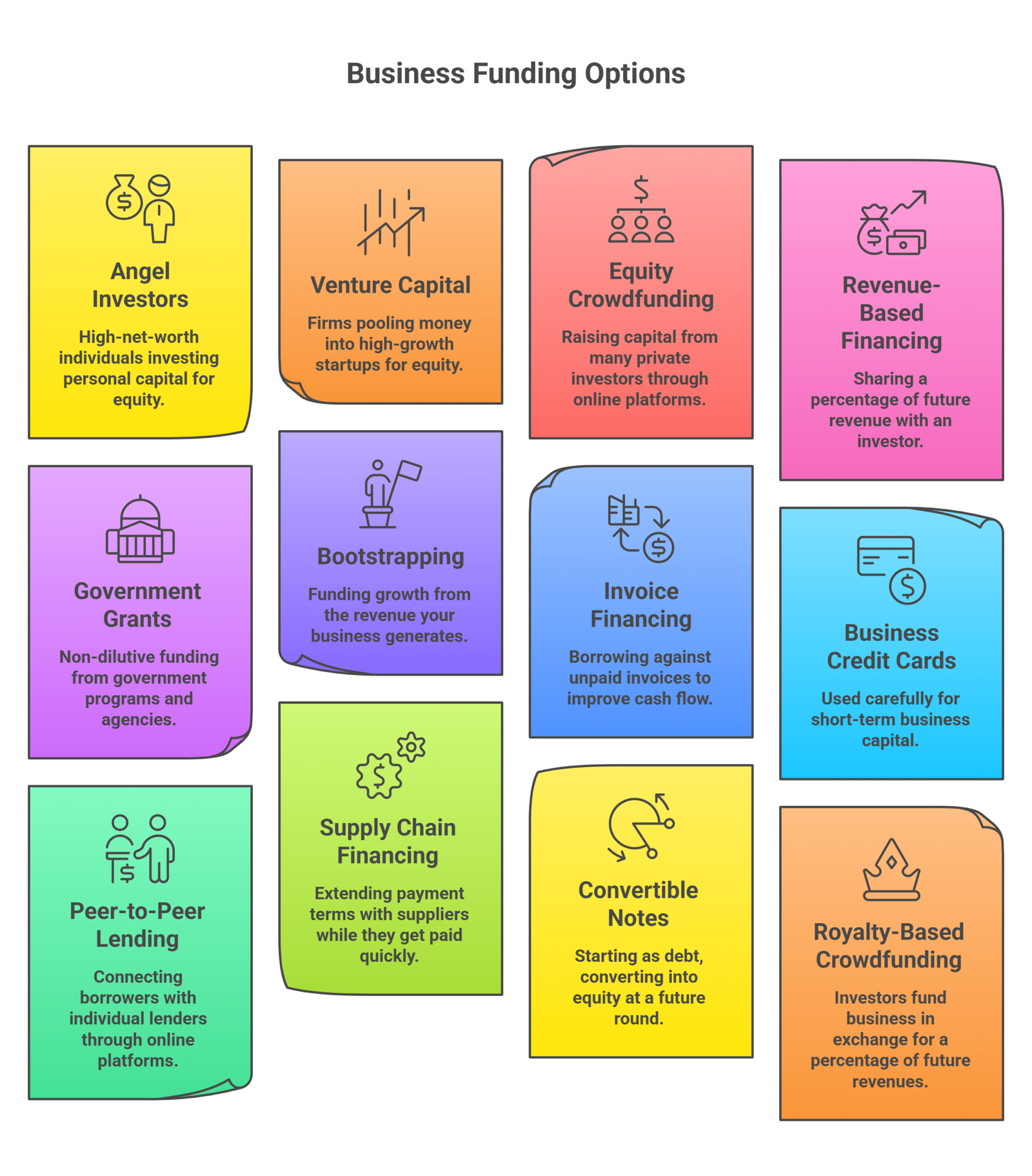
1. Angel Investors
An angel investor is typically a high-net-worth individual who invests personal capital into a business in exchange for equity or convertible notes. They are often former entrepreneurs themselves, which means they bring mentorship and networks alongside money.
Angel investors tend to work with early-stage businesses. They are more willing to take on risk than institutional investors, and they often move faster. You do not need perfect financials to attract an angel. You need a compelling business plan, a credible team, and a clear sense of your market.
To find angel investors, look at platforms like AngelList, attend startup events, connect with local business networks, and ask for warm introductions through your existing contacts. Investors in your industry sector are usually the most valuable because they already understand the problem you are solving.
When working with angel investors, be transparent. Have your financials ready, know your valuation, and be prepared to negotiate equity-based funding terms.
2. Venture Capital
Venture capital is a form of equity financing where firms pool money from institutional investors and deploy it into high-growth startups. Moreover, venture capitalists look for businesses that can scale quickly and deliver significant returns.
Not every business is a fit for venture capital. Venture capitalists typically invest in companies with large addressable markets, scalable models, and a team that can execute fast. If your business fits that profile, VC funding can be transformative.
The trade-off is equity and control. Venture capitalists will usually want a board seat or significant input on strategic decisions. They are investing for a return, often through acquisition or an IPO, so make sure your goals are aligned.
Early conversations with venture capitalists should be relationship-driven. Most deals come through referrals. Start building those relationships long before you need the money.
3. Equity Crowdfunding
Equity crowdfunding lets you raise business capital from a large number of private investors through online platforms. Instead of giving up equity to one or two backers, you spread ownership across many smaller investors.
This model works especially well for consumer-facing businesses with an engaged audience. Your customers can become your investors, which also deepens their loyalty to your brand.
Platforms like Republic, Wefunder, and StartEngine are popular for equity crowdfunding in the US. The Division of Securities in your state, such as those operating under the Utah Uniform Securities Act, may have specific rules around securities transactions, so make sure any raise is compliant with local regulations.
Equity crowdfunding requires work upfront. You need a strong campaign, a clear pitch, and consistent communication throughout the raise.
4. Revenue-Based Financing
Revenue-based financing is one of the most founder-friendly funding models available. Instead of giving up equity or taking on debt, you agree to share a percentage of future revenue with an investor until a set repayment cap is reached.
This model is ideal for businesses with predictable and recurring revenue. It aligns investor returns with your growth, so there is no pressure to hit an arbitrary repayment schedule regardless of how your business is doing.
Revenue-based financing is growing fast. Providers like Clearco, Capchase, and Pipe specialize in this model. It is particularly popular among SaaS businesses, ecommerce brands, and subscription services.
One thing to watch: the effective cost of revenue-based financing can be higher than it looks. Model out the total repayment carefully before you commit.
5. Government Grants and Programs
Government grants are one of the most overlooked ways to raise money for a business without a loan. Unlike equity or debt, grants do not need to be repaid and do not dilute your ownership.
The Small Business Administration offers a range of programs including SBA-guaranteed loans, but also grant programs, business assistance initiatives, and connections to the Small Business Investment Company network. These are not handouts. They are programs designed to stimulate economic activity.
Beyond federal programs, your local economic development agency is worth contacting directly. Many states and municipalities offer targeted funding for specific industries, regions, or founder demographics.
Women-owned businesses, minority-owned businesses, veteran-owned businesses, and native American-owned businesses often have access to dedicated grant programs. If you fall into one of these categories, research what is available in your state before looking elsewhere.
Maryland startups, for example, can access Maryland Financial Incentives for Businesses, which includes grants and tax credits specifically designed for growing companies. Other states have equivalent programs.
For social impact businesses, grant funding is even more accessible. Foundations, non-profits, and government bodies actively fund ventures with a strong social impact mandate.
Use tools like the Funding Navigator to search for grants relevant to your business.
6. Bootstrapping and Retained Revenue
Bootstrapping means funding your growth from the revenue your business generates. It is the most underrated form of business finance.
When you bootstrap, you maintain total control. There is no investor to answer to, no equity diluted, and no repayment pressure. You grow at the pace your cash flow allows.
The discipline that bootstrapping forces is also valuable. It pushes you to find profitable customers fast, cut unnecessary costs, and focus on what actually drives revenue. Many of the most resilient businesses in the world were built this way.
Bootstrapping does not mean doing everything cheaply. It means being intentional about where you invest. Use retained earnings to build assets, improve your product, and hire the people who will generate the most return.
7. Invoice Financing and Invoice Factoring
If your business has outstanding invoices from customers, you can unlock that capital without waiting for payment.
Invoice financing lets you borrow against unpaid invoices. You keep the relationship with your customer and collect the payment yourself. Invoice factoring is slightly different. You sell your invoices to a third party at a discount, and they collect payment directly.
Both approaches improve your cash flow quickly. They are not technically loans in the traditional sense, though they do come with fees. Invoice discounting is a related model that offers similar benefits with slightly more flexibility.
These options work best for B2B businesses where payment terms stretch 30, 60, or even 90 days. Rather than sitting on accounts receivable, you put that capital to work immediately.
8. Business Credit Cards and Cash Advances
Used carefully, credit cards can be a legitimate tool for short-term business capital. They are not ideal for long-term financing, but they can bridge gaps and fund specific investments when managed well.
A business cash advance is a separate product offered by many providers. It is similar to revenue-based financing but typically shorter-term and tied to your card sales volume. Business cash advance services like those offered by Square Capital or PayPal Working Capital are fast to access and require minimal paperwork.
Be cautious about interest rates. Credit cards and cash advances tend to carry higher rates than other options. Use them for short-term needs, not long-term growth capital.
9. Peer-to-Peer Lending
Peer-to-peer (P2P) lending connects borrowers with individual lenders through online platforms, bypassing traditional banks. The rates are often more competitive than bank overdrafts or credit cards, and the application process is faster than most bank loans.
P2P lending sits in a grey zone between traditional debt financing and alternative financing. You are still borrowing money and repaying with interest, but without the friction of a conventional lender.
Platforms like Funding Circle and LendingClub are established in this space. Assess the interest rates carefully and compare them against other options before committing.
10. Supply Chain Financing
Supply chain financing lets your business extend payment terms with suppliers while the supplier gets paid quickly through a third-party financer. This preserves your cash flow without borrowing.
It is a collaborative approach to business finance that works when you have established supplier relationships and consistent purchasing volumes.
11. Convertible Notes
Convertible notes are a form of early-stage funding that start as debt but convert into equity at a future round. They are commonly used by startups to raise capital quickly without needing to agree on a valuation upfront.
Investors like convertible notes because they get downside protection through the debt structure and upside through equity conversion. Founders like them because they are simpler and faster to execute than a full equity round.
If you are planning to raise a priced equity round in the next 12 to 18 months, convertible notes can be a smart bridge.
12. Royalty-Based Crowdfunding
Royalty-based crowdfunding is less common but worth knowing about. Investors fund your business in exchange for a percentage of future revenues, similar to revenue-based financing but structured through a crowdfunding campaign.
This model suits creative businesses, artists, and content-driven companies well. It lets you raise business capital without giving up equity and without taking on traditional debt.
13. Strategic Partnerships and Corporate Investment
Some of the best early-stage funding comes not from investors or lenders but from strategic partners. Large corporations sometimes invest in or partner with smaller businesses that complement their own offering.
These relationships can include cash investment, shared resources, distribution agreements, or joint ventures. They often come with more strings than pure equity investment, but they also bring credibility and market access that money alone cannot buy.
If you operate in a sector where corporate partnerships are common, this is worth exploring as part of your broader fundraising strategy.
14. Competitions and Accelerators
Business competitions and accelerator programs offer non-dilutive capital alongside mentorship, network access, and sometimes office space. Programs like Y Combinator, Techstars, and thousands of regional accelerators actively fund promising businesses.
Many accelerators take a small equity stake, typically 5 to 10 percent, in exchange for their investment and program support. Others are grant-funded and take nothing.
Research programs that are specific to your industry or stage. Winning even a small competition builds credibility and can open doors to larger investors.
15. Home Equity and Personal Assets
Some founders use home equity loans or personal savings to fund early business growth. This is a high-risk approach because you are putting personal assets on the line, but it signals strong conviction to other investors.
If you go this route, treat it as a temporary bridge. Use personal capital to prove out your concept, then seek external funding once you have traction.
Building Your Business Plan Before You Raise
Before approaching any funding source, you need a solid business plan. Not a 100-page document, but a clear, honest articulation of your market, your model, your financials, and your plan for growth.
A strong business plan answers the questions every investor or grant committee will ask. How big is the market? How do you make money? What does your cash flow look like over the next 12 to 24 months? Why is your team the right team to execute?
Your business plan is also a tool for you. It forces you to pressure-test your assumptions and identify the gaps before someone else does.
Choosing the Right Path
There is no single best answer to how to raise money for a business without a loan. The right approach depends on your stage, your industry, your growth goals, and how much ownership you are willing to share.
Early-stage founders often combine approaches. A small angel investment alongside a government grant and revenue-based financing can give you the runway to prove your model without over-diluting your equity.
As you scale, venture capital or equity crowdfunding may become more relevant. The key is to stay intentional about how you structure each raise and what you are giving up in return.
Frequently Asked Questions
What is the most common way to raise money for a business without a loan?
The most common approaches are bootstrapping from revenue, raising from angel investors, applying for government grants, and using revenue-based financing. The right option depends on your business model and stage.
Can I raise money without giving up equity?
Yes. Revenue-based financing, government grants, invoice financing, and royalty-based crowdfunding all let you raise capital without diluting your ownership.
What is the difference between angel investors and venture capitalists?
Angel investors are typically individuals who invest their own money at early stages. Venture capitalists manage pooled funds from institutional investors and usually invest at later stages and in larger amounts. Both take equity in exchange for their investment.
How do I find angel investors for my business?
The most effective way is through warm introductions from your professional network. Platforms like AngelList, local startup communities, and industry-specific investor networks are also good starting points.
What government grants are available for small businesses?
This varies by location, industry, and founder demographics. The Small Business Administration is a good starting point in the US. Women-owned businesses, minority-owned businesses, and veteran-owned businesses often have access to additional dedicated programs.
How do convertible notes work?
Convertible notes start as debt and convert into equity at a future funding round, usually at a discount to the new round price. They are commonly used in early-stage funding because they are faster to execute than a priced round.
Can a first-time founder raise from venture capitalists?
Yes, though it is harder. Most venture capitalists invest based on the team as much as the idea. Having relevant experience, strong early traction, or well-known advisors can make a significant difference.
Conclusion
Learning how to raise money for a business without a loan opens up more options than most founders realize. From angel investors and venture capitalists to government grants, revenue-based financing, equity crowdfunding, and invoice financing, there are dozens of paths available depending on your goals and stage.
The businesses that raise successfully are the ones that come prepared. They know their numbers, understand their market, and can articulate clearly why their business deserves investment.
If you are ready to build a funding strategy that is structured, realistic, and tailored to your business, working with a financial expert can make a significant difference. The CFO services at oakbusinessconsultant.com are designed to help business owners navigate exactly this. From preparing investor-ready financials to modeling your cash flow and structuring your raise, a fractional CFO can give you the strategic clarity you need to move forward with confidence.
Reach out for a free consultation, and let’s start building a business finance strategy that works for you.


