15 Business Ideas Worth Starting Right Now
15 business ideas worth starting right now (and how to know before you spend money)
Every year brings a fresh batch of “best business ideas” lists, and most of them read the same: a grab bag of trends with no real answer to the question that actually matters, which is whether the idea can turn a profit once rent, tools, and taxes are accounted for. An idea that’s trending on social media isn’t the same as an idea with a viable margin.
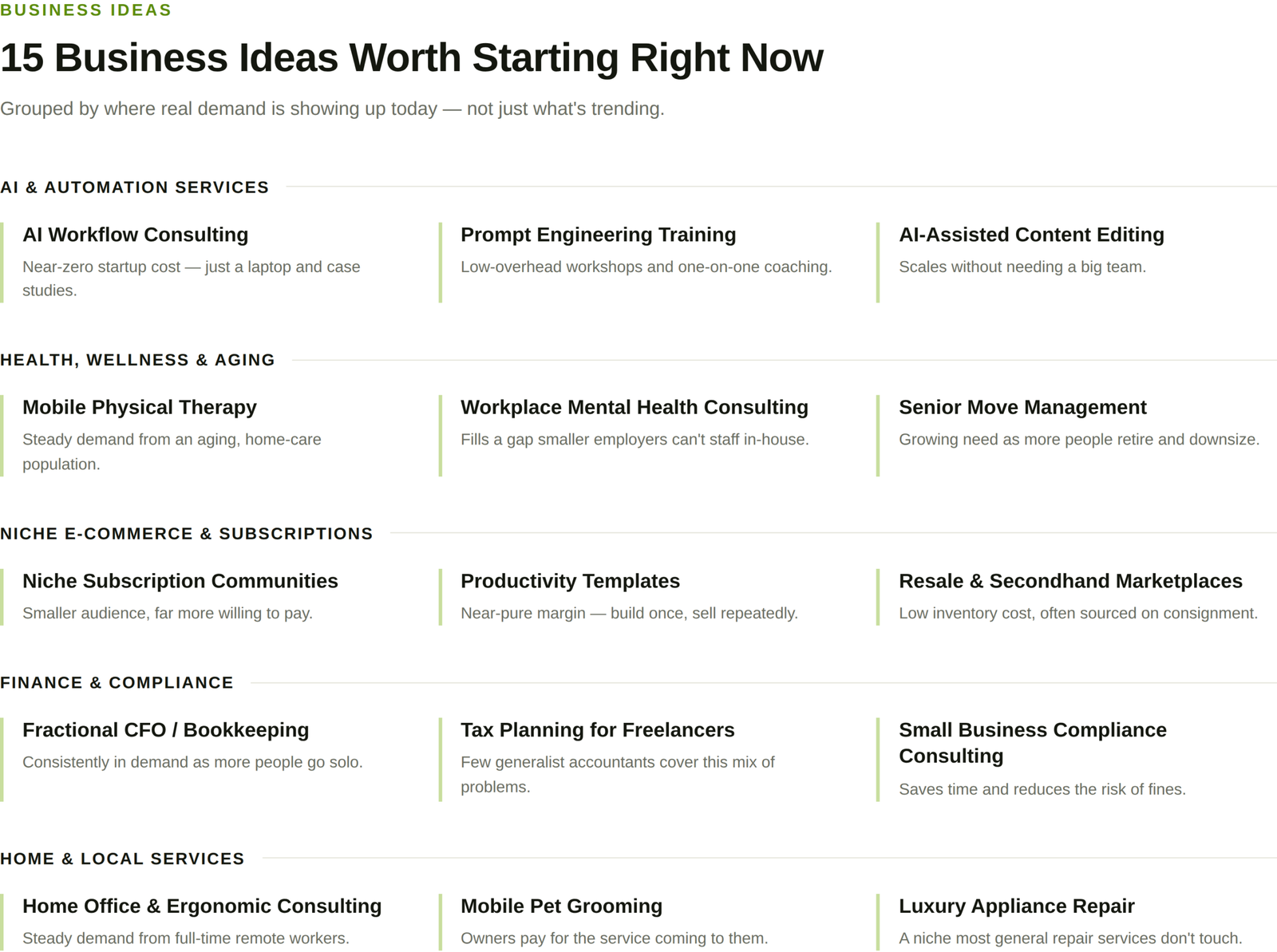
The businesses below are grouped by category, based on where real demand is showing up right now: AI-driven services, health and wellness, niche e-commerce, and finance and compliance work that’s in short supply as more people go solo. Each one includes a rough sense of what it costs to start and what kind of margin to expect, because that’s usually the part a trend list skips.
AI and automation services
AI workflow consulting. More small businesses are adopting AI tools than ever, but most don’t know how to plug them into daily operations without creating a mess. A consultant who can set up automation for customer support, reporting, or scheduling fills a real gap, and the startup cost is close to zero beyond a laptop and some client-facing case studies.
Prompt engineering and AI training. Employees are being handed AI tools with almost no training on how to use them well. Running short workshops or one-on-one coaching sessions on effective prompting is a low-overhead service that companies are increasingly willing to pay for.
AI-assisted content and video editing. Creators and small brands need help keeping up with content volume, and tools that speed up editing, transcription, and repurposing make this a service business that scales without a big team behind it.
Health, wellness, and aging
Mobile physical therapy or rehab services. As more care moves out of clinics and into homes, mobile rehab and physical therapy businesses are seeing steady demand, particularly from an aging population that prefers care delivered where they live.
Workplace mental health consulting. Small and mid-sized employers increasingly want to offer mental health resources but rarely have the budget or staff to build that infrastructure in-house. A consultant who can design a lightweight, affordable program fills a gap larger firms already have covered.
Senior move management. Downsizing and relocating later in life is physically and emotionally difficult, and a service built around sorting, packing, and helping older adults settle into a new home addresses a need that’s only going to grow as more people retire.
Niche e-commerce and subscription products
Niche subscription boxes or communities. Paid newsletters and small subscription communities, built around a specific interest rather than a broad audience, continue to outperform generic content because the audience is smaller but far more willing to pay.
Productivity templates and digital tools. Selling ready-made dashboards, trackers, and workflows for tools like Notion, Excel, or Airtable is close to pure margin once the initial templates are built, since the same product can be sold repeatedly with no added production cost.
Resale and secondhand marketplaces. Parents and budget-conscious shoppers are driving steady demand for curated secondhand goods, particularly kids’ clothing and toys, and this model keeps upfront inventory costs low since stock is often sourced on consignment.
Finance and compliance services
Fractional CFO or bookkeeping for solopreneurs. As more people start businesses on their own, the number of founders who need financial guidance but can’t justify a full-time hire keeps growing. Offering part-time, contract-based financial support, from basic bookkeeping up to cash flow planning, is one of the more consistently in-demand services right now, and it’s the exact gap fractional CFO services are built to fill.
Tax planning for freelancers and creators. Freelancers, streamers, and other creator-economy workers often have irregular income and confusing deduction rules, and few generalist accountants specialize in that specific mix of problems.
Small business compliance consulting. Keeping up with labor law and reporting requirements is a constant headache for small business owners, and a consultant who can track changes and handle filings on their behalf saves real time and reduces the risk of fines.
Home and local services
Home office design and ergonomic consulting. Remote and hybrid work aren’t going away, and a service that combines ergonomic assessments with practical office setup continues to find steady demand among people working from home full time.
Mobile pet grooming or pet care services. Pet ownership remains high, and busy owners are increasingly willing to pay for services that come to them rather than requiring a trip to a groomer or sitter.
Luxury appliance repair. As high-end kitchen equipment becomes more common, so does the need for technicians who specialize in maintaining and repairing it, and this is a niche most general repair services don’t touch.
What it actually costs to start
| Business type | Typical startup cost | Typical margin | Examples |
| Service-based | $5,000 to $25,000 | 15% to 20% | Consulting, freelancing, mobile services |
| Product-based | $50,000 to $150,000 | Often under 10% | Retail, manufactured goods, physical inventory |
| Subscription or recurring | Moderate to high upfront | Up to 30% or higher | SaaS, membership sites, subscription boxes |
| Online-only | $3,000 to $10,000 | Varies by model | E-commerce, digital products, content businesses |
These figures shift a lot based on location, scale, and how much of the work the founder does personally versus hiring out. They’re a starting point for a conversation, not a guarantee.
How to know if an idea is worth pursuing
Most of these ideas can fail just as easily as they can succeed, and the difference usually comes down to whether the idea was tested before real money went into it.
Before committing, it’s worth checking three things. First, whether there’s actual search or social demand for the problem being solved, not just personal enthusiasm for the idea. Second, whether people will pay before the product or service fully exists, which a simple waitlist or pre-order page can test cheaply. Third, whether the numbers work once realistic costs are included, not just the optimistic version of the math.
That last step is where a lot of otherwise good ideas fall apart. A business plan built around realistic costs and a clear-eyed revenue model will surface problems long before they show up in a bank account, and a proper startup financial model does the same thing with more precision, projecting cash flow, break-even timing, and funding needs before a single customer is signed.
Frequently Asked Questions
What’s the easiest business to start with little money?
Service-based businesses like consulting, freelance work, or coaching tend to have the lowest startup costs, since they rely on skills and time rather than inventory or equipment.
How do I know if a business idea will actually be profitable?
Model out realistic costs, not optimistic ones, against a conservative estimate of demand. A basic financial model that maps revenue against fixed and variable costs will show a break-even point long before the business launches.
Should I validate an idea before writing a full business plan?
Yes. Quick validation, through a landing page, a waitlist, or direct conversations with potential customers, is far cheaper than discovering a lack of demand after a full plan and financial model are already built.
Is a subscription or recurring revenue business better than a one-time sale model?
Recurring revenue models are generally more scalable and can carry higher margins, but they usually take longer to become profitable since customer retention has to be earned over time rather than won in a single transaction.
Do I need a business plan for a small, low-investment idea?
Even a simple service business benefits from a short plan that covers who the customer is, what it costs to deliver the service, and what pricing needs to be to turn a profit. It doesn’t need to be long to be useful.
What’s the biggest reason new businesses fail?
Running out of cash before the business becomes self-sustaining is one of the most common reasons, and it’s usually the result of underestimating costs or overestimating how quickly revenue would arrive.
Conclusion
A good business idea and a good business plan aren’t the same thing. The list above is meant to point toward where real demand is sitting today, but every one of these ideas still has to survive contact with actual costs, actual competitors, and actual customers willing to pay.
For anyone ready to move past the idea stage, Oak’s business plan and startup financial model services build out the numbers behind an idea before real money is on the line, and Oak’s fractional CFO services for startups help founders keep those numbers on track once the business is actually running.