
Mastering Financial Aid Modeling
Mastering Financial Aid Modeling: Optimize Enrollment and Revenue
Enrollment is up at a lot of institutions right now, and net tuition revenue is falling anyway. That gap is the real problem financial aid modeling is supposed to solve. When a school hands out aid using the same grid it used five recruiting cycles ago, it ends up over-awarding students who would have enrolled regardless and under-awarding the ones a slightly bigger offer would have won. Both mistakes cost money. Financial aid modeling is how enrollment and finance teams stop guessing at which students need what, and start knowing.
At its core, aid modeling uses historical enrollment data, a student’s academic and financial profile, and predictive analytics to forecast how a given award will affect that student’s odds of enrolling, persisting, and graduating. Institutions that do this well no longer set merit or need-based awards by feel. They test scenarios, model outcomes, and adjust in real time as a recruiting cycle unfolds.
Why grid-based awarding is running out of runway
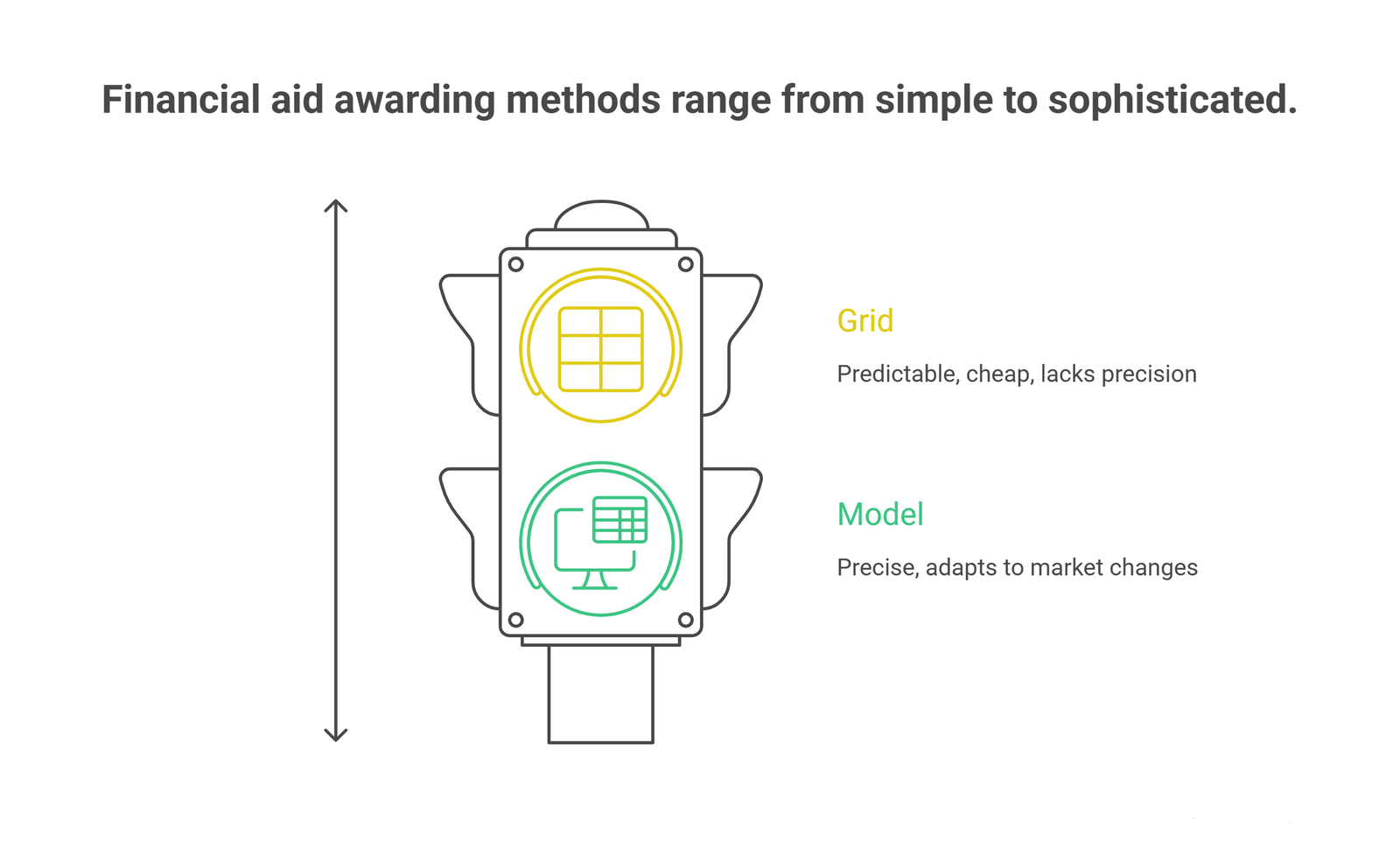
Most financial aid offices still lean on some version of a grid: a two-factor table, typically five bands of academic strength by five bands of financial need, that assigns every student in a cell the same award. Grids are predictable and cheap to run, which is why they’ve lasted this long. Admissions counselors can quote an estimated award on a campus visit without waiting on a model.
The cost of that predictability is precision. Two students in the same grid cell can have very different probabilities of enrolling, but a grid pays them the same amount. Some students in that cell were over-awarded (they would have come anyway), and others were under-awarded (a few thousand more dollars would have closed the deal). Multiply that mismatch across an incoming class and the grid quietly erodes both net tuition revenue and yield at the same time.
Rolling admissions cycles, faster competitor offers, and rising price sensitivity have made this worse. Institutions that model aid only once a year, then hold the numbers fixed through the cycle, are reacting to a recruiting environment that has already moved on by the time they adjust.
Three financial aid strategies, compared
Most institutions fall somewhere on a spectrum between a rigid grid and a fully individualized model. A useful way to think about where a school sits:
| Strategy | How awards are set | Predictability | Precision |
| Grid | Fixed bands by GPA/test score and need (commonly 5×5) | High, easy to quote on a campus visit | Low, similar students in the same band get identical awards |
| Matrix | Individualized formula calculated first, then compressed into a custom grid for staff to execute | Moderate, more bands than a standard grid | Higher than a grid, still loses some precision in the compression |
| Individualized | A distinct predictive award calculated per student, based on dozens of inputs | Lower for early conversations, since no fixed table exists | Highest, each award targets that student’s specific probability of enrolling |
A grid isn’t automatically the wrong choice. For high-volume programs where staff need to quote award ranges instantly, or for institutions without the enrollment history to build a reliable individualized model yet, a grid or matrix can still be the right fit. The point of financial modeling here isn’t to force every school onto the most sophisticated system available. It’s to match the model to what the institution’s data and recruiting process can actually support.
From prediction to prescription: the shift that actually matters
Most of what gets marketed as “aid modeling” today is still purely predictive: it tells you a student’s likelihood of enrolling, but not what to do about it. That distinction matters more than it sounds. A predictive model might flag that one prospect has a 45% chance of enrolling and another has 55%. Useful information, but it doesn’t tell an aid office what action closes the gap.
A prescriptive model goes a step further. It recommends that raising the first student’s award by a specific amount would move their probability to 70%, while the same dollar amount barely moves the second student’s odds at all, then explains why: recent campus visit activity, counselor engagement, or a sibling already enrolled might all factor in. That’s the difference between a dashboard that describes the problem and a system that tells an aid director where the next dollar does the most good.
Institutions still running purely rule-based grids, purely predictive dashboards, or reactive last-minute award bumps to fill seats are all, in different ways, playing defense. None of these approaches is wrong in isolation, but none of them alone gives an aid office the ability to act on a signal mid-cycle rather than discover it in a post-mortem report.
What the FAFSA overhaul changed for aid models
The rollout of the Student Aid Index in place of the old Expected Family Contribution forced a real stress test on institutional models. Schools relying on static, backward-looking data struggled to adapt when the underlying formula changed, including how sibling enrollment, family business or farm assets, and negative SAI values get treated. Institutions running live simulation, rather than a model refreshed once a year, adjusted their awarding in real time and protected both enrollment and net revenue through the transition.
That’s a preview of what any future federal methodology change will demand: a model built to be re-run and re-tested, not one built once and left alone until next year’s budget cycle.
Core components of a modern aid modeling system
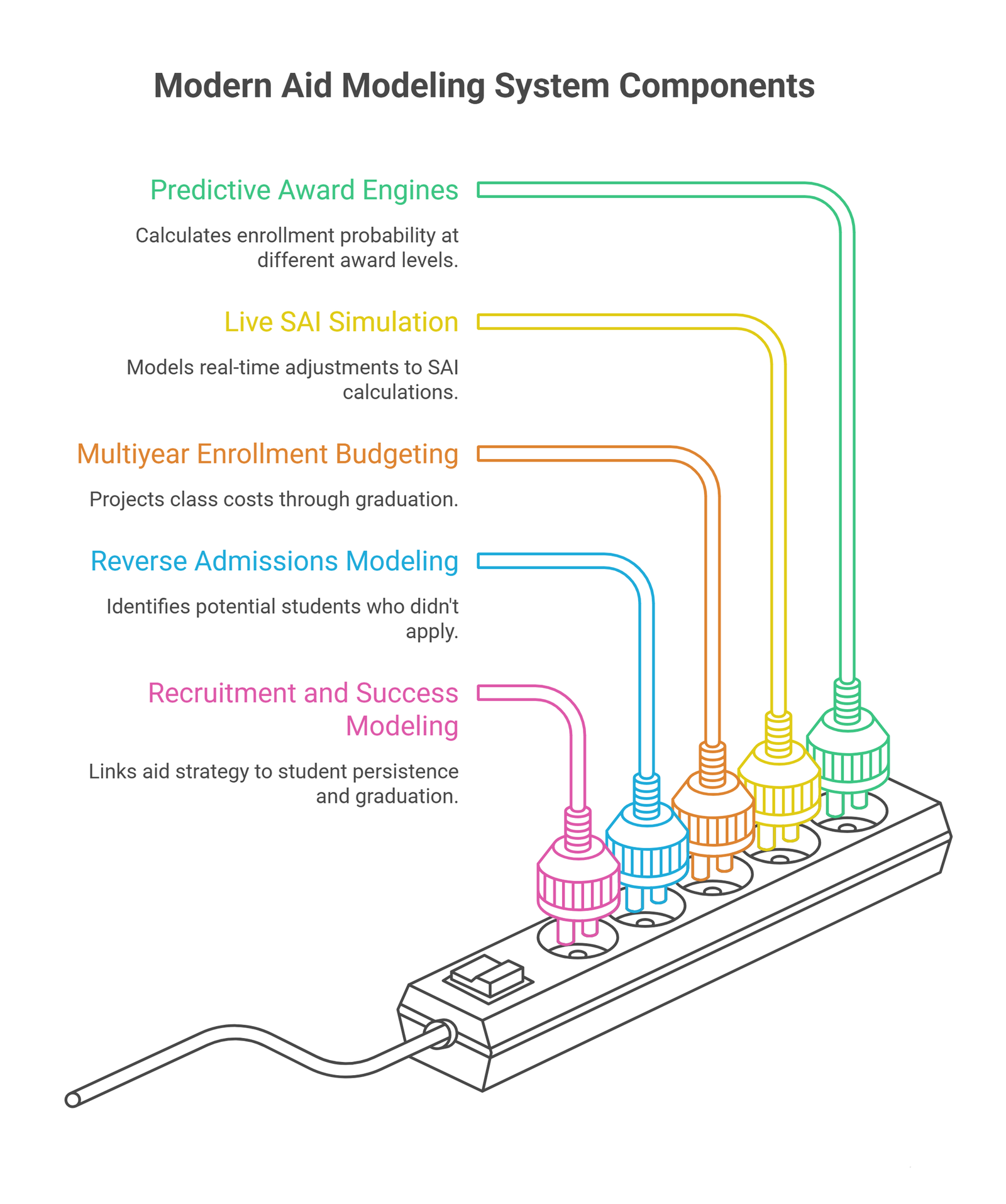
A financial aid model that actually holds up under pressure tends to include the same handful of building blocks:
- Predictive award engines that calculate each applicant’s enrollment probability at different award levels, not just a single blended score.
- Live SAI simulation that models sibling-in-college adjustments, family business and farm net worth treatment, and negative SAI scenarios as they happen, rather than waiting for a batch update.
- Multiyear enrollment budgeting that projects a class through graduation, factoring in melt, transfer, and retention, so an award decision this cycle is weighed against its four- or six-year cost.
- Reverse admissions modeling that surfaces students who’d likely thrive at the institution even though they never applied, opening recruiting pools the traditional funnel misses entirely.
- Recruitment and student success modeling tied together, so aid strategy isn’t optimized for yield alone while ignoring which awarded students actually persist and graduate.
Institutions building this out from scratch usually need the underlying education industry financial model work done first: multiyear tuition, discount rate, and net revenue projections that the aid model then optimizes against. Without that foundation, even a sophisticated predictive engine is optimizing against numbers nobody has stress-tested.
What results actually look like
The honest version of “what does this get us” is less dramatic than the case studies suggest, but it’s real. Net tuition revenue per full-time student has been declining nationally even as enrollment ticks up, the sharpest drop of its kind in decades, which means headcount growth alone isn’t fixing institutional finances. Schools that model aid continuously, instead of setting it once a year, are the ones positioned to close that gap: they catch over-awarding before it compounds across a class, and they catch under-awarding before a strong prospect quietly enrolls somewhere else.
Career schools, online programs, and institutions serving non-traditional or adult learners have found particular traction here, since those populations often don’t fit the assumptions baked into a traditional grid at all. The institutions seeing the clearest gains tend to be the ones that treat aid modeling as an ongoing discipline with dedicated oversight, similar to how they’d treat any other function under CFO services, rather than a spreadsheet someone updates once before the cycle opens.
Frequently Asked Questions
How is aid modeling different from traditional leveraging?
Traditional leveraging assigns the same award to every student in a grid cell. Modern aid modeling calculates a distinct award for each student based on their individual probability of enrolling and their financial need.
What’s the difference between predictive and prescriptive aid modeling?
Predictive modeling tells you how likely a student is to enroll. Prescriptive modeling tells you what specific award adjustment would change that likelihood, and by how much, so it produces a recommendation instead of just a probability.
Do we need a large data team to build this?
Not necessarily. Institutions with a clean multiyear enrollment and financial history can often start with a modest model and expand it as more cycles of data accumulate, rather than waiting until they have a full analytics department.
Will aid modeling hurt our commitment to need-based aid?
Done well, it does the opposite. A precise model lets an institution meet demonstrated need more consistently while spending merit aid only where it actually changes a student’s decision, instead of handing it out by default.
How quickly can we expect to see results?
Some improvements in yield and class shape show up in the first cycle after implementation, but the compounding value, sharper models built on more historical data, tends to build year over year rather than arrive all at once.
Is this only useful for private colleges with high sticker prices?
No. Public universities, community colleges, and career schools are all applying aid modeling, since the underlying problem, limited aid dollars and imperfect information about who needs what, exists at every tuition level.
Conclusion
Financial aid modeling isn’t a one-time project; it’s an operating discipline. The institutions pulling ahead are the ones that treat every recruiting cycle as new data to re-test their model against, not a repeat of last year’s grid. Before any of that predictive work can run, though, it needs a solid multiyear financial foundation underneath it. If your institution’s tuition and discount rate projections haven’t been rebuilt recently, that’s the place to start: speak with an analyst about what a modern aid model would need from your existing numbers, or explore education business plan support if you’re building that foundation from the ground up.