How Do You Determine What a Business Is Worth?
Business Valuation: How to Assess True Worth
Every business owner reaches a point where they need a clear answer to one question: how do you determine what a business is worth? Whether you are planning a sale, bringing in investors, settling an estate, or simply making smarter decisions, knowing your business value is not optional. It is essential.
This guide walks you through the full valuation process in plain language. No jargon overload. No confusion. Just what you need to know.
Why Business Valuation Matters
Before diving into methods, it is worth understanding why business owners go through this process at all.
You need a valuation when you are selling your business, buying another, applying for a loan, bringing on a partner, handling estate planning, or resolving a dispute. In each case, an accurate number protects you. It prevents you from leaving money on the table or overpaying for something that is not worth it.
The challenge is that business value is not a fixed number. It changes with market conditions, company performance, industry trends, and dozens of other factors. That is exactly why the valuation process requires careful thought and the right methods.
The Three Core Valuation Methods
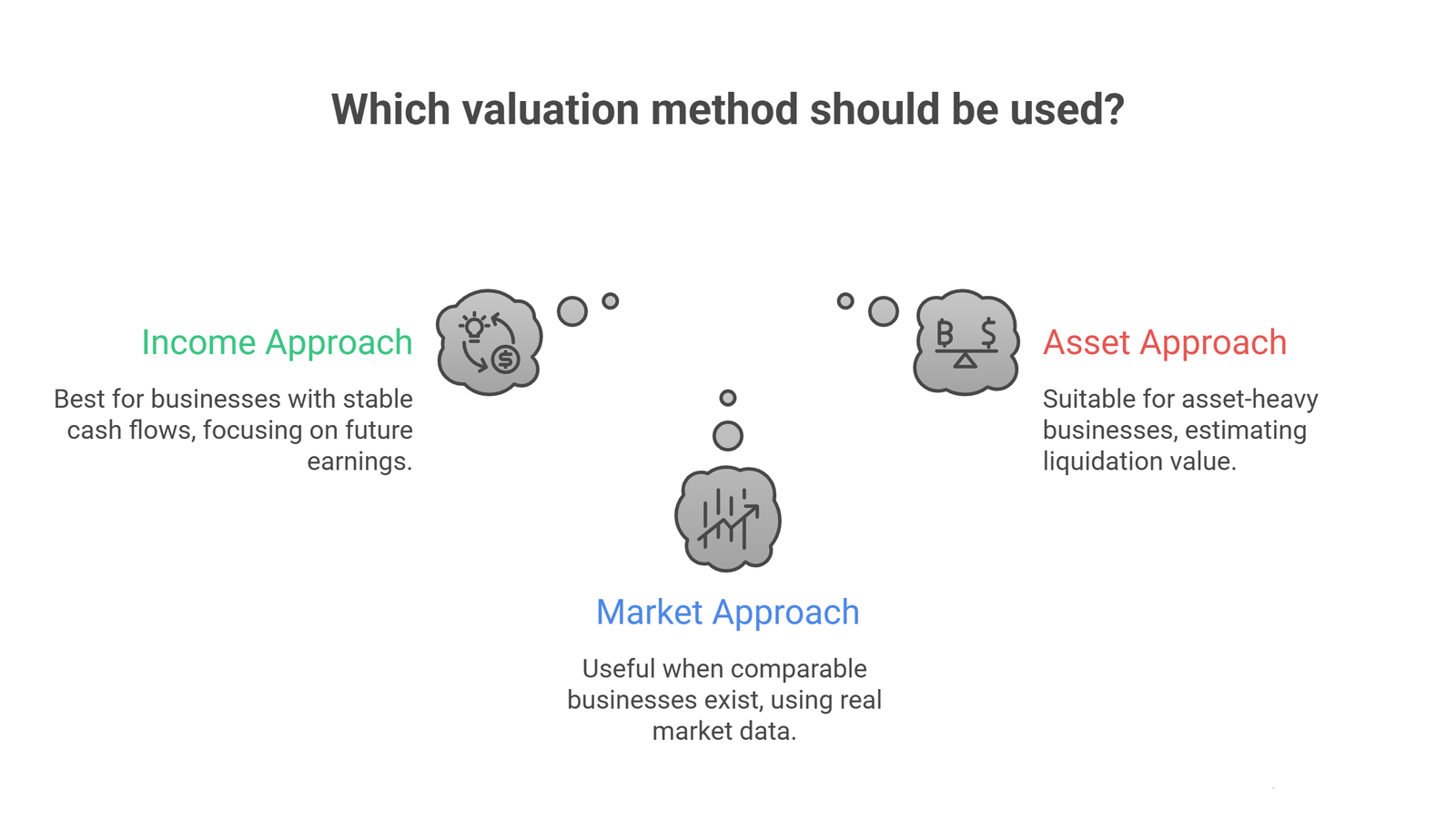
When professionals answer how do you determine what a business is worth, they almost always start with three core valuation methods. Each one looks at value from a different angle.
1. The Income Approach
The income approach focuses on what a business earns. The logic is simple: a business is worth what it can produce in future income.
The most widely used version of this is discounted cash flow analysis. You project future cash flows, then discount them back to their net present value using the cost of capital. The result tells you what those future earnings are worth in today’s dollars.
The key inputs include owner’s discretionary earnings, revenue growth rates, and the weighted average cost of capital. Small changes in these assumptions can shift the valuation significantly, so accuracy in your financial statements matters a lot here.
Another common tool under this approach is the earnings multiplier. Instead of projecting years of cash flows, you apply a multiple to current earnings. The multiple reflects risk, growth potential, and industry norms.
The income method is generally favored when a business has stable, predictable cash flows. It is also the most useful for buyers who want to understand what return they can expect.
2. The Market Approach
The market approach answers the valuation question by looking at what similar businesses have sold for. It uses real market data to set a benchmark.
There are two main tools inside this approach. The first uses comparable companies that are publicly traded. You look at their share price, market capitalization, and financial metrics to build a picture of how the market values businesses like yours.
The second uses precedent transactions. These are comparable sales transactions of private businesses in your industry. A business broker or business appraiser can help you find this data.
From these comparisons, you derive market multiples. Common ones include revenue multiples, EBITDA multiples, and the industry-specific multiple relevant to your sector. The market multiple you apply reflects the current appetite investors and buyers have for your type of business.
The market approach works best when there are enough comparable companies or recent transactions to draw from. In niche industries, finding good comparables can be difficult.
3. The Asset Approach
The asset approach values a business based on what it owns minus what it owes. It is sometimes called the asset method or asset-based valuation.
You start with the balance sheet. Total up all company assets, including both tangible items like equipment and real estate, and intangible assets like intellectual property, brand value, patents, and customer loyalty. Then subtract liabilities.
The result is book value. But book value and market value are rarely the same. Assets on the balance sheet are recorded at historical cost. They may be worth significantly more or less today.
A more refined version is liquidation value, which estimates what you would get if you sold all assets immediately. This is the floor of what a business is worth.
The asset approach is most useful for asset-heavy businesses, holding companies, or businesses that are not generating strong income. For service businesses where value lives in people and relationships, it often understates true worth.
What Goes Into the Valuation Process
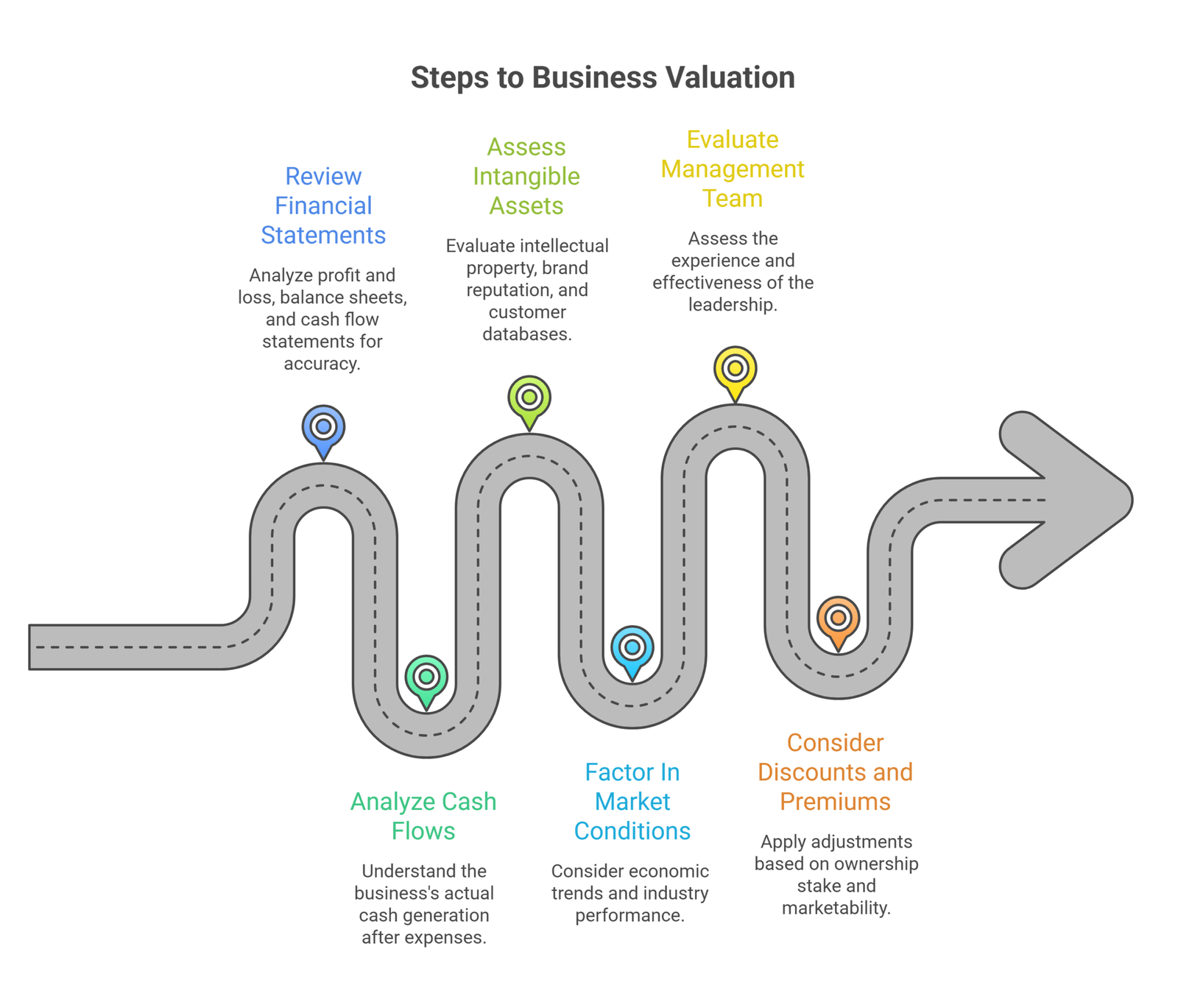
Understanding how do you determine what a business is worth is not just about picking a method. It is about gathering the right information and using it correctly.
Here is what a thorough valuation process typically involves.
Reviewing Financial Statements
Start with three to five years of financial statements. Profit and loss statements, balance sheets, and cash flow statements are the foundation. If you have clean, accurate records, the process is much smoother.
A business appraiser will also look at your tax return filings to verify the numbers. Discrepancies between what you report to the IRS and what you show investors raise red flags. Consistency matters.
Analyzing Cash Flows
Cash flow analysis is one of the most telling steps. Strong, consistent cash flows increase enterprise value. Volatile or declining cash flows reduce it.
The goal is to understand what the business actually produces after expenses, debt service, and owner compensation are accounted for. This is the number that drives most income approach calculations.
Assessing Intangible Assets
Intangible assets often get overlooked, but they can be the most valuable part of a business. Intellectual property, brand reputation, proprietary software, long-term contracts, and customer databases all add value.
A business with a loyal customer base and a recognized brand is worth more than one with identical financials but no competitive moat. These factors are harder to quantify but cannot be ignored.
Factoring In Market Conditions
The same business can be worth very different amounts depending on market conditions. In a strong economy with low interest rates, buyers are willing to pay higher multiples. In a downturn, multiples compress.
Industry trends also matter. A business in a growing sector commands a premium. One in a declining industry faces a marketability discount or a key man discount if it depends too heavily on one person to function.
Evaluating the Management Team
Buyers and investors pay close attention to the management team. A company with experienced leadership and systems in place is more valuable than one where everything runs through the owner. Strong management reduces management risk and increases the likelihood of a smooth business transfer.
Considering Discounts and Premiums
In the valuation process, adjustments are common. A minority discount applies when someone is buying less than a controlling stake. A marketability discount applies when shares are hard to sell quickly. These reduce the final number.
On the other side, businesses with strong growth potential, unique intellectual property, or dominant market position may command a premium.
Which Method Should You Use?
No single method gives the complete picture. That is why credentialed appraisers and valuation firms typically use more than one approach and then reconcile the results.
If you are running a profitable service or tech business, the income approach gives the most relevant answer. Additionally, if you are in a sector with lots of recent business sales, the market approach grounds the number in reality. If your business holds significant physical assets, the asset approach keeps you honest.
The right answer to how do you determine what a business is worth usually comes from combining methods and using judgment about which one fits your situation best.
Documents You Need
Before starting any valuation, gather these:
- Three to five years of profit and loss statements
- Balance sheets for the same period
- Tax return filings
- A list of all company assets, including intangible assets
- Details on outstanding liabilities and debt
- Any existing contracts, leases, or agreements
- Information on intellectual property ownership
- Management projections for the next two to three years
The more complete your documentation, the more accurate and defensible the final number will be.
Professional Valuation: When to Bring in an Expert
Some business owners try to run their own numbers using basic Excel formulas or an NPV calculator. For a rough estimate, that is fine. But for anything with real stakes, professional valuation is the right move.
A certified business intermediary, chartered business valuator, or member of the American Society of Appraisers brings credibility and methodology that holds up under scrutiny. Organizations like the American Institute of Certified Public Accountants and the International Valuation Standards Council set the standards these professionals follow.
For tax compliance, legal disputes, or formal sale processes, having a qualified business appraiser or business broker involved is not optional. It is protection.
Common Mistakes in Business Valuation
Even experienced business owners make these errors.
Using only one method. A single approach can miss important value drivers or liabilities. Always cross-check.
Relying on outdated financials. A business valued on three-year-old numbers does not reflect current reality. Use the most recent data available.
Ignoring intangible assets. Brand, reputation risk management, customer loyalty, and intellectual property are often the biggest value drivers.
Applying the wrong market multiple. Industry-specific multiples vary widely. Using a generic number without checking comparable companies in your sector leads to errors.
Mixing up asset-based valuations with income-based ones. Each answers a different question. Mixing them without understanding the difference creates confusion.
Frequently Asked Questions
What is the most common method used to value a small business?
For most small businesses with stable earnings, the income approach using an earnings multiplier or discounted cash flow analysis is the most widely used. The market approach using revenue multiples or market-based valuations is also common when comparable sales data is available.
How many times revenue is a business worth?
Revenue multiples vary significantly by industry. A SaaS business might trade at five to ten times revenue. A traditional service business might trade at one to two times. The industry-specific multiple depends on profit margins, growth rates, and market conditions.
What is the difference between book value and market value?
Book value is what shows up on the balance sheet based on historical costs. Market value reflects what a buyer would actually pay today. For most businesses, market value is higher because it accounts for earning power, intangible assets, and growth potential.
Do I need a professional to value my business?
For informal planning, you can use basic tools. But for a business sale, estate planning, legal disputes, or financing, working with a business appraiser or certified business intermediary gives you a defensible, credible number.
How long does the valuation process take?
A basic business valuation can take a few days. A full professional valuation with detailed cash flow analysis, market comparisons, and reconciliation across valuation models typically takes two to four weeks depending on complexity.
What documents do I need for a business valuation?
You will need financial statements, tax return filings, a complete asset list including intangible assets, details on liabilities, management projections, and any contracts or intellectual property documentation.
Conclusion
Knowing how do you determine what a business is worth is one of the most powerful things you can do as a business owner. It informs every major decision, from growth strategy to exit planning.
The process takes time and skill. It requires clean financial statements, honest cash flow analysis, a clear picture of your intangible assets, and a solid understanding of market conditions. Done right, it gives you a number you can act on with confidence.
If you are ready to get a clear, accurate picture of your business value, the team at Oak Business Consultant can help. Our CFO services are built to give business owners the financial clarity they need to grow, plan, and exit on their own terms. Reach out now to learn more.