The 30/70 of Failure
The 70/30 rule: how much of your budget should chase growth
Most small business owners run their budget on instinct. A good month buys a new hire or a marketing push. A tight month freezes everything. Neither approach protects what’s already working or gives new ideas a real shot, because there’s no fixed line between the two. The 70/30 rule fixes that: put 70% of your resources behind what’s proven, and set aside 30% to test what’s next.
This guide covers what the 70/30 rule actually means, how it differs from similar frameworks like 70-20-10, and how to apply it to a real budget without turning it into a rigid formula.
What the 70/30 rule actually says
The 70/30 rule is a resource allocation heuristic, not an accounting standard or a tax rule. It says: protect the 70% of your spending that’s already generating reliable revenue, and dedicate 30% to improvement, growth, or experimentation. The “70” covers what keeps the business running today: payroll, core operations, proven marketing channels, existing product lines. The “30” covers what might make the business better tomorrow: a new offer, a second sales channel, better tooling, or fixing a weak spot before it becomes a liability.
The rule isn’t about hitting 70% and 30% exactly. It’s a discipline check. Two mistakes show up constantly in founder-run businesses: pouring everything into the next idea and neglecting the operations that already pay the bills, or the opposite, protecting the status quo so tightly that the business never tests anything new. The 70/30 split forces a business owner to name both buckets on purpose instead of drifting into one by default.
How it’s different from the 70-20-10 rule
The 70-20-10 rule is a close cousin, and the two get confused constantly. Where 70/30 splits spending into “proven” and “everything else,” 70-20-10 breaks the “everything else” into two more specific tiers.
| Framework | Structure | Best fit |
| 70/30 rule | 70% proven, 30% growth or improvement | Small businesses making a single allocation call: protect vs. improve |
| 70-20-10 rule | 70% core, 20% adjacent, 10% transformational | Larger organizations running a formal innovation portfolio across multiple initiatives at once |
The 70-20-10 split originated at Google, where engineering time was divided between the core product, related projects, and speculative new ideas. It works well when a company has enough scale to fund three distinct tiers at once. Most small businesses don’t have that kind of bandwidth. A single owner or a lean team usually can’t run a meaningful 10% “blue sky” bucket alongside a 20% adjacent bucket without either one becoming symbolic. The 70/30 version collapses that into one workable decision: what’s protected, and what’s not.
Applying the 70/30 rule to a real budget
Start with an honest audit, not a target. Before assigning anything to the 70 or the 30, list where money is actually going right now: payroll, rent, software, marketing spend by channel, inventory or production costs, and any experiments already in motion. Most business owners are surprised by this step alone. Money often drifts into “maintenance” that never gets reevaluated.
Once the audit is done, sort spending into the two buckets.
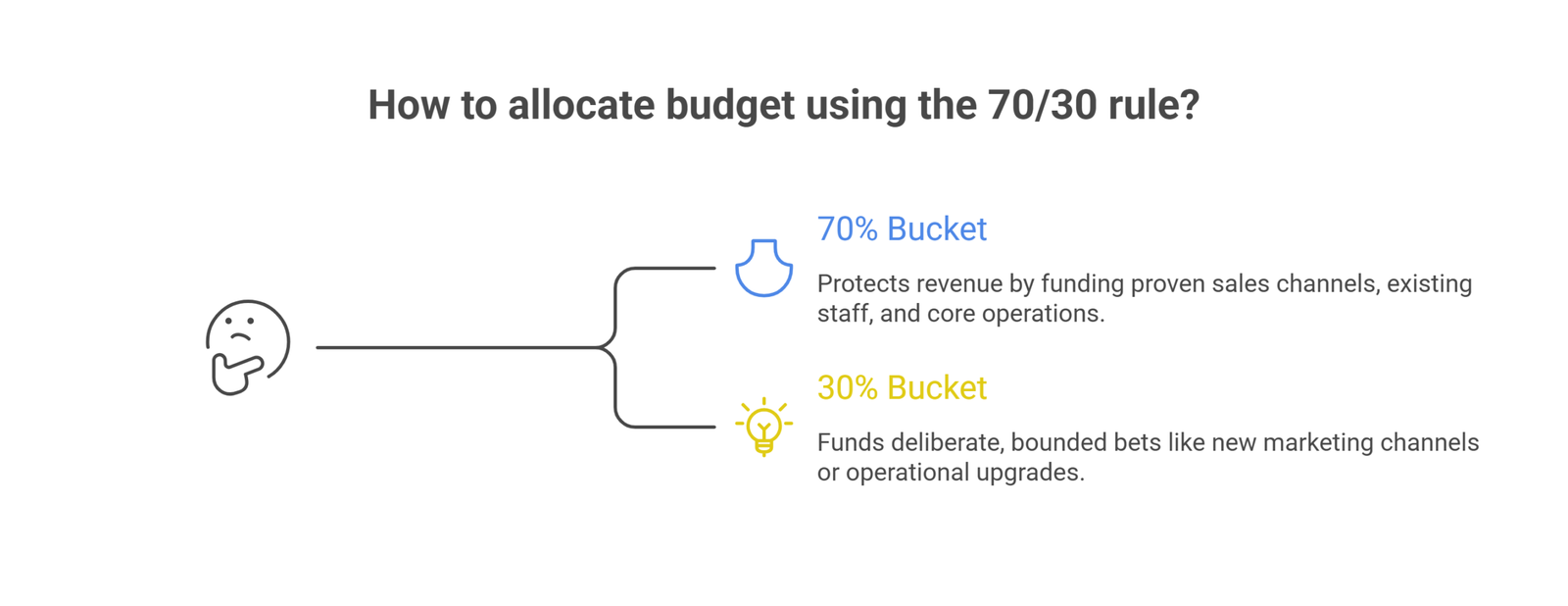
The 70% bucket protects revenue you can already count on. This includes the sales channels with a track record, the team and tools that keep delivery consistent, and any contract or client relationship the business depends on. Cutting into this bucket to fund an experiment is usually the fastest way to damage a business that was otherwise stable.
The 30% bucket funds deliberate, bounded bets: a new marketing channel, an operational upgrade, a pilot product line, or fixing a known weak point, such as a business that depends entirely on one client or one founder. The key word is bounded. A 30% experiment needs a defined budget and a checkpoint, not an open-ended commitment.
Worked example: a business owner running $20,000 a month in total spend keeps $14,000 on proven sales channels, existing staff, and core operations, and allocates $6,000 to testing a second marketing channel and upgrading a reporting tool. If the new channel starts outperforming the old one within a quarter, that’s the signal to revisit the split, not to wait for a year-end review.
Common mistakes that break the rule
- Treating it as exact math. The value of the rule is the discipline of naming two buckets, not hitting 70.0% precisely. Rounding is fine.
- Calling everything strategic. If every expense gets labeled “core” to avoid hard choices, the 30% bucket disappears and nothing new ever gets tested.
- Starving the improvement bucket during a slow month. Cutting the 30% first feels safe, but it’s usually the bucket fixing the exact weaknesses that made the slow month happen.
- Ignoring the data once a split is set. If a 30% bet is clearly outperforming a piece of the 70%, that’s a reason to rebalance, not a reason to wait for the next planning cycle.
- Running it without a review date. A 70/30 split with no scheduled check-in tends to quietly become 90/10 as day-to-day operations crowd out the experimental bucket.
When to lean closer to 80/20 or 60/40
The 70/30 split is a starting point, not a law. A business preparing for a sale often shifts closer to 80/20, since buyers pay for stability and predictability more than they pay for unfinished experiments. A business in a genuinely disruptive market, where the core offer is losing ground to new competitors, may need to shift closer to 60/40 to fund a faster pivot. The ratio should reflect how much risk the business can absorb right now, not a number borrowed from a book.
Frequently Asked Questions
What is the 70/30 rule in business?
It’s a resource allocation guideline: dedicate roughly 70% of budget, time, or attention to proven, revenue-generating activities, and 30% to improvement or growth initiatives.
Is the 70/30 rule the same as the 70-20-10 rule?
No. The 70-20-10 rule splits the non-core portion into two tiers, adjacent and transformational, and is more common in larger organizations running multiple innovation initiatives at once. The 70/30 rule is a simpler, single split better suited to small businesses.
How do I know if my business is spending too much on the “70” bucket?
If the business hasn’t tested a new channel, offer, or process improvement in the last 12 months, the 30% bucket has likely been crowded out. That’s usually a sign spending has drifted closer to 90/10 or higher.
Should every business use exactly 70/30?
No. The split should reflect the business’s stage and risk tolerance. A business preparing for sale often leans closer to 80/20, while one facing real competitive pressure may need closer to 60/40.
How often should the split be reviewed?
Quarterly at minimum. A monthly glance at where spending actually landed against the intended split catches drift before it compounds into a full year of underfunding growth.
Can the 70/30 rule apply to time as well as money?
Yes. Founders can apply the same discipline to their own hours, protecting time spent on client delivery and core operations while reserving a defined block for testing new offers or fixing structural weaknesses in the business.
Conclusion
A 70/30 split only works if someone is checking it against actual spending, not just setting the ratio once and moving on. For businesses juggling this alongside day-to-day operations, this is usually where outsourced CFO support earns its cost: someone needs to own the numbers, flag when the split has drifted, and rebalance before a slow quarter turns into a bigger problem.
If the 30% bucket keeps getting justified with guesswork instead of real projections, a startup financial model can turn “we think this channel will work” into a testable, numbers-backed bet. And if the audit step above turns up spending that’s never been organized into a real plan, structured budgeting is usually the right place to start before applying any allocation rule on top of it.
Businesses that need ongoing eyes on the split, not just a one-time consultation, often move to Virtual CFO support so the review happens on a schedule instead of only when something feels off. Whichever path fits, the tools to track the split accurately matter as much as the ratio itself; our breakdown of budgeting tools covers what to use to keep both buckets honest.
Talk to Oak’s team about building a spending plan that protects what’s working and funds what’s next.