Mistakes that Startups make in a Financial Model
9 financial model mistakes that quietly sink promising startups
Most startups do not fail because the underlying idea was weak. They fail because the numbers behind it were wrong, and nobody caught it until the cash ran out. A financial model exists to catch exactly that kind of problem early, but only if it is built with the same discipline every time. The same handful of mistakes show up again and again, in models built by first-time founders and experienced operators alike.
Revenue projections that ignore the competition
The most common mistake is assuming a product will win the market simply because it exists. Every founder believes their product changes the game, but competitors are fighting for the same customers, and most markets move slower than a pitch deck suggests. Overestimating revenue does not just create an embarrassing gap between plan and reality. It leads founders into decisions, like hiring ahead of demand or locking in fixed costs, that are hard to reverse once revenue falls short.
The opposite mistake, being too conservative, causes its own damage. It can undervalue the business and make investors read low growth assumptions as a lack of market understanding rather than caution.
Fix: Build three scenarios, realistic, optimistic, and pessimistic, grounded in actual market sizing, competitor benchmarking, and observed customer behavior rather than a top-down guess. The realistic case should be the one presented as the plan, with the other two shown as sensitivity ranges.
Underestimating expenses
Founders tend to remember the obvious costs: rent, salaries, software. They forget the ones that are harder to predict, like customer acquisition cost that rises once the easy channels are saturated, contractual rent increases, or the true cost of compliance as the company scales. Underestimating expenses is one of the most common reasons a startup runs out of cash faster than expected, even while revenue is growing.
Expenses also rarely rise in a smooth line. They jump in steps: a new hire adds a full salary and equipment cost overnight, a software tool crosses a usage tier, a lease expands all at once when the current space runs out. A model that assumes everything scales gradually will understate how sharply costs can spike right before a growth milestone.
Fix: Build the expense side from historical data and industry benchmarks, and map costs to the specific milestones that trigger them rather than spreading them evenly across the year. Include both fixed and variable costs, plus a contingency line for the expenses that always turn up unplanned.
Ignoring working capital and cash timing
A model can show a profitable business on paper and still run out of cash, because profit and cash are not the same thing. A business selling through a marketplace like Amazon makes a sale immediately but might not see that cash for weeks, while inventory for the next order still needs to be paid for now. That gap is where otherwise healthy businesses get into trouble.
Fix: Model cash inflows and outflows separately from revenue and expense recognition. A proper cash flow analysis builds in a buffer for the delay between delivering a product or service and actually being paid for it.
Building a model that never gets updated
A model built once and left untouched becomes a liability rather than an asset. Founders end up making decisions based on numbers that no longer reflect reality, simply because rebuilding the model feels like too much work every time something changes.
Fix: Build the model as a proper three-statement model, so changing one assumption updates everything connected to it automatically. Schedule a recurring review, monthly for an early-stage company and quarterly once things stabilize, so the model gets checked against actuals on a fixed cadence rather than only when something goes wrong.
Missing unit economics and acquisition costs
A revenue and expense forecast can look reasonable in aggregate while hiding a business that loses money on every customer. This is a particularly common blind spot for subscription and marketplace businesses, where the real story lives in customer acquisition cost and lifetime value, not the top-line revenue number.
The trap is subtle in the early days. A founder’s first customers usually come through personal contacts and warm introductions, so acquisition looks nearly free. Once that network runs out and the business has to pay for reach through ads, sales hires, or paid content, acquisition cost climbs, and a model built on those early numbers stops reflecting reality.
Fix: Calculate the unit economics for a single customer or transaction before scaling the model up, and model acquisition cost as something that rises in stages rather than a flat number carried forward from month one. If the business does not make sense at the level of one customer, more customers will not fix it.
Vague or overstated capital needs
How much money does the business actually need, and what specifically will it be spent on? Founders who cannot answer that clearly, or who pad the number because they assume investors expect it, damage their own credibility. Investors have reviewed enough models to recognize a number that is not grounded in an actual plan.
Fix: Build a month-by-month budget that shows exactly where the capital goes, tied to specific milestones such as hiring a second engineer, launching in a new market, or reaching a revenue threshold, rather than a lump sum with no attached plan.
A financial model disconnected from the business plan
A business plan and a financial model are supposed to describe the same business, but they often drift apart. A plan that describes a new product launch the financial model never accounts for is an inconsistency investors notice immediately, and it undermines trust in everything else in the document.
Fix: Treat the model as a living translation of the business plan. When the plan changes, whether that is a new product, a pricing change, or a shift in go-to-market strategy, update the model in the same sitting, not weeks later.
Overestimating market size
Founders often inflate their addressable market by confusing three distinct numbers. Total addressable market (TAM) is the full revenue opportunity if the product captured the entire market. Serviceable available market (SAM) narrows that down to what is actually reachable given geography and capability. Serviceable obtainable market (SOM) is the realistic share the business can capture in a given timeframe. A revenue model should be grounded in SOM, since that is the only one of the three that reflects what the company can actually sell.
Fix: Work backward from SOM using real customer segments, competitor market share, and the limits of the company’s own sales and marketing capacity, rather than starting from the biggest possible number and working down. A proper market analysis makes that starting point far more defensible.
No scenario view and no annual rollup
A model built only month to month misses the bigger picture, and a model built only annually misses the seasonality and short-term cash crunches that actually sink a business. Both views are needed, and neither replaces the other.
Scenario planning deserves the same rigor. A single forecast treated as the only possible outcome is not really a plan, it is a hope. Stress-testing the model against a slower sales cycle, a delayed launch, or higher-than-expected costs shows a founder, and an investor, exactly where the business is most fragile.
Fix: Maintain both a monthly view, which shows near-term cash position and seasonality, and an annual rollup, which shows longer-term growth and profitability trends. Present both when talking to investors, since each answers a different question they are likely to ask.
Quick reference
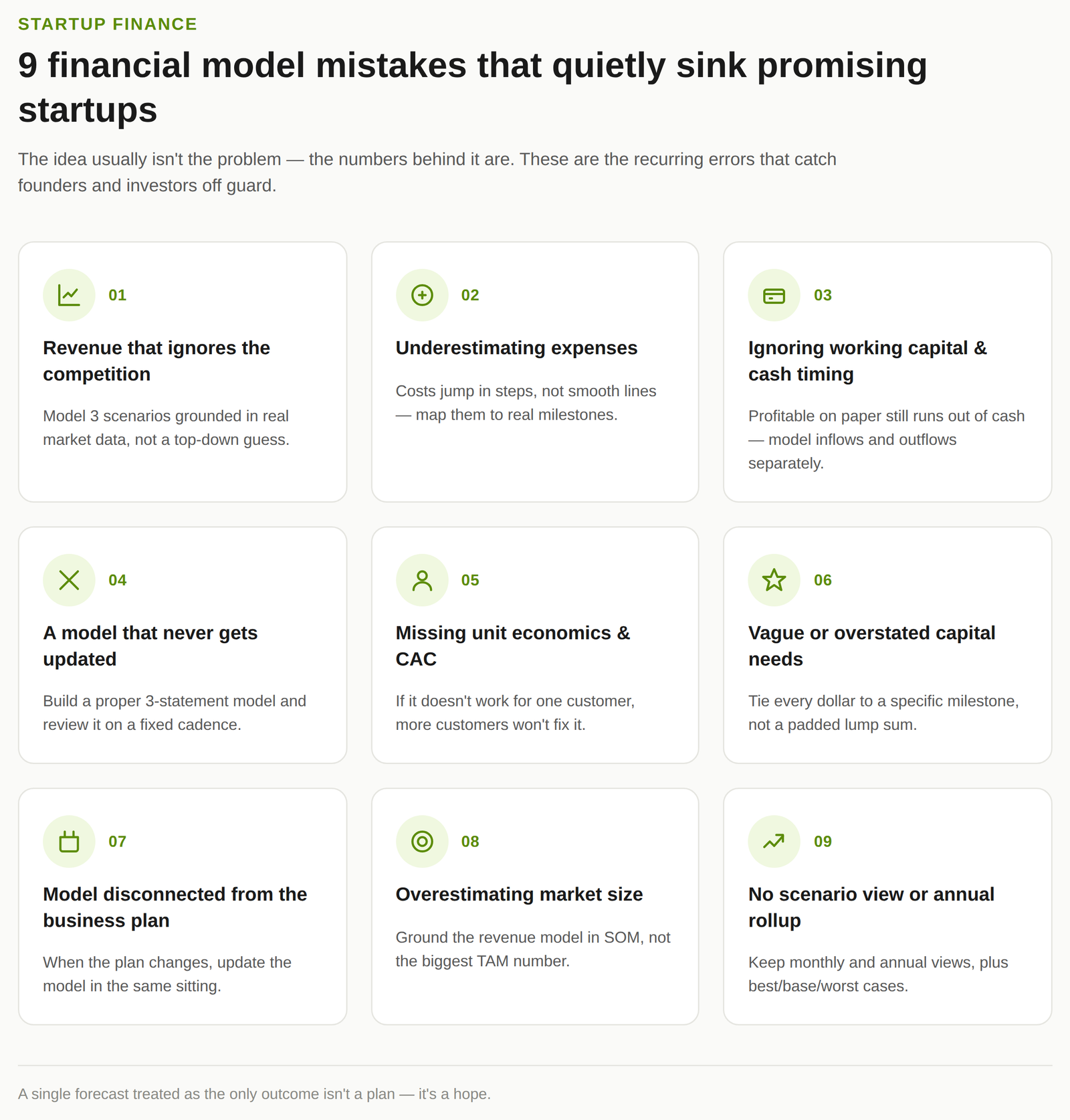
| Mistake | Quick fix |
| Overly optimistic (or pessimistic) revenue | Build realistic, optimistic, and pessimistic scenarios |
| Underestimated, non-linear expenses | Base costs on historical data and benchmarks, map them to milestones |
| Ignoring cash timing | Model cash flow separately from revenue recognition |
| Static, unmaintained model | Build a three-statement model and review it on a set schedule |
| Missing unit economics | Check profitability at the level of one customer, model rising CAC |
| Vague capital ask | Tie funding needs to specific milestones, month by month |
| Plan and model don’t match | Update both together whenever either one changes |
| Inflated market size | Ground the revenue model in SOM, not TAM |
| Only monthly or only annual view | Maintain both, and stress-test the assumptions |
Frequently Asked Questions
Do investors actually check unit economics, or just the headline revenue number?
Experienced investors check both, and often go straight to unit economics first, since a business that loses money on every customer does not become profitable just by adding more customers. Strong top-line growth paired with weak unit economics is one of the first things that gets flagged in diligence.
Is TAM, SAM, or SOM the number that should drive a revenue forecast?
SOM. TAM and SAM describe the size of the opportunity, but SOM is the only one of the three that reflects what the company can realistically capture with its current sales, marketing, and product capacity.
Why does customer acquisition cost rise as a startup scales?
Early customers usually come through founder networks and warm introductions, which cost almost nothing to reach. Once that pool is exhausted, growth depends on paid channels, sales hires, or content that takes time to compound, all of which push acquisition cost higher than the early numbers suggest.
Can a small startup skip scenario planning and just build one forecast?
It is possible, but risky. A single forecast hides how sensitive the business is to a slower sales cycle, a delayed launch, or higher-than-expected costs. Even a simple best-case and worst-case version alongside the main plan gives a founder, and an investor, a much clearer view of the risk involved.
Conclusion
A financial model is never really finished. Founders who treat it as a working tool, revisited regularly and checked against real results, are the ones who catch a cash problem while there is still time to fix it. Founders who build it once for a pitch deck and never open it again are usually the ones surprised by how fast the runway disappeared.
Oak Business Consultant works directly with founders to build and stress-test financial models that hold up under investor scrutiny. If your model needs a second look before your next raise, Oak’s CFO services for startups and startup financial model services work directly on both the numbers and the strategy behind them.