Sports Financial Model Case Study: Multi-Phase Venture Planning
Client Overview
Our client is a sports retail brand expanding into a multi-phase venture that includes a sports app, an indoor complex, and outdoor fields. The client aims to integrate technology, real estate, and sports services under one brand. To support this vision, they needed a robust sports financial model covering 10-year projections, phased investments, and multiple revenue streams. The model included three-statement structures, DCF analysis, and waterfall returns to guide investor discussions and strategic planning.
Client Challenges
- Fragmented Financial Planning Across Phases
The project was divided into three distinct phases—launching a sports app, constructing an indoor facility, and developing outdoor fields. Each phase involved different types of investments, cost structures, and revenue models. Aligning these variables within a single financial framework proved to be highly complex. - Lack of Internal Financial Modeling Capabilities
The client’s team lacked the expertise to build a dynamic financial model that could support multiple revenue streams, phased development, and long-term planning. - Need for a Strategic, Scalable Solution
They required an expert-designed model to guide decisions across real estate, infrastructure, and technology investments—flexible enough to adapt to evolving operational and investor requirements. - Complexity in Revenue Structures
The venture included multiple revenue streams. These ranged from digital app subscriptions and training services to retail sales, therapy programs, and facility rentals. Each stream had its own pricing strategy, volume drivers, and seasonality factors, making it difficult to model accurately. - Investor Return Complexity
The investment structure included both real estate and facility investors. The client needed a clear model for waterfall distributions and land appreciation-based returns. Defining equity splits, return hurdles, and partner roles was essential for structuring financing rounds. - Lack of Integrated Financial Statements
They required a complete three-statement model—covering income statement, balance sheet, and cash flow. Without this integration, it was hard to evaluate the project’s long-term financial health or present a coherent view to potential investors. - Presentation and Communication Gaps
Financial insights were difficult to communicate effectively. The client needed a branded, visual dashboard to illustrate trends, summarize outcomes, and present the financial opportunity in a clear and engaging manner.
Key Features of the Provided Sports Financial Model
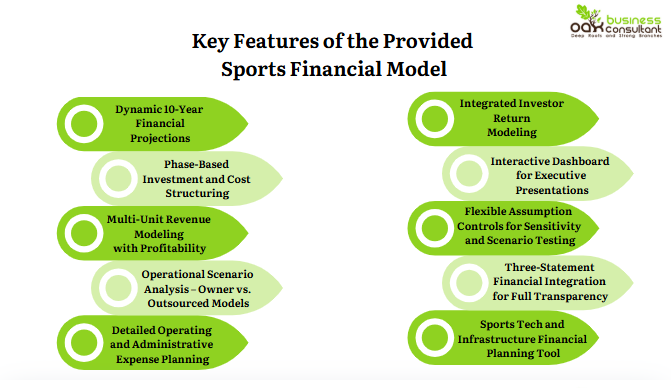
Dynamic 10-Year Financial Projections
The sports financial model provided a comprehensive 10-year view of the project’s financial trajectory. It captured the financial implications of each project phase: from digital product launch to indoor sports facility construction and outdoor complex development. With flexible timeline controls and forecast granularity, the model offered full visibility into projected revenue growth, cash flow trends, and EBITDA progression across the life of the venture. This long-term outlook was critical for early-stage investor outreach, strategic capital planning, and validating the overall business model.
Phase-Based Investment and Cost Structuring
Each phase of the sports tech and infrastructure project required a distinct investment structure. The model broke down capital expenditure (CapEx) into real estate acquisition, technology development, and physical site construction. It included granular input sheets for cost categories such as materials, labor, subcontracting, and equipment rental. By dynamically linking these inputs to the overall financial plan, the model enabled robust cost forecasting and made it easier to align financing needs with execution milestones—essential for any capital-intensive, multi-phase project.
Multi-Unit Revenue Modeling with Profitability
Revenue modeling was structured by business unit, allowing the client to assess detailed profitability analysis across each of them. The model captured revenue from sports therapy, athlete training programs, e-commerce retail, food & beverage operations, facility rentals, and the digital sports app. Each revenue stream included its own pricing, volume, utilization rates, and seasonality assumptions. This helped the client develop a clear understanding of unit-level contribution margins, breakeven points, and long-term revenue scalability—vital for validating monetization strategies.
Operational Scenario Analysis – Owner vs. Outsourced Models
To support decision-making on operational strategy, the financial model featured a built-in toggle system to switch between “Owner-Operated” and “Outsourced” scenarios for each revenue unit. This scenario analysis directly impacted fixed costs, SG&A overheads, and operating margins. The flexibility allowed the client to evaluate the trade-offs between in-house operations and third-party partnerships, facilitating strategic discussions around cost control, service quality, and long-term scalability of operations.
Detailed Operating and Administrative Expense Planning
The model offered a flexible framework for managing operating expenses (OpEx) and administrative overheads. Users could classify expenses as recurring, one-time, or periodic and assign them to specific business units or functions. This included staff salaries, marketing costs, insurance, utility expenses, technology subscriptions, and facility maintenance. By mapping costs to relevant business units, the model provided clear visibility into net operating profit and enabled unit-level performance tracking.
Integrated Investor Return Modeling – IRR, Equity Splits, Waterfall Distributions
The investor return module was designed to handle complex capital structures. For real estate investors, it calculated returns based on land appreciation, rental income, and eventual asset exit value. For operating facility investors, we implemented a detailed IRR-based waterfall distribution structure. This included preferred returns, capital return tiers, and profit split for limited partners and general partners. The framework helped the client design investor offerings that were financially sound, legally compliant, and aligned with typical venture or private equity expectations.
Interactive Dashboard for Executive Presentations
To support pitch presentations and board-level reviews, the model included a dynamic financial dashboard. Key outputs such as revenue forecasts, IRR, cash burn, cumulative investment, and payback periods were visualized using real-time charts and graphs.The dashboard simplified complex financial data into a clear executive summary. This made it easier for investors, lenders, and strategic partners to quickly understand the project’s financial viability.
Flexible Assumption Controls for Sensitivity and Scenario Testing
The model allowed users to modify assumptions across timelines, cost inflation, adoption rates, monetization strategies, and capital sources. This enabled real-time scenario testing and sensitivity analysis to assess risk and opportunity under different market or execution conditions. The functionality proved especially useful during investor negotiations, helping the client demonstrate the resilience of the financial plan under various economic environments.
Three-Statement Financial Integration for Full Transparency
All operational and investment inputs were fully integrated into the Income Statement, Balance Sheet, and Cash Flow Statement. This ensured that every change in the business model was reflected in GAAP-compliant financials. The integration supported internal decision-making, investor due diligence, and use of the model as a working tool for CFO-level financial oversight.
Comprehensive Sports Tech and Infrastructure Financial Planning Tool
The final model brought together multiple business functions—real estate, technology, retail, and services—into one unified, investor-ready financial platform. It served as a strategic planning tool, a capital raise companion, and an operational roadmap. By aligning financial assumptions with execution strategy, the model helped the client present a compelling investment case and manage financial complexity across the project lifecycle.
Outcome
The model gave the client a detailed financial structure with the flexibility to test scenarios and timelines. It helped them prepare for investor presentations by outlining each phase’s financial requirements, expected returns, and operating strategies. The model also formed a base for long-term collaboration. We are now working on tailored investor-ready business plans and pitch decks for different investment phases. Additionally, we are exploring opportunities to support the client further with fundraising consultancy and CFO advisory services.
What’s In It for You?
Building a sports tech and infrastructure venture involves more than just passion. It demands financial clarity, investor alignment, and strategic foresight. Without an integrated financial model, you risk misjudging capital needs and underestimating operational complexity. Lacking phase-specific insights and robust scenario planning can also lead to presenting an incomplete picture to investors.
How to Overcome These Challenges?
To scale confidently and attract the right partners, you need to:
- Develop a comprehensive sports financial model that covers 10-year projections, multi-phase investments, and diverse revenue streams.
- Structure your business by separating business units, forecasting each with its own pricing, utilization, and growth assumptions.
- Build in scenario analysis tools to evaluate owner-operated vs. outsourced models, margin sensitivity, and capital structuring strategies.
- Present a compelling case to investors with waterfall return modeling, clear IRR calculations, and a dashboard that communicates financial strength and scalability.
Let’s Build Your Roadmap to Growth
At Oak Business Consultant, we specialize in building advanced financial models tailored to sports, real estate, and tech-integrated ventures. Whether you’re launching a digital platform, opening a facility, or pitching investors—we’ll equip you with a financial strategy that brings clarity, control, and confidence. Book a free consultation today to bring structure to your vision and credibility to your investor conversations.
Frequently Asked Questions
What is the purpose of a 10-year sports financial model?
The model provides long-term financial projections across multiple phases of the project. It helps in capital planning, investor discussions, and validating the business model for technology, real estate, and sports operations.
How does the model handle multi-phase investments?
Each phase—sports app, indoor facility, and outdoor complex—is modeled separately with dedicated cost inputs, CapEx plans, and revenue assumptions. This allows for phase-specific forecasting and funding strategy.
Can the model show different operational strategies like outsourcing?
Yes. The model includes scenario toggles that allow users to compare ‘Owner-Operated’ versus ‘Outsourced’ models. This impacts margins, staffing needs, and long-term profitability.
What types of revenue streams are included?
The model captures revenue from digital app subscriptions, training programs, therapy services, facility rentals, retail sales, and food & beverage operations—each with its own pricing and volume metrics.
Conclusion
The financial model gave the client a clear, integrated view of a complex, multi-phase sports venture—bridging real estate, technology, and operations. It streamlined strategic planning, supported investor readiness, and equipped leadership with the tools to make data-driven decisions across a 10-year horizon. Need a model built around your vision? Let’s talk about how we can design a financial planning solution tailored to your venture’s scale and complexity.