


How to achieve competitive advantage in any business?
What is a competitive advantage?
The goal of running a business is not just to survive the race. It is to win it — consistently, sustainably, and on your own terms.
Competitive advantage is the reason some companies grow while others stagnate. It is why people choose Apple over a cheaper alternative, why McDonald’s thrives in almost every country on earth, and why Walmart can undercut rivals without sacrificing quality. Understanding how competitive advantage works, and how to build it deliberately, is one of the most valuable things any business leader can do.
This guide breaks it all down: what competitive advantage actually means, the six main strategies for achieving it, real-world examples, and why it matters more than ever in today’s market.
What Is Competitive Advantage?
Competitive advantage is a business’s ability to consistently outperform its rivals in ways that matter to customers. It is what allows a company to generate more sales, attract better talent, command higher prices, or serve customers more efficiently than anyone else in the market.
At its core, competitive advantage answers one simple question: Why should a customer choose you over everyone else?
It is not about being lucky or having a great idea at the right time. It is about building capabilities and positioning that are difficult for competitors to copy. When done right, competitive advantage becomes a structural feature of your business, not just a temporary edge.
There are two classic sources of competitive advantage, first described by economist Michael Porter:
- Lower cost — producing goods or services at a lower cost than competitors, allowing for more competitive pricing or higher margins
- Differentiation — offering something unique that customers value highly enough to pay a premium for
Everything else, from technology adoption to operational excellence, is ultimately a path toward one or both of these outcomes.
The Six Core Strategies
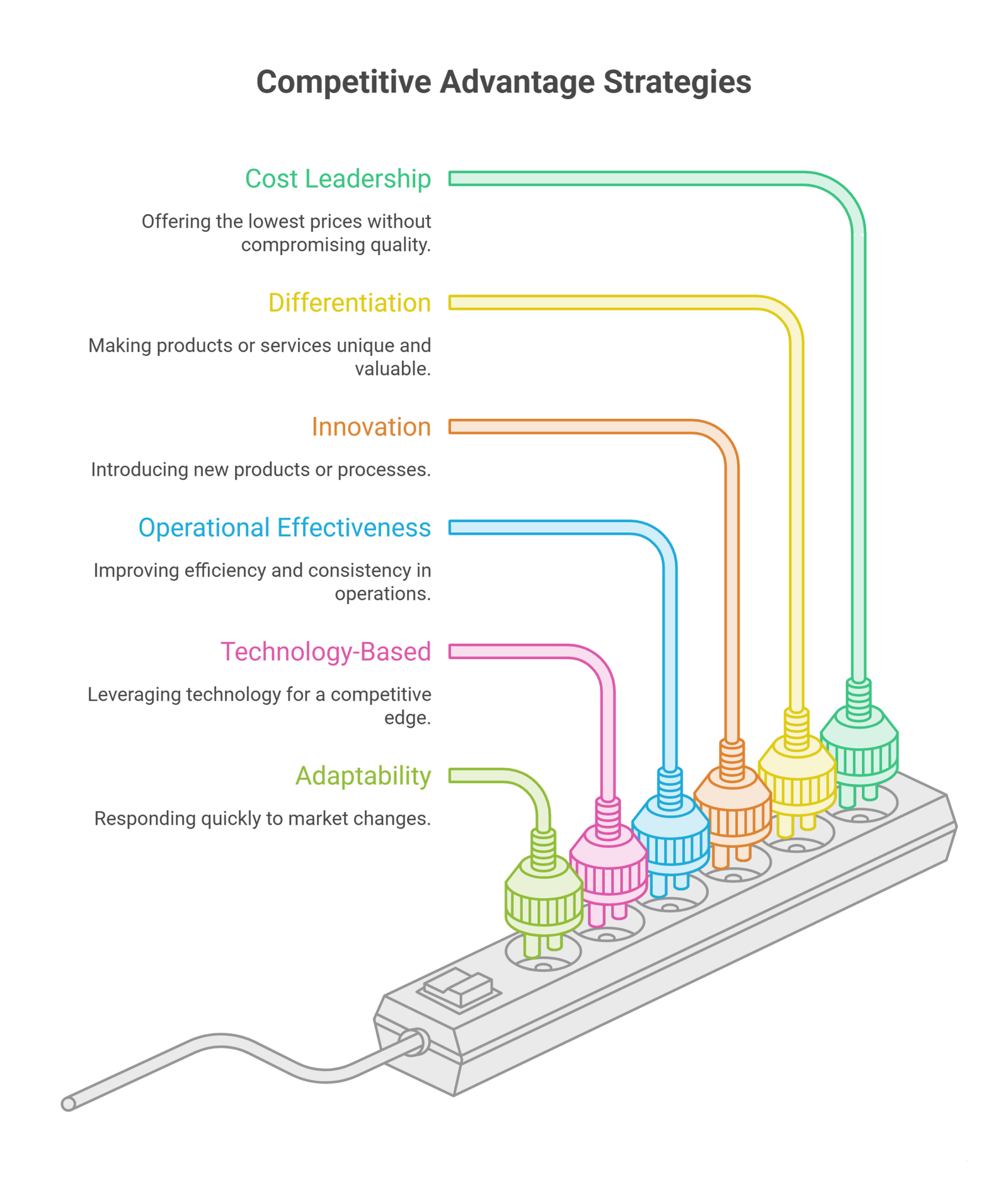
Different businesses achieve competitive advantage through different routes. Here are the six most proven strategies, with a clear look at how each one works.
1. Cost Leadership Strategy
The cost leadership strategy is about becoming the lowest-cost producer in your industry without compromising quality to the point of losing customers. A business that achieves this can offer lower prices than competitors and still maintain healthy margins, or it can match competitor prices and make far more profit on each sale.
Cost leadership is not simply about being cheap. It requires disciplined operations, smart procurement, economies of scale, and relentless efficiency across the whole business. Walmart is the textbook example. Its supply chain infrastructure, bulk purchasing power, and logistics networks mean it can offer prices few rivals can touch and still run profitably at scale.
When it works best: Industries with price-sensitive customers and relatively standardized products, such as retail, manufacturing, and logistics.
Watch out for: Competing purely on price without building operational moats can leave a business vulnerable when a well-funded competitor decides to undercut you.
2. Differentiation Strategy
Differentiation is the art of making your product or service meaningfully different from everything else in the market, and then communicating that difference so clearly that customers are willing to pay more for it.
Differentiation can come from many places: design, quality, customer service, brand identity, features, speed, or emotional resonance. The key is that the difference must be real and it must matter to your target customer. A premium price tag alone is not differentiation. The value behind it must be genuine.
Apple is the most studied example of differentiation done well. Steve Jobs did not just build better computers. He built an entire ecosystem of design, simplicity, and aspiration that made Apple products feel categorically different from everything else. That identity is now so deeply embedded that many Apple customers would not consider switching regardless of price.
When it works best: Markets where customers have varying needs and preferences, and where branding and product quality play a significant role in purchase decisions.
Watch out for: Differentiation can erode quickly if competitors copy your features. Sustained differentiation requires continuous investment in what makes you unique.
3. Innovative Strategy
Innovation-driven competitive advantage comes from introducing something the market has never seen before, or dramatically reimagining how something is done. It is less about incremental improvement and more about leaping ahead of where the industry currently sits.
This strategy requires a culture that tolerates risk, embraces experimentation, and rewards creative thinking. The payoff, when it works, is enormous. Companies that genuinely innovate often define entirely new categories and enjoy years of lead time before competitors catch up.
Think of Netflix moving from DVD rentals to streaming before most people could imagine it. Or Amazon introducing one-click purchasing and Prime delivery when two-day shipping seemed impossibly ambitious. These were not natural evolutions, they were bets that reshaped entire industries.
When it works best: Technology, software, consumer products, and any industry experiencing significant disruption or change.
Watch out for: Innovation without execution is just an idea. Many innovative businesses fail not because the idea was wrong, but because they could not scale or sustain it operationally.
4. Operational Effectiveness Strategy
This strategy is about doing what you already do, but doing it better than anyone else. It is the competitive advantage of execution. Processes are tighter, waste is lower, delivery is faster, and quality is more consistent.
Operational effectiveness is often underestimated because it is not glamorous. There is no viral launch moment. But over time, a business that consistently outperforms its peers in execution builds a moat that is remarkably hard to cross.
FedEx is a classic case. It started with an innovative concept, guaranteed overnight delivery but the real advantage was built through obsessive operational discipline. Even as rivals entered the market, FedEx’s logistics infrastructure and culture of precision kept it ahead.
When it works best: Logistics, manufacturing, healthcare operations, and any business where reliability and consistency drive customer loyalty.
Watch out for: Operational effectiveness alone can be copied, given enough time and investment. It is most powerful when combined with another source of advantage.
5. Technology-Based Competitive Strategy
In today’s business environment, how well a company uses technology often determines whether it leads or lags. A technology-based competitive strategy means leveraging tools, platforms, data, and automation in ways that competitors cannot easily replicate.
This goes beyond having the latest software. It means building systems, collecting meaningful data, using analytics to make better decisions, and freeing up human talent for higher-value work. Companies that master this can serve more customers, respond faster, reduce costs, and innovate more efficiently.
Amazon’s recommendation engine, Google’s search algorithm, and Shopify’s e-commerce infrastructure are all examples of technology advantages that were years in the making and remain extremely difficult for competitors to replicate quickly.
When it works best: Any industry, but especially those with large data sets, complex operations, or customer-facing digital experiences.
Watch out for: Technology requires continuous investment and skilled people. It can become a liability if it is not maintained, updated, and aligned with the business strategy.
6. Adaptability Competitive Advantage
The ability to adapt quickly when conditions change is itself a form of competitive advantage — and it has arguably never mattered more than it does today. Companies that can pivot their operations, business models, or customer offerings in response to disruption come out of turbulent periods stronger than those that cling to what worked before.
The COVID-19 pandemic was a brutal but instructive test of adaptability. Businesses that could shift to remote operations, e-commerce, or new service models often not only survived but captured market share from slower-moving rivals. Those that could not adapt even if they had been successful before struggled badly.
Adaptability is not just about reacting to crises. It is about building an organization that is structurally capable of change: lean decision-making, flexible processes, a culture that embraces learning, and leadership that is honest about what the market is telling them.
When it works best: All businesses benefit from adaptability, but it is especially critical in fast-moving industries and during periods of broader economic or social disruption.
Watch out for: Change for its own sake is not adaptability. Constant pivoting without strategic clarity can be just as damaging as being too rigid.
Competitive Advantage in the Real World
Looking at how successful companies have actually built their advantages makes the theory more concrete.
McDonald’s runs one of the most efficient food production systems on earth. Through economies of scale, standardized processes, and an enormous supply chain, it produces consistent food at prices most competitors cannot match. Its competitive advantage is not the food itself — it is the system behind it.
Apple has built one of history’s most powerful brand differentiators. Customers pay significantly more for Apple products not just because of the hardware, but because of the design philosophy, the ecosystem integration, and the identity that comes with the brand. That differentiation has been decades in the making.
Walmart combines cost leadership with sheer scale. Its buying power, logistics network, and supply chain relationships allow it to offer low prices across an enormous product range while maintaining profitability. Customer loyalty follows naturally when people know they can trust the price.
Netflix executed a technology-and-innovation strategy that made it the dominant player in streaming before most of its competitors understood what streaming even meant as a business.
Each of these companies made a deliberate strategic choice, invested heavily in it over time, and built operational systems that made it difficult for competitors to close the gap quickly.
Why Competitive Advantage Matters
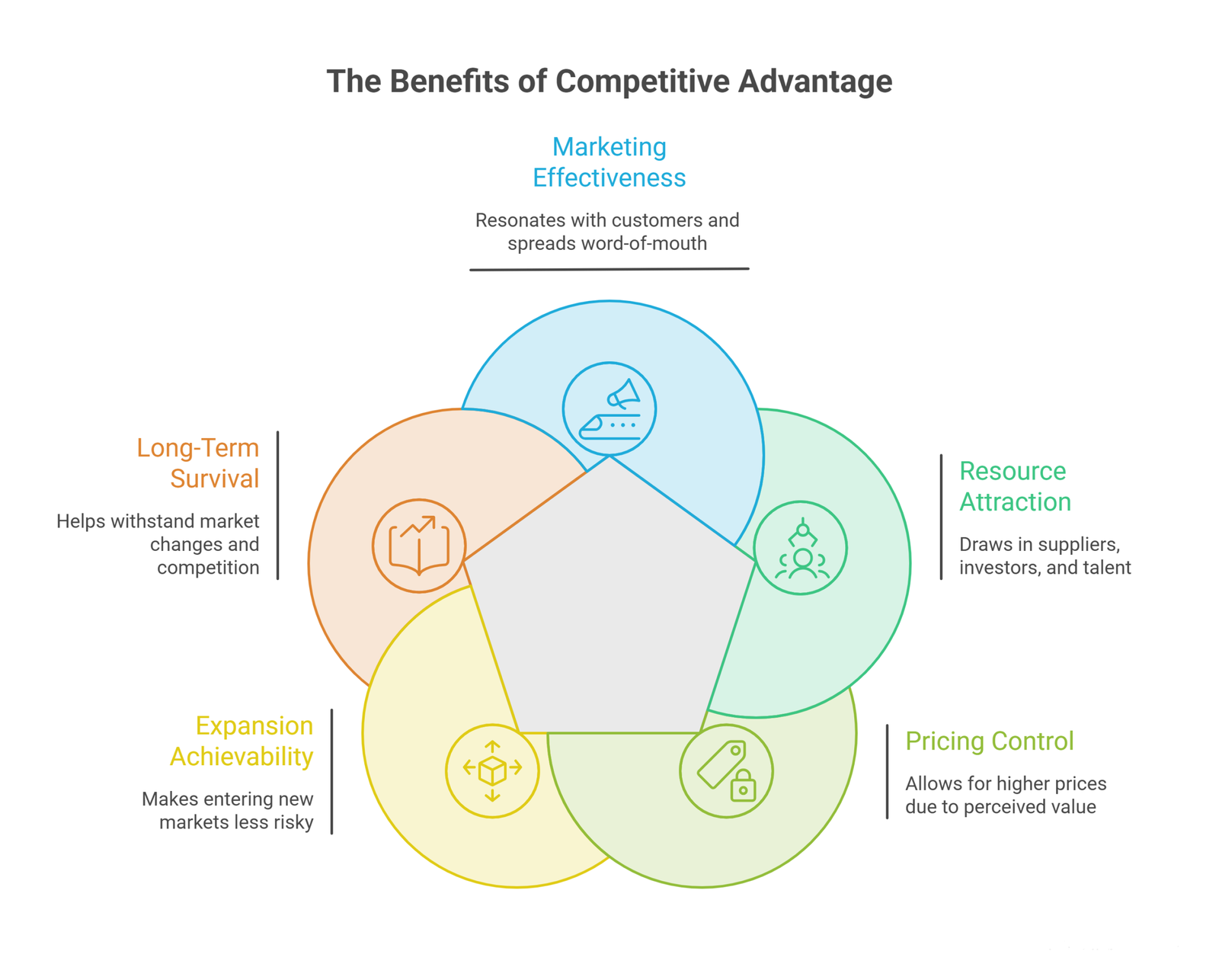
Building a genuine competitive advantage pays off across every area of the business.
Marketing becomes more effective. When you are known for something specific and valuable, your marketing messages resonate more deeply. Customers already have a reason to pay attention. Word-of-mouth spreads more naturally. You spend less effort convincing and more time connecting.
You attract better resources. Suppliers, vendors, and partners want to work with market leaders. Investors are drawn to businesses with clear differentiation. A strong competitive position gives you access to better deals, better talent, and better partners — all of which reinforce your advantage.
You control your pricing. One of the most powerful things a competitive advantage can give you is pricing power. When customers believe you offer something genuinely better than the alternatives, price sensitivity drops. You are no longer competing purely on cost, which protects your margins even as market conditions shift.
Expansion becomes more achievable. A business with a strong competitive advantage has a playbook that works. Expanding into new markets or product lines is less risky because you know what drives your success and you can carry it with you. A recognized brand and proven model open doors that would otherwise stay closed.
Long-term survival improves significantly. Markets are not static. Competition intensifies, customer preferences shift, and technology disrupts established ways of doing business. Companies with genuine competitive advantages are far better positioned to weather these changes and come out ahead.
How to Start Building Yours
Building competitive advantage is not something that happens in a single strategic planning session. It is a long-term commitment. But the starting point is clear: know your market deeply, know your strengths honestly, and make a deliberate choice about where you are going to focus.
Here are four practical starting points:
1. Audit your current position. Where do you genuinely outperform competitors today? What do your best customers say they value most about you? These answers often reveal the seeds of a competitive advantage that can be developed further.
2. Understand your competitors clearly. You cannot differentiate from rivals you do not understand. Know their pricing, their positioning, their weaknesses, and how customers perceive them relative to you.
3. Choose a primary strategy and invest in it. Most businesses that try to be everything end up being nothing in particular. Choose one of the six strategies above as your primary focus and build your operations, culture, and investments around it.
4. Measure and refine constantly. A competitive advantage that worked last year may need to evolve this year. Track the metrics that matter, listen to customers, and be willing to refine your approach as the market changes.
Frequently Asked Questions
Can a small business build a genuine competitive advantage?
Absolutely. Many small businesses have powerful advantages that larger rivals struggle to match, local knowledge, personal relationships, faster decision-making, or deep specialization in a niche. Size is not the determining factor; clarity of focus and consistent execution are.
How long does it take to build a competitive advantage?
It depends on the strategy. A technology-based advantage might take years of investment. A differentiation advantage can sometimes be established faster if the branding and product are strong from the start. In general, meaningful competitive advantages take time to build and even more time to defend. That is also what makes them valuable.
What is the difference between competitive advantage and competitive strategy?
Competitive strategy is the plan — the deliberate choices a company makes about where to compete and how. Competitive advantage is the outcome — the superior position that results from executing that strategy well over time.
Can a business lose its competitive advantage? Yes, and it happens more often than companies expect. Competitive advantages erode when rivals catch up, technology changes the rules, customer preferences shift, or a company stops investing in what made it successful. Maintaining an advantage requires the same discipline as building it in the first place.
Which competitive advantage strategy is best for a startup?
There is no single answer, but startups often find success by starting with a narrow differentiation or innovation strategy, focusing on a specific customer problem that established players are not solving well. Cost leadership typically requires scale, which startups rarely have early on.
Conclusion
Competitive advantage is ultimately about having a clear, defensible reason why customers should choose you over everyone else, and then building your entire business around delivering on that reason consistently.
It is not a one-time achievement. It requires sustained effort, honest self-assessment, and the willingness to keep investing in what makes you genuinely better. The businesses that build lasting competitive advantage are not necessarily those with the biggest budgets or the most obvious ideas. They are the ones that commit to a direction, execute with discipline, and never stop improving.
Whether you are a startup finding your footing or an established company navigating a shifting market, the question is the same: what are you building that competitors will struggle to replicate? Answer that well, and everything else becomes easier.Is Your Competitive Advantage Investor-Ready? Having a unique edge is great, but translating that advantage into a bulletproof narrative that convinces institutional investors is where many founders stumble. Let our professional fundraising services help you articulate your operational moats, project defensible market share, and secure the capital you need to scale. Schedule your free capital growth consultation.


