Case Study: Reducing Churn with an SVOD Financial Model
Client Overview
The client operates in Subscription Video on Demand (SVOD), offering movies, series, music, and original content via flexible subscription plans. They aim to grow subscriber base, improve user engagement, and diversify revenue streams.Oak Business developed a SVOD financial model integrating CAPEX, OPEX, subscription revenue, content costs, and key metrics like CLV, ARPU, CAC, and churn rate. The model includes Income Statements, Cash Flows, Balance Sheets, and depreciation schedules. It supports evaluation of NPV, IRR, WACC, and enterprise value, helping optimize content distribution, exclusive content, and high-quality shows for sustainable growth.
Challenges for the Platform
1. Scaling Subscriber Base
The client faces challenges in rapidly growing its subscriber base while keeping Customer Acquisition Costs (CAC) manageable. Maintaining subscriber retention is critical due to competition and evolving user behavior trends. Optimizing Customer Lifetime Value (CLV) is essential to ensure long-term profitability.
2. Content Acquisition and Production
Securing high-quality video content and developing original programming requires significant investment. Negotiating content licensing agreements and acquiring exclusive content adds complexity and cost. Balancing content costs with revenue potential remains a key challenge.
3. Revenue Optimization
The platform must balance subscription plans, ad-supported tiers, and transactional video on demand (TVOD) options to maximize revenue streams. Implementing ad monetization while preserving a premium ad-free experience is a delicate task. Accurate forecasting through the SVOD financial model is critical to project ARPU, revenue, and profitability.
4. Technology and Platform Efficiency
Investments in OTT technology, content management systems, and platform enhancements are required for seamless streaming. Ensuring a smooth user experience across devices, including mobile-native content, is essential. Protecting content through robust content security systems is also a key operational challenge.
5. Investor and Financial Planning
The client needs to demonstrate strong financial projections to attract equity and bond investment. Managing CAPEX and OPEX while providing clear visibility through Income Statements, Cash Flow, and Balance Sheets is critical. Investors also require evaluation of metrics such as NPV, IRR, WACC, and enterprise value.
Services Provided
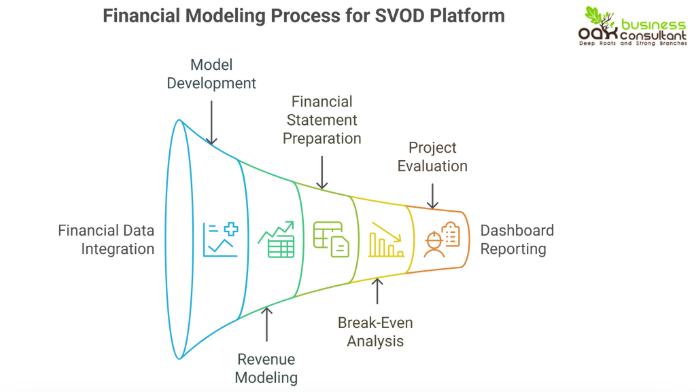
Oak Business delivered comprehensive services to support the client’s expansion and funding strategy, focusing on operational efficiency and investor readiness.
1. Developing the SVOD Financial Model
We created a detailed SVOD financial model that integrates CAPEX, OPEX, subscription revenue, and content costs, providing a complete view of the platform’s financial health. The SVOD financial model tracks key metrics such as Customer Lifetime Value (CLV), Average Revenue Per User (ARPU), Customer Acquisition Cost (CAC), and churn rate.
2. Modeling Revenue and Subscriptions
We built a comprehensive revenue model based on subscription plans, including premium and ad-supported tiers. Additionally, we incorporated lost subscriptions and subscriber growth projections directly into the SVOD financial model to ensure accurate forecasting. We also integrated marketing spend, content strategy, and monetization channels to optimize revenue streams.
3. Preparing Financial Statements and Analysis
We linked the Income Statement, Cash Flow Statement, and Balance Sheet directly to the SVOD financial model. This ensures that any updates in assumptions automatically reflect across all financial statements. We modeled depreciation, amortization, and operational expenses to provide accurate insights for investors.
4. Calculating Break-Even and Key Metrics
We used the SVOD financial model to calculate the break-even point and track critical performance indicators. We included metrics such as subscriber engagement, content ROI, and operational efficiency to enable data-driven management decisions.
5. Conducting Project Evaluation and Valuation
We evaluated the project using the SVOD financial model, calculating Net Present Value (NPV), Internal Rate of Return (IRR), Weighted Average Cost of Capital (WACC), and payback period. We also assessed enterprise value, market value, and intellectual property valuation to guide funding and investor equity allocation.
6. Building Dashboard and Reporting
We developed a visual dashboard to present projections, KPIs, and financial insights drawn from the SVOD financial model. The dashboard highlights revenue trends, subscriber growth, and content performance, helping both investors and management quickly understand the platform’s potential.
Outcome
Oak Business delivered a robust SVOD financial model that provides clear visibility into revenue streams, subscriber growth, and operating expenses. Investors can evaluate metrics such as NPV, IRR, WACC, and enterprise value, while management can track CLV, ARPU, and churn rate.
The model, dashboards, and financial statements enable data-driven decisions on content strategy, subscription plans, and platform enhancements, supporting sustainable growth and maximizing investor value.
What’s in It for You?
As a SaaS founder, digital product owner, or financial stakeholder in a recurring revenue business, managing growth and sustainability in the subscription economy presents unique financial challenges. Without a structured subscription-based financial model, your business may face:
- Unreliable revenue forecasts, making long-term planning difficult and limiting scalability.
- Rising customer acquisition and retention costs, without clear insight into ROI.
- Ineffective pricing and tiering strategies, reducing ARPU and limiting market positioning.
- Inconsistent cash flow, caused by unmanaged churn, deferred revenue, and billing cycles.
- Investor hesitation, due to lack of transparency in core SaaS metrics like MRR, CLV, CAC, and renewal rates.
How to Overcome These Challenges
Implementing a tailored subscription-based financial model allows you to address these pain points and build a foundation for predictable, scalable growth:
- Build a Scalable Recurring Revenue Framework: Gain visibility into monthly recurring revenue (MRR), churn, Customer Lifetime Value (CLV), and renewal rates through dynamic forecasting.
- Optimize Pricing and Subscription Tiers: Test and implement flexible pricing strategies for different customer segments to increase retention and maximize ARPU.
- Refine Acquisition and Retention Strategies: Track key metrics like CAC and CLV to allocate marketing spend effectively and reduce churn.
- Strengthen Cash Flow and Capital Planning: Accurately manage deferred revenue, monitor billing cycles, and forecast cash requirements to support operations and growth.
- Increase Investor Readiness: Present professional-grade projections, IRR, and scenario analysis to build investor confidence and secure funding efficiently.
Ready to Elevate Your Recurring Revenue Strategy?
At Oak Business Consultant, we specialize in creating robust, investor-ready subscription-based financial models for SaaS and digital service providers. Book a free consultation today to unlock financial clarity, optimize performance, and scale your business with confidence.
Frequently Asked Questions
What was the main challenge for the client?
The platform struggled to scale its subscriber base while managing CAC, retaining users, and optimizing content investments.
How did Oak’s financial model help address these challenges?
The model provided a clear view of revenues, expenses, churn, CLV, and ARPU, enabling data-driven decisions for growth and retention strategies.
Did the model support content strategy decisions?
Yes, it forecasted content acquisition and production costs, evaluated ROI for original programming, and helped balance spending with projected revenue.
How did the model improve revenue optimization?
By simulating subscription tiers, ad-supported options, and TVOD streams, the model identified pricing strategies that maximize ARPU and overall profitability.
Was investor readiness improved?
Absolutely. Oak’s model generated professional financial statements, NPV, IRR, WACC, and enterprise value metrics, presenting a credible case to investors and lenders.
How did the model enhance operational efficiency?
It tracked CAPEX, OPEX, content costs, and platform technology investments, allowing the client to optimize resource allocation and plan long-term expenses.
Conclusion
The SVOD financial model provided the client with clear insights into revenue streams, subscriber growth, and operational performance. It allowed accurate forecasting and supported informed decision-making. The model also helped present a clear picture to investors, highlighting the platform’s growth potential in the competitive video streaming market. Contact us today to discuss how a tailored SVOD financial model can guide your business strategy and investment planning.