Revolutionizing Finance: The Power of AI Financial Modeling
AI financial modeling: why most finance teams still aren’t using it
Corporate finance has spent three decades tied to the spreadsheet. Revenue projections, cash flow schedules, and scenario plans all still start life in a grid of formulas that one wrong cell reference can quietly break. Artificial intelligence promises to change that, and finance leaders believe it: most surveyed CFOs now say AI will be extremely important to their department within the year. Yet only a small fraction of finance teams report actually using it in their core modeling workflows. That gap, not a lack of enthusiasm, is the real story of AI financial modeling in 2026.
The gap between believing in AI and using it
Confidence in AI has outpaced adoption. In a survey of North American CFOs at companies with $1 billion or more in revenue, 87% expected AI to be extremely or very important to their finance function this year, while separate industry research found only around 17% of finance teams were actively using AI inside their core workflows. The difference comes down to timing and capability rather than appetite. Agentic modeling tools, the kind that can build and revise a working model rather than just answer questions about one, only became reliable enough for serious use in early 2026. Before that point, most “AI in finance” activity was limited to chat-based Q&A layered on top of static spreadsheets.
For finance teams still working out how AI fits into financial modeling, that lag is normal, not a sign of falling behind. The tools genuinely were not ready a year ago.
The shift from traditional to AI-driven modeling
Traditional financial models, built by hand in Excel, involve manual data entry, formula creation, and scenario analysis. They work, but they struggle with large or messy datasets, unstructured inputs like press releases or SEC filings, and anything that needs updating in real time. Recent research puts the share of business spreadsheets containing at least one critical error at 94%, and every one of those errors can quietly distort a forecast or a valuation.
AI-driven modeling closes those gaps by automating the data-heavy parts of the job. It can pull financial data from sources like Capital IQ, investor presentations, and internal systems, then use predictive algorithms to spot patterns in historical results and project forward. Generative AI adds a further layer: a finance lead can now ask a model in plain language, “what happens to runway if churn rises two points next quarter,” instead of rebuilding a scenario tab from scratch.
| Aspect | Traditional modeling | AI-driven modeling |
| Data handling | Manual entry, limited to structured data | Automates structured and unstructured data (news, filings, CRM exports) |
| Speed | Slow, iteration-heavy | Real-time updates and instant scenario planning |
| Accuracy | Exposed to manual error | Improved through pattern recognition and anomaly detection, though new errors can hide in AI-generated formulas |
| Scalability | Struggles with large datasets | Handles large datasets through neural networks |
| Oversight needed | Manual review of every formula | Verification of AI logic, not just outputs |
Core technologies behind the shift
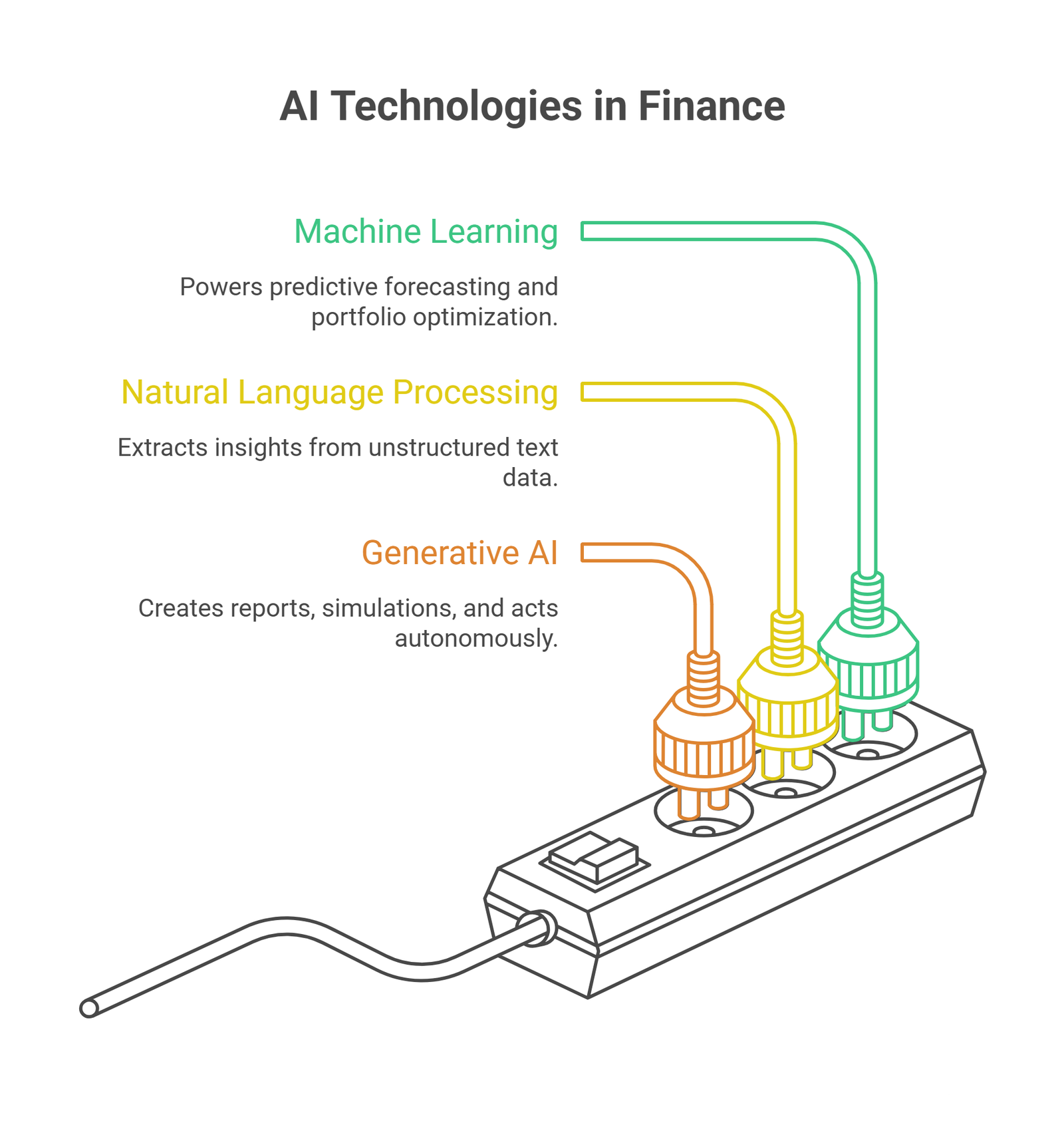
Three technology families are doing most of the work:
- Machine learning and neural networks power predictive forecasting for revenue and expenses, and support portfolio optimization approaches like Markowitz mean-variance optimization or the Black-Litterman model.
- Natural language processing reads unstructured inputs, financial statements, filings, customer reviews, and pulls out usable signal such as geographic revenue splits or shifts in market sentiment. Large language models can draft variance commentary or summarize a dense filing in seconds.
- Generative and agentic AI goes further still, producing full reports or simulations and, increasingly, acting with some autonomy: flagging anomalies, drafting variance analysis, or building out a 3-statement model from raw inputs through a chat interface.
These capabilities tend to plug into tools finance teams already use rather than replace them outright, which is part of why adoption is accelerating even among teams that were slow to move.
Where this is actually running today
AI-assisted modeling has moved past the pilot stage in a few clear areas:
- Forecasting and FP&A. Platforms such as Datarails and Planful layer AI on top of familiar spreadsheet workflows, automating variance detection and flagging revenue or cost anomalies without forcing teams onto new systems.
- Investment banking and deal work. Junior bankers increasingly use AI tools to draft first-pass 3-statement models and pull data out of investor decks, freeing senior staff to focus on advisory judgment rather than data entry.
- Fraud and risk monitoring. Banks run real-time transaction monitoring for fraud detection, paired with stress testing that models how a portfolio behaves under different economic shifts.
- Startup and SMB modeling. Smaller companies without a dedicated modeling team can now get investor-ready projections without hiring a full-time analyst, which is changing how startup financial models and fractional CFO engagements get scoped.
The risk nobody prices in: verification
The uncomfortable part of AI modeling is that the errors baked into traditional spreadsheets do not disappear, they just move. A model an AI assembled in minutes can still contain a broken formula or a schedule that silently fails to feed into the rest of the workbook, and it is often harder to catch because a human never typed the logic by hand. An AI that reports a balance sheet as balanced when it is not is, in practice, more dangerous than a tool that produces nothing at all.
That is why governance is becoming as important as the modeling itself. Regulators increasingly treat explainable AI, being able to show how a model reached a conclusion, as a requirement rather than a nice-to-have for credit, risk, and compliance decisions, alongside standard data-security frameworks like SOC 2 and GDPR. Finance teams adopting AI modeling need a habit of tracing every formula and confirming every linked schedule actually calculates what its label says, the same discipline a careful analyst would apply to a hand-built model, just aimed at a new kind of output.
Where this is headed
Expect agentic systems to keep taking on more autonomous work, from drafting variance commentary to proposing capital allocation scenarios for a human to approve. Integration with quantum computing and blockchain-verified data sources is further out but already being discussed as a way to strengthen both computational depth and transparency in modeling. The more immediate trend is AI acting as a financial copilot: a natural-language layer sitting on top of the model that lets non-specialists ask questions and get real projections back, not just a chatbot summary of what a spreadsheet already says.
As these tools mature, they are likely to lower the bar for smaller businesses to access modeling that used to require a specialist, while shifting the analyst’s job further toward reviewing and directing AI output rather than building every schedule by hand.
Frequently Asked Questions
Why are so few finance teams using AI in their core workflows despite the hype?
Capability caught up with expectations only recently. Reliable agentic modeling tools became viable in early 2026, so most of the gap between CFO enthusiasm and actual use reflects timing, not reluctance.
How does AI improve risk management in finance?
Through anomaly detection, stress testing, and scenario planning, often incorporating established frameworks like Value at Risk, the Capital Asset Pricing Model, or Black-Scholes for more granular risk profiling.
Can AI tools integrate with Microsoft Excel?
Yes. Most AI finance platforms are built to sit on top of Excel rather than replace it, so teams keep their existing spreadsheets while gaining automated data pulls and variance flagging.
Is AI financial modeling realistic for a small business?
Yes, and this is where adoption is moving fastest. SMB owners can get investor-ready projections without a dedicated financial modeler, though the model still benefits from a professional review before it goes in front of investors or a bank.
What is the biggest risk in adopting AI for financial modeling?
Trusting AI-generated output without verifying it. Errors can hide inside formulas nobody typed by hand, and an AI confidently reporting a wrong number is riskier than a model that visibly fails.
Conclusion
AI financial modeling in 2026 is not a story of universal adoption, it is a story of a capability gap that is closing fast. The technology to automate forecasting, flag anomalies, and build working models from messy data now exists and works, but most finance teams are still figuring out how to bring it into daily use without losing the discipline that catches errors before they reach a board deck or an investor.
If your team is weighing how to bring AI into your forecasting and modeling process without losing that oversight, Oak Business Consultant’s Financial Modeling Services can help you build models that use AI where it genuinely helps and keep a professional review where it matters. Contact us to talk through what that looks like for your business.