Pricing Analysis Methods The Guide to Smarter, Profitable Pricing
Pricing Analysis Methods You Should Know
Pricing is one of the most powerful levers in any business. Set it too high and you lose customers. Set it too low and you leave money on the table or worse, signal that your product isn’t worth much. The difference between companies that consistently win on price and those that constantly second-guess themselves usually comes down to one thing: a disciplined, repeatable approach to pricing analysis methods.
This guide breaks down everything you need to know from foundational concepts to advanced research techniques so you can price with confidence, defend your margins, and grow your market share.
What Is Pricing Analysis and Why Does It Matter?
Price analysis is the process of evaluating whether a price is fair, competitive, and sustainable. This can be done without necessarily diving into the underlying cost structure. Pricing analysis, more broadly, refers to the systematic study of how prices are set, how customers respond to them, and how they stack up against market conditions and competitor strategies.
Done well, pricing analysis methods give you:
- A clear picture of where your prices stand relative to competitors
- Insight into customer perceptions and willingness to pay
- Data to support profit maximization without sacrificing volume
- A foundation for a resilient, long-term pricing strategy
Every business, whether a startup setting its first price point or an enterprise renegotiating contracts benefits from a structured analytics-based approach to pricing.
The Core Categories of Pricing Analysis Methods
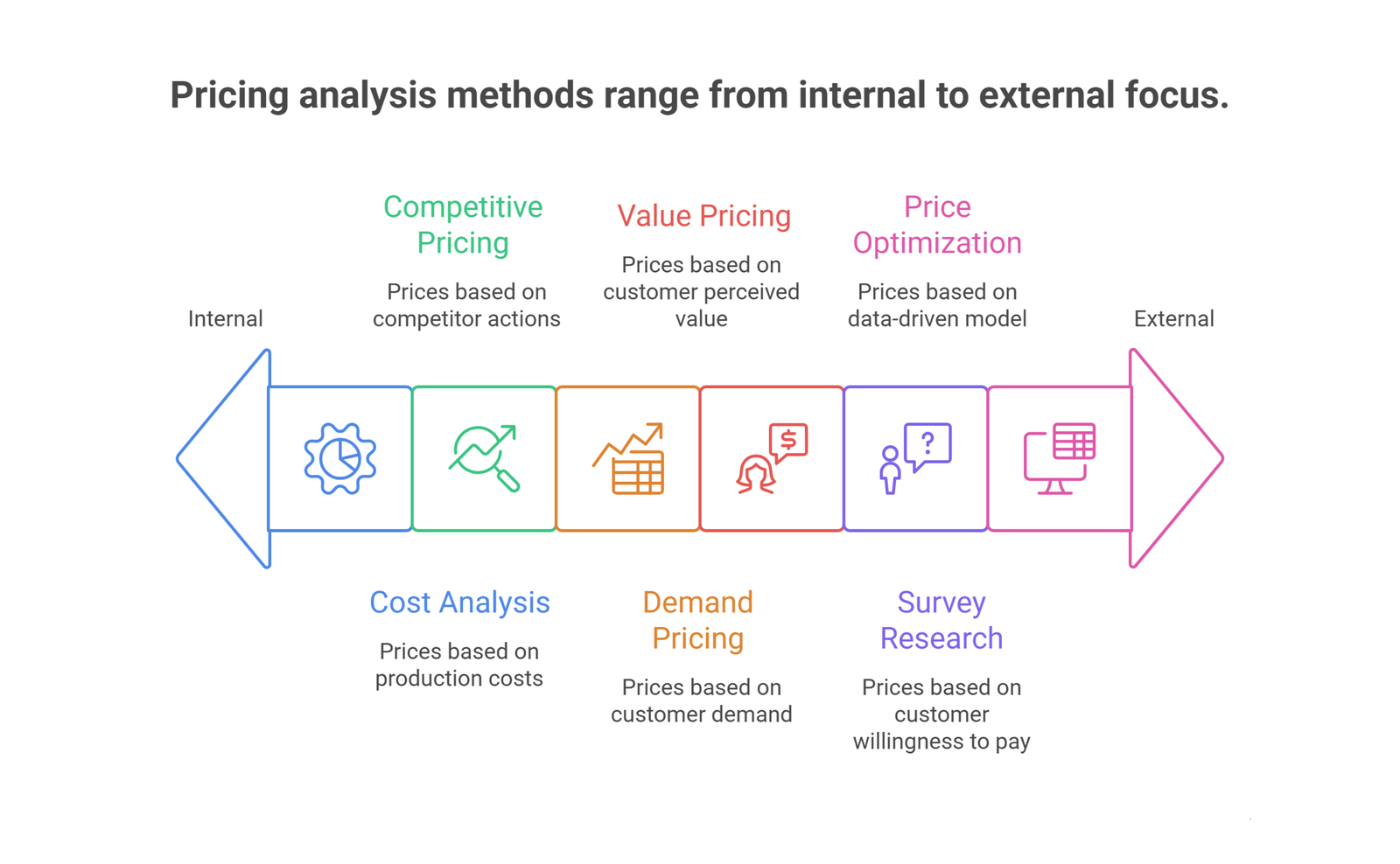
There is no single “best” method. The right approach depends on your goals, your industry, your data availability, and your customers. Most sophisticated businesses use a combination of the methods below.
1. Competitive Pricing Analysis
Competitive pricing analysis, sometimes called price comparison analysis, involves systematically tracking and evaluating what competitors charge for similar products or services. It is one of the most widely used pricing analysis methods, particularly in retail, SaaS, and manufacturing.
The process typically involves:
Competitor price monitoring: Regularly capturing unit prices across your competitive set, either manually, through competitor price monitoring software, or via electronic trading platforms and pricing data feeds.
Price index calculation: Creating a price index by dividing your price by the average market price gives you a quick snapshot of whether you’re above, at, or below market. A price index above 1.0 means you’re priced at a premium; below 1.0 means you’re priced more aggressively.
Analyzing competitors pricing strategies: Look beyond the number itself. Are competitors using dynamic pricing, where prices shift based on demand or time? Are they using loss-leader tactics on certain SKUs to capture volume? Understanding the logic behind competitor strategies is as valuable as knowing the price itself.
The goal of competitive pricing analysis isn’t to automatically match or undercut. It’s to make informed, deliberate decisions about where you want to sit in the market and whether your pricing reflects your brand value appropriately.
2. Cost Analysis and Cost-Plus Pricing
Cost analysis involves breaking down all the costs associated with producing and delivering a product or service. This breakdown is then used to inform pricing decisions. Cost-plus pricing is the simplest application: you calculate your cost price, add a target contribution margin, and arrive at a selling price.
Key components include:
Activity-based costing (ABC): Rather than spreading overhead costs across all products equally, ABC assigns costs based on actual resource consumption. This gives a far more accurate picture of what each product truly costs to deliver, improving price assessments at the SKU level.
Cost realism analysis: Particularly important in government contracting and procurement, cost realism analysis evaluates whether a proposed price reflects a realistic estimate of what it will actually cost to perform the work. The Federal Acquisition Institute provides guidance on this process. Resources like the Contract Pricing Reference Guides outline formal methodologies for cost realism analysis. These include reviewing financial statements, examining cost calculation tools, and applying parametric estimating methods.
Parametric estimating methods: These use statistical cost estimating relationships (CERs) mathematical models that link cost to one or more technical or programmatic parameters. They are widely used in aerospace, defense, and large capital project environments to develop independent cost estimates and validate proposals.
Contribution margin analysis: Rather than focusing only on total cost, looking at contribution margin, revenue minus variable costs helps identify which products or customer segments are most profitable and where pricing adjustments will have the greatest impact.
The limitation of pure cost-plus pricing is that it ignores market conditions and customer value. It tells you the floor of what you need to charge, but not the ceiling of what the market will bear.
3. Value-Based Pricing
Value-based pricing shifts the focus from internal costs to external customer value. Instead of asking “what does it cost us to make this?” you ask “what is this worth to the customer?”
This approach requires deep market research and an understanding of customer perceptions. You need to identify the specific product features and benefit contributions that matter most to your target consumers, quantify their economic value, and price accordingly.
Value-based pricing tends to drive higher margins, better customer satisfaction, and stronger brand value alignment. It also requires more ongoing investment in customer research but that investment pays dividends across your entire marketing mix, not just pricing.
4. Demand-Based Pricing and Dynamic Pricing
Demand-based pricing uses data on customer demand patterns, buying interest, and price sensitivity to set prices that maximize revenue across different market conditions.
Dynamic pricing, an advanced form of demand-based pricing, adjusts prices in real time or near-real time based on factors like time of day, inventory levels, competitor moves, and customer segments. Airlines, hotels, and ride-sharing platforms have used dynamic pricing for decades. Increasingly, manufacturers and B2B companies are applying similar principles through analytics tools and software tools that analyze market behaviors at scale.
The behavioral economics dimension of dynamic pricing is worth noting. Research from Columbia Business School and others has shown that how a price is presented, not just the number itself, significantly influences purchasing decisions. The psychology behind pricing, including charm pricing, anchoring, and decoy effects, plays a real role in conversion rate and sales performance.
5. Survey-Based Pricing Research Methods
When you need primary data on price sensitivity and willingness to pay, survey-based pricing research methods are the gold standard. There are several well-validated approaches:
Van Westendorp Price Sensitivity Meter
The Van Westendorp Price Sensitivity Meter (PSM) is one of the most widely used tools in market research for pricing. It presents respondents with four questions:
- At what price would this product be so cheap it raises quality concerns?
- At what price would this be a bargain — good value for the money?
- At what price would this start to feel expensive, but still acceptable?
- At what price would this be too expensive to consider?
By plotting the cumulative response curves for each question, van Westendorp analysis reveals an “acceptable price range” and the “optimal price point”, the intersection where the fewest respondents feel the price is either too cheap or too expensive. This is powerful for price discovery, new product launches, and repositioning exercises.
Gabor-Granger Technique
The Gabor-Granger technique measures buying interest at specific price points. Respondents are shown a product and asked whether they would buy it at a given price. By testing multiple price points across different respondent groups, you build a demand curve. This curve shows how purchase intent changes with price.
Gabor Granger analysis is particularly useful for identifying the revenue-maximizing price. It is also valuable for understanding price elasticity within a specific market segment.. It’s direct, easy to implement, and produces actionable unit prices for analysis.
Conjoint Analysis
Conjoint analysis goes a step further by evaluating how customers trade off between product features and price simultaneously. Rather than asking about price in isolation, respondents are presented with different product configurations. These configurations include combinations of features, brand, and price. Respondents are then asked to choose or rank their preferences.
The outputs of conjoint analysis include importance scores for each attribute, including price, part-worth utilities, and market simulations that predict market share under different pricing scenarios. It is the most powerful of the survey-based methods for understanding customer value and supporting brand price trade-off decisions.
Conjoint analysis is frequently used in concept testing for new products. It helps you understand not just what customers will pay, but which combination of features at which price point will win in the market.
Monadic Price Testing
Monadic price testing exposes different respondent groups to a single price each (rather than showing multiple prices to the same person, which creates anchoring effects). Each group evaluates the product at its assigned price, and the results are compared across groups.
Numeric price entry is a variation where respondents type in the exact price they’d be willing to pay, providing richer distributional data. Monadic price testing is considered among the cleanest methods for avoiding bias in price assessments.
Brand Price Trade Off
Brand price trade-off (BPTO) asks respondents to repeatedly choose between brands as the price of their preferred brand increases. It simulates real market behaviors under competitive conditions and reveals the brand insights needed to understand how much premium your brand can command before customers switch.
6. Price Optimization and Analytics-Based Methods
Price optimization combines data from cost analysis, market research, competitor price monitoring, and behavioral economics into a unified model. This model identifies the optimal price for each product, customer segment, and channel.
Modern price optimization relies on analytics tools that can process large datasets, including financial statements, sales performance history, market trends, and social media signals to model the impact of price changes on volume, revenue, and contribution margin.
Key applications include:
Market segment pricing: Different market participants have different disposable income levels, median income levels, and willingness to pay. Price optimization models allow you to set differentiated prices across segments without triggering arbitrage or cannibalization.
Price reporting and governance: In large organizations, maintaining pricing consistency and compliance policy across sales teams is a real challenge. Systematic price reporting, often enabled through a dedicated software tool or ERP-integrated cost calculation tool, ensures that pricing decisions are tracked, auditable, and aligned with overall marketing strategy.
Identifying unbalanced pricing: Analytics often reveal unbalanced pricing, situations where some products are significantly over- or under-priced relative to their value or cost. Correcting unbalanced pricing is one of the highest-ROI activities in a pricing optimization program.
Integrating Multiple Pricing Analysis Methods: A Practical Framework
The most effective pricing programs don’t rely on a single method. Here’s a practical framework for integrating pricing analysis methods across the pricing lifecycle:
- Stage 1 — Market Research and Price Discovery: Use van Westendorp and Gabor-Granger to establish an initial understanding of the acceptable price range and demand curve for a new product or market entry.
- Stage 2 — Competitive Benchmarking: Conduct price comparison analysis and build a price index to understand how your intended price positions you relative to competitor strategies and industry practice.
- Stage 3 — Cost Validation: Apply cost analysis, including activity-based costing and, where relevant, cost realism analysis to confirm that your target price is sustainable and delivers an acceptable contribution margin.
- Stage 4 — Value Alignment: Use conjoint analysis or value-based pricing frameworks to ensure that your price reflects genuine customer value and supports your brand value positioning.
- Stage 5 — Optimization and Monitoring: Deploy analytics tools for ongoing price optimization, competitor price monitoring, and price reporting. Review pricing regularly against market conditions and market growth trends.
- Stage 6 — Behavioral Refinement: Apply insights from behavioral economics and the psychology behind pricing to optimize how prices are communicated, not just what the numbers are, to improve conversion rate and sales performance across all sales processes.
Common Mistakes in Pricing Analysis
Even experienced marketing professionals and product marketing managers fall into predictable traps. Here are the most common:
Relying solely on cost-plus pricing. It ignores customer value and competitive dynamics entirely. It’s a starting point, not a strategy.
Confusing competitive pricing with race-to-the-bottom pricing. Matching every competitor move destroys margin and market share over time. Competitive pricing analysis should inform your positioning, not dictate it.
Ignoring price sensitivity by segment. A single price rarely optimizes across all market segments. Segmented pricing backed by solid market research almost always outperforms a one-size-fits-all approach.
Failing to account for ethical limitations and legal limitations. Pricing has real compliance dimensions. Price-fixing, predatory pricing, and discriminatory pricing all carry legal risk. Always ensure your pricing strategy includes review against applicable legal and regulatory standards.
Treating pricing as a one-time decision. Market conditions, competitor strategies, and customer perceptions all change. Pricing analysis is an ongoing discipline, not a one-time exercise.
Frequently Asked Questions
Which pricing analysis method is best for a new product launch?
For new product launches, a combination of the Van Westendorp Price Sensitivity Meter and conjoint analysis typically produces the most actionable results. Van Westendorp gives you the acceptable price range quickly. Conjoint analysis helps you understand how price interacts with product features to drive purchase decisions and market share.
How does behavioral economics affect pricing strategy?
Behavioral economics has profoundly influenced modern pricing strategy. Research shows that customers don’t evaluate prices in isolation. They use anchors, compare to reference prices, and respond differently to the same price depending on how it’s framed. Understanding the psychology behind pricing helps businesses present prices in ways that increase buying interest, improve conversion rate, and reduce price sensitivity without changing the actual number.
What is cost realism analysis and when is it used?
Cost realism analysis is the process of evaluating whether proposed costs in a contract or procurement are realistic, complete, and consistent with the scope of work. It is primarily used in government contracting and large procurement environments. This process is referenced extensively in resources like the Contract Pricing Reference Guides from the Federal Acquisition Institute. The goal is to ensure that the price assessments made during proposal evaluation reflect what the work will actually cost.
How often should a business review its pricing?
At a minimum, pricing should be reviewed annually. In fast-moving markets, retail, SaaS, commodities, quarterly or even monthly reviews are appropriate. Trigger-based reviews should also occur when there are significant changes in market conditions, competitor strategies, input costs, or market trends. Regular price reporting keeps leadership informed and enables faster, more confident pricing decisions.
Conclusion
Pricing is never just a number. It’s a reflection of your costs, your competitive position, your brand value, and the value your customers believe you deliver. The businesses that treat pricing as a strategic discipline, applying rigorous pricing analysis methods, investing in ongoing market research, and building the internal systems for consistent price reporting and optimization, consistently outperform those that rely on gut feel or simple cost-plus formulas.
Whether you’re navigating a competitive repricing exercise, launching a new product, or building a pricing strategy from the ground up, having the right financial expertise in your corner makes all the difference.At Oak Business Consultant, our fractional CFO services help businesses build the financial frameworks, analytics capabilities, and strategic pricing discipline they need to compete and win on price. If you’re ready to make smarter pricing decisions backed by real data and financial expertise, connect with our CFO team today.