External vs Internal CFO: What Works Best for Your Business?
External CFO or Internal CFO: Selecting the Right Financial Strategy
When your business reaches a certain size, you start feeling the weight of financial decisions more than ever. Cash flow gets complicated. Investors start asking questions. Tax planning becomes a real concern. And suddenly, having a bookkeeper or a basic accountant just is not enough.
That is when the CFO question comes up: do you hire someone full-time, or do you bring in an external CFO who works with you on a flexible basis?
It is not a simple answer, and this guide is here to help you think it through properly, without the jargon.
What Is an External CFO?
An external CFO (also called an outsourced CFO or fractional CFO) is a senior financial professional who provides CFO-level expertise to your business without being on your full-time payroll. They work with you on a part-time, project, or retainer basis, giving you access to high-level financial leadership at a fraction of the cost of a full-time hire.
An external CFO handles the same core responsibilities as an in-house CFO: financial strategy, financial planning, financial reporting, cash flow management, risk analysis, regulatory compliance, and supporting major financial decisions. The difference is the engagement model.
This setup has become increasingly popular. The virtual CFO market is growing at a CAGR of 9.6%, and it is easy to see why. Businesses get the strategic firepower they need without committing to a six-figure salary plus benefits.
What Does an In-House CFO Do?
A full-time CFO is a permanent member of your executive team. They show up every day, sit in on every leadership meeting, and have their hands on everything financial, from financial statements and financial forecasting to supply chain management and ERP systems.
The in-house CFO model works well when your business is large enough to justify the cost, which typically runs $150,000 to $400,000 or more per year in salary alone. It also makes sense when you have complex, ongoing financial oversight needs, when your industry requires someone deeply embedded in day-to-day operations, or when you are navigating continuous regulatory compliance across multiple jurisdictions.
An in-house CFO builds deep institutional knowledge over time. They know your systems, your team, your client relationships, and your history. That continuity has real value. But for many growing businesses, especially startups, SMEs, and founder-led companies, that level of overhead simply does not make sense yet.
The Real Cost Difference
A full-time CFO in the US typically costs $200,000 to $450,000 per year when you factor in salary, benefits, equity, bonuses, and overhead. For a mid-sized or early-stage business, that is a significant commitment.
Outsourced CFO services typically cost anywhere from $3,000 to $15,000 per month depending on scope. You pay for what you need. When you need more support, say during a capital raise or ahead of funding rounds, you scale up. When things are steady, you scale back.
For business owners watching profit margins and trying to manage cost efficiency, this flexibility is a genuine advantage and not just a compromise.
External CFO vs In-House CFO: Side-by-Side Comparison
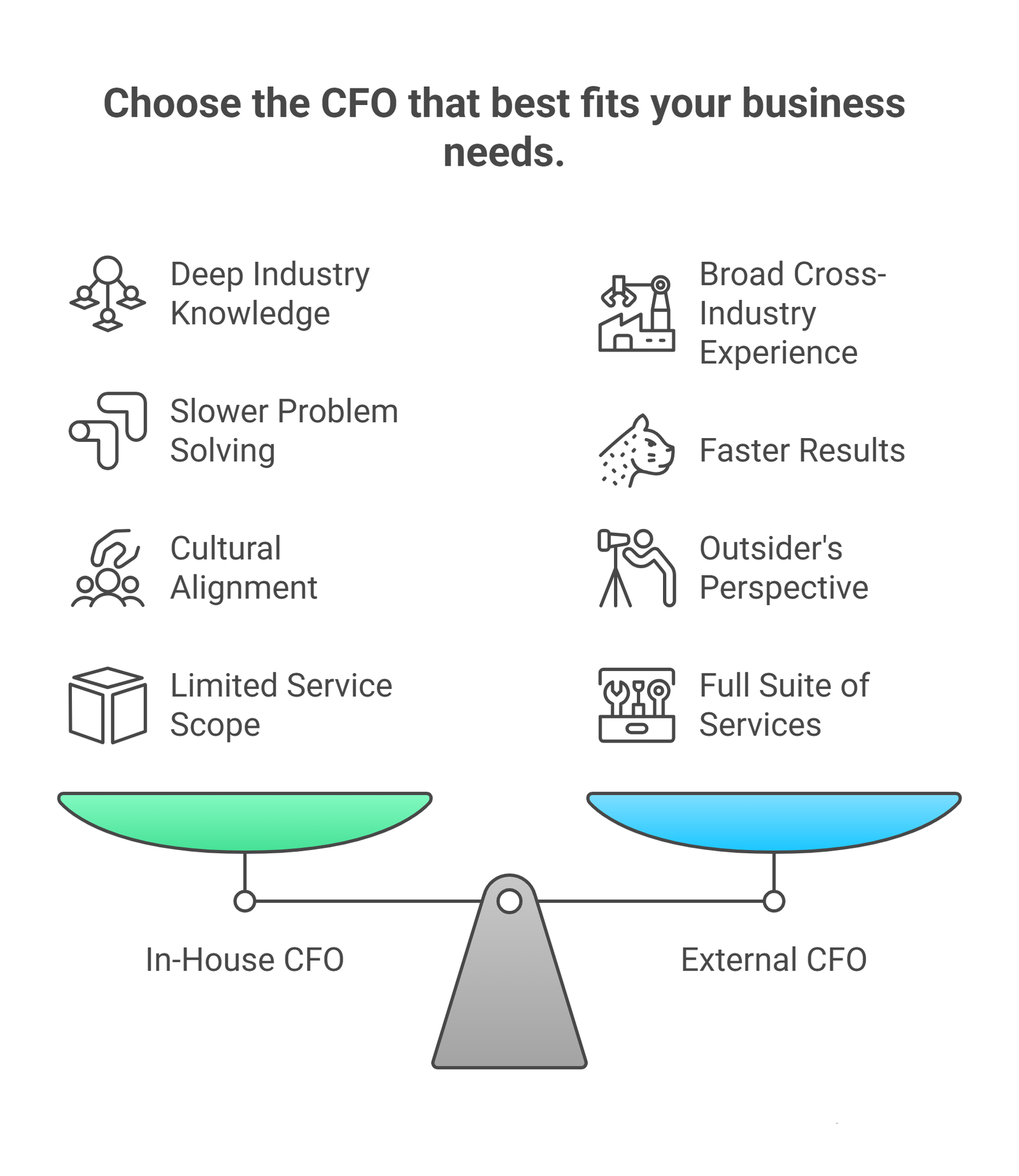
This table breaks down the key differences so you can quickly see which model aligns with where your business is right now.
| Factor | External CFO | In-House CFO |
| Cost | $3,000 to $15,000 per month | $200,000 to $450,000+ per year |
| Flexibility | High, scale up or down as needed | Fixed full-time commitment |
| Time to deploy | Days to weeks | Months to recruit and onboard |
| Industry experience | Broad, cross-sector perspective | Deep, company-specific knowledge |
| Objectivity | High, outside perspective | Can develop internal blind spots |
| Availability | Part-time or project-based | Full-time, always present |
| Financial oversight | Strategic and advisory | Strategic and operational |
| Best suited for | SMEs, startups, growth-stage businesses | Enterprise-level, complex operations |
| Support team access | Often includes controllers and analysts | Single executive hire |
| Scalability | Very flexible as needs change | Requires rehiring or restructuring |
| Investor readiness | Strong, especially for capital raises | Strong with deep internal context |
| Cultural integration | Lower by design | High, embedded in leadership team |
Where an External CFO Genuinely Adds Value
An external CFO is not just a cheaper version of a full-time hire. In many situations, they are actually the better choice.
Broad Cross-Industry Experience
An outsourced CFO typically works across multiple businesses and industries at the same time. That means they bring industry-specific knowledge, pattern recognition, and financial clarity that an in-house CFO embedded in one company may never develop. They have seen what works, what does not, and where businesses like yours usually run into trouble.
Faster Results on Key Financial Challenges
Because an external CFO has done this before, many times, they can move quickly on cash flow issues, financial modeling, profitability analysis, and financial forecasting. They are not learning on the job. They come with frameworks, FP&A tools, and processes already built.
Investor and Lender Readiness
If you are raising capital, an external CFO is often invaluable. They understand term sheet review, debt and equity financing, and how to present your financial documents in a way that gives investors and lenders confidence. For VC-backed firms or businesses entering their first serious funding rounds, this expertise is hard to overstate.
Objectivity
An in-house CFO is part of the culture. That is great for alignment, but it can create blind spots. An external CFO brings an outsider’s perspective to your financial strategy, which means they are more likely to flag uncomfortable truths about cash flow, cost management, accounts receivable problems, or financial data that is not adding up.
Access to a Full Suite of CFO Services
Many outsourced CFO providers do not just send one person. You may get access to controller services, operational accounting services, systems analysis support, CRM systems integration help, Power BI reporting, and financial management software guidance alongside the strategic CFO support.
Where an In-House CFO Has the Edge
An in-house CFO is the right call in a number of situations.
If your business is large and operationally complex, running multiple divisions, managing a significant headcount, navigating constant regulatory compliance across different regions, you need someone embedded full-time. The depth of financial oversight required simply cannot be delivered on a part-time basis.
If your business model involves highly sensitive financial data, proprietary systems, or constant real-time financial decisions, having someone in the building every day matters.
And if culture and leadership continuity are critical, if you need your CFO to be a visible, influential presence in the organization, a full-time hire is usually the better fit.
For enterprise-scale businesses, a full-time CFO is often a necessity, not a luxury.
The Hybrid Approach: Best of Both Worlds?
Many businesses land somewhere in the middle. They work with an external CFO to handle strategic financial oversight, financial planning, and major initiatives like raising capital, while keeping a strong internal finance team handling day-to-day operational accounting services and financial reporting.
This hybrid approach is increasingly common, especially in the startup ecosystem and among scaling businesses. It gives you senior financial leadership without the full-time cost, while maintaining internal operational stability.
As your business grows and the complexity justifies it, transitioning your external CFO relationship into a full-time in-house CFO hire becomes a natural next step.
Signs You Need an External CFO Right Now
Not sure which way to go? Here are the signals that an outsourced CFO is likely what your business needs today.
You are struggling with cash flow issues and cannot pinpoint why. You are preparing for a capital raise or approaching funding rounds. Your financial reporting is inconsistent or unreliable. You are making major financial decisions without proper financial modeling or risk analysis. Moreover, you are losing track of accounts receivable and profit margins are slipping. You need CFO support for a specific project such as an acquisition, a restructure, or a new market entry. Additionally, you want financial clarity but cannot justify a full-time salary yet. You need an interim CFO while you search for a permanent hire.
An external CFO can step in quickly, diagnose your financial situation honestly, and start delivering strategic value within weeks, not months.
Signs You Need a Full-Time, In-House CFO
On the other side, here are signs it is time to bring someone on full-time.
Annual revenue exceeds $20 to $30 million and financial complexity is growing fast. You have a large finance team that needs senior day-to-day leadership. Your business is in a heavily regulated industry requiring constant, embedded financial oversight. You are scaling internationally and need a CFO building systems and processes from the inside. You have outgrown the capacity of outsourced CFO services and need deeper involvement. Your board or investors are requiring a permanent CFO appointment.
Business size matters, but so does complexity. Revenue alone is not the only deciding factor.
Frequently Asked Questions
Can a small business afford an external CFO?
Yes, and that is often exactly who benefits most. Outsourced CFO services are specifically designed to give small and mid-sized businesses access to financial experts they could not otherwise afford. Monthly costs are a fraction of a full-time hire.
What tasks does an external CFO typically handle?
Depending on scope, an external CFO can handle financial strategy, financial planning and forecasting, cash flow management, financial reporting, regulatory compliance, raising capital, debt and equity financing, financial modeling, tax planning, risk analysis, operational optimizations, and investor and lender readiness.
How long does it take to see results from an outsourced CFO?
Most businesses start seeing meaningful financial clarity and early wins within the first 30 to 60 days. An experienced external CFO can quickly identify cash flow issues, operational inefficiencies, and financial reporting gaps and begin addressing them right away.
Can an external CFO help with fundraising?
Yes, and this is one of the strongest use cases. An experienced outsourced CFO can lead or support capital raise efforts, prepare financial documents, handle term sheet review, manage investor relationships, and position your business for funding rounds with the financial credibility investors expect.
What does CFO support look like on a day-to-day basis?
It varies based on your arrangement and business size. On any given week, CFO support might include reviewing financial reports, advising on financial decisions, monitoring cash flow management, tracking accounts receivable, running a profitability analysis, or preparing financial documents ahead of a board meeting or investor conversation.
Conclusion
There is no universal answer to whether an external CFO or a full-time in-house CFO is right for your business. It comes down to where you are, what you need, and what you can realistically invest.
What is clear is that financial leadership is not optional. Whether you are managing cash flow, preparing for a capital raise, strengthening your financial reporting, or trying to build a real growth strategy, you need someone who knows what they are doing at the CFO level.
For most growing businesses, an external CFO is the smartest starting point. It gets you experienced financial experts, strategic financial oversight, and real results without the cost and commitment of a full-time hire.
If you are ready to explore what the right CFO support looks like for your business, Oak Business Consultant offers tailored CFO services designed specifically for businesses at every stage of growth. Let us talk about what is possible.