CPA vs CFO: Which Does Your Business Need?
CPA vs CFO: What’s the Difference?
In the lifecycle of a growing enterprise, there comes a critical moment when simply managing the books is no longer enough to ensure long-term survival. As a business scales, the complexity of its financial landscape shifts from simple record-keeping to high-stakes decision-making. To navigate this evolution, small business owners must distinguish between two vital yet distinct roles. The debate of cpa vs cfo is not about which is better, but about which expertise is required for the specific stage of your company’s journey.
While both professionals are essential to a robust finance department, they operate on opposite ends of the temporal spectrum. A Certified Public Accountant is primarily focused on the past and present, ensuring accuracy and tax compliance. In contrast, a Chief Financial Officer is the architect of the future, driving financial strategy and long-term financial growth. When evaluating cpa vs cfo for your business, it is important to realize that one provides the data while the other provides the direction.
This article provides an in-depth analysis of the roles, responsibilities, and strategic value of each, helping business owners determine how to build a world-class financial bench.
The Certified Public Accountant (CPA): The Guardian of Compliance
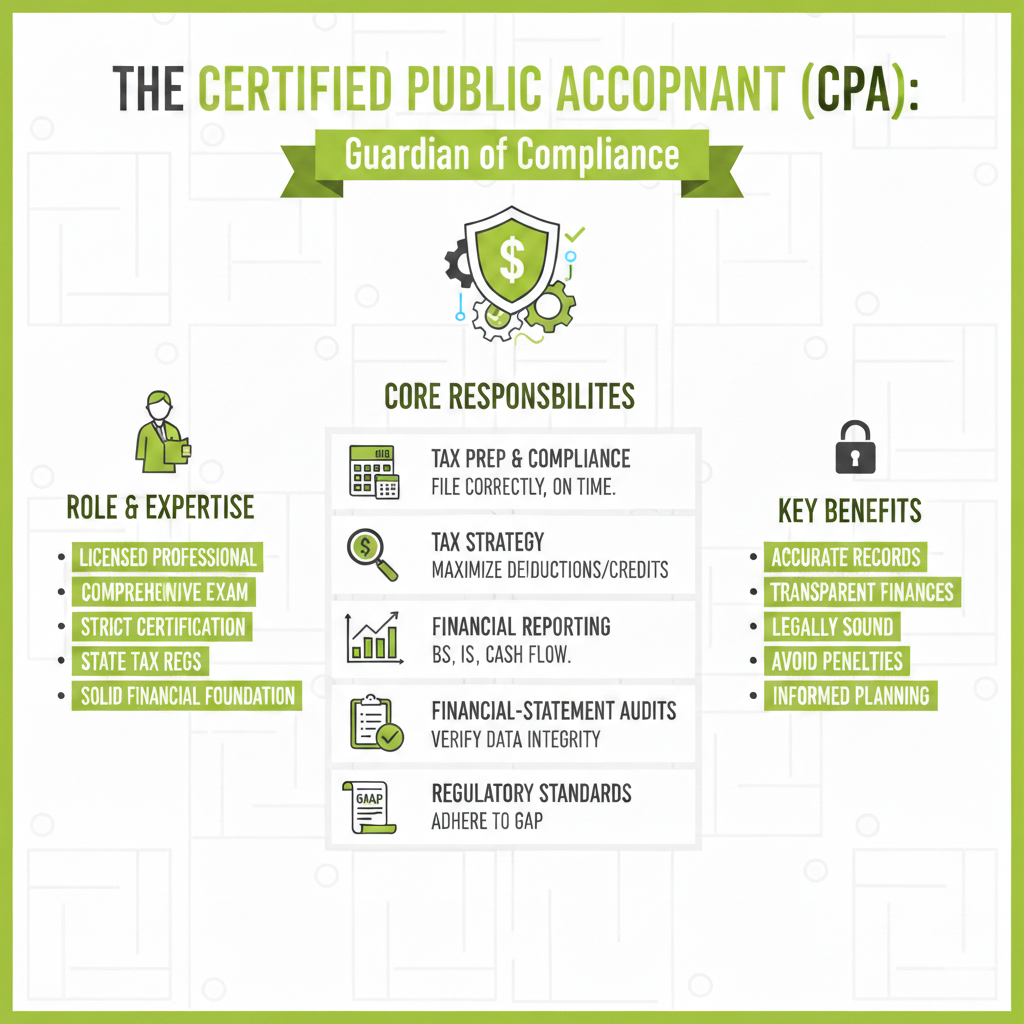
A Certified Public Accountant is a licensed professional who has mastered the technical rigors of accounting. Beyond completing a degree, a CPA must pass the comprehensive CPA exam and adhere to strict certification requirements and state-specific tax regulations. They are the individuals who ensure that your financial foundation is solid.
Core Responsibilities of a CPA
The primary mandate of a CPA is to ensure that your financial records are accurate, transparent, and legally sound. Most small business entities interact with a CPA firm for periodic needs, such as the annual filing of tax returns or conducting an external audit.
Key functions include:
- Tax Preparation and Compliance: Ensuring all business taxes are filed correctly and on time to avoid penalties.
- Tax Strategy: Utilizing deep knowledge of tax law to identify deductions and credits that minimize the company’s tax burden.
- Financial Reporting: Preparing formal financial statements (Balance Sheets, Income Statements, and Cash Flow Statements) that reflect historical performance.
- Financial‑Statement Audits: Providing financial audit services that verify the integrity of a company’s data for lenders and investors.
- Regulatory Standards: Keeping the business aligned with GAAP (Generally Accepted Accounting Principles) and other regulatory standards.
Essentially, a CPA tells you where your money went and ensures you stay on the right side of the law. In the context of cpa vs cfo, the CPA provides the reliable historical data upon which all future plans are built.
The Chief Financial Officer (CFO): The Architect of Strategy
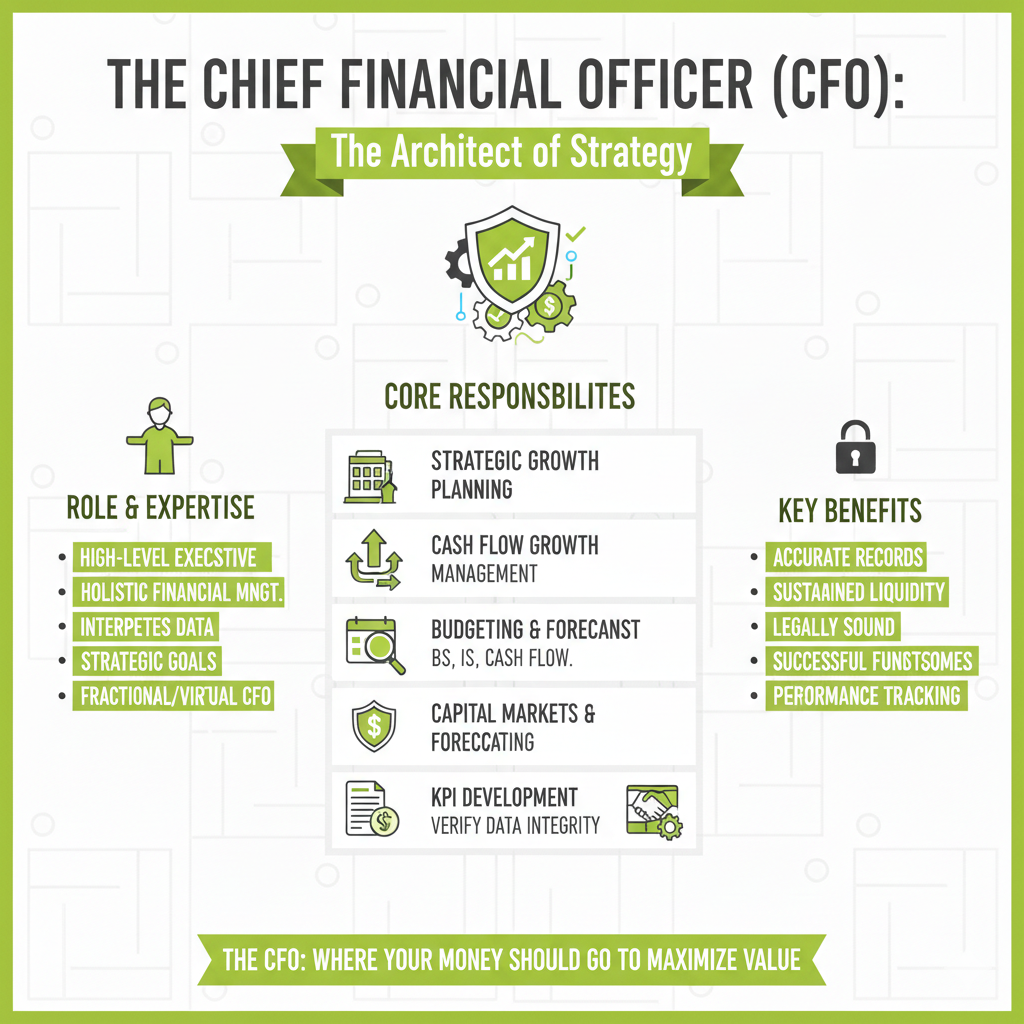
A Chief Financial Officer is a high-level executive responsible for the holistic financial management of the organization. While many CFOs hold a CPA designation, the role itself is far broader. The CFO is a finance expert who interprets financial data to steer the company toward its strategic goals. When comparing cpa vs cfo, the CFO’s role is more about leadership and forward-looking leadership development programs.
Core Responsibilities of a CFO
For many small and mid-sized business owners, hiring a full-time executive is cost-prohibitive. This has led to the rise of Fractional CFO and virtual CFO services, which provide the same high-level expertise on a scalable basis.
Key functions include:
- Strategic Growth Planning: Aligning the company’s financial resources with its corporate goals and expansion targets.
- Cash Flow Management: Implementing sophisticated cash flow models to ensure the business maintains liquidity during rapid scaling.
- Budgeting and Forecasting: Developing financial forecasts and financial projections (12, 24, and 36-month models) to predict future outcomes.
- Risk Management: Conducting a thorough risk assessment to identify and mitigate potential financial risk.
- Capital Markets and Fundraising: Leading capital raising efforts, preparing investor pitch decks, and navigating Series A/B strategies.
- KPI Development: Identifying and tracking financial KPI’s that serve as early warning signs or performance indicators.
The CFO is the visionary who tells you where your money should go to maximize value.
CPA vs. CFO: A Comparative Deep Dive
To better understand which professional your business needs, it is helpful to compare their functions across several critical business areas. The cpa vs cfo dynamic is essentially the difference between the historian and the strategist.
1. Time Orientation: History vs. Foresight
The most significant difference lies in their perspective. A CPA is retrospective. They analyze financial records to report on what has already happened. This is crucial for tax preparation and satisfying the requirements of an external audit.
A CFO is prospective. They use the CPA’s data as a starting point for scenario analysis and financial modeling. If you are asking, “How did we do last quarter?” you need a CPA. If you are asking, “Can we afford to acquire a competitor next year?” you need a CFO.
2. Tax Compliance vs. Financial Strategy
While a CPA focuses on tax compliance, ensuring that all tax returns meet the current tax law, the CFO integrates these considerations into a larger financial strategy. For example, a CPA will tell you the tax implications of a new equipment purchase; a CFO will conduct a feasibility study to determine if that purchase will provide a sufficient return on investment (ROI) to justify the cash flow outlay.
3. Financial Systems and Infrastructure
A CPA ensures your chart of accounts and bank reconciliations are handled correctly within your corporate accounting framework. A CFO looks at the “big picture” of your financial systems. They evaluate financial management software, streamline the organization’s structure, and implement internal accounting team protocols to improve efficiency and data integrity.
4. Capital and Liquidity
Managing cash flow is perhaps the most vital shared interest, but the approach differs. A CPA monitors cash flow to ensure books are balanced. A CFO performs cash flow forecasting and burn-rate projections to ensure the company doesn’t run out of “runway” during a growth spurt. They are also the lead negotiators in merger and acquisition transactions and credit financing deals. In the cpa vs cfo conversation, the CPA maintains the account, while the CFO leverages it.
When Does a Scaling Business Need Both?
It is a common misconception that one role can fully replace the other. In reality, they are most effective when working in tandem.
The Evolution of the Finance Department
- Early Stage: A startup may only need a bookkeeper and a CPA for annual tax services.
- Growth Stage: As the business hits the $1M–$5M revenue mark, cash flow management and Budgeting and Forecasting become complex. This is often the time to engage outsourced CFO services or a Fractional CFO.
- Maturity: A large organization will have a full CFO suite, an Accounting Manager, and an external CPA firm for independent financial audit services.
Synergistic Collaboration
The CPA provides the “clean” financial data (the raw material). The CFO acts as the financial strategist, using that data to build financial plans, conduct market and competitor analysis, and drive financial growth. Without the CPA’s accuracy, the CFO’s forecasts are unreliable. Without the CFO’s strategy, the CPA’s reports are merely a record of the status quo. Ultimately, cpa vs cfo is not a choice you make, but a partnership you build.
Critical Services Offered by CFOs and CPAs
| Service Category | CPA Primary Focus | CFO Primary Focus |
| Taxation | Tax compliance, filing tax returns. | Tax strategy as it relates to corporate goals. |
| Growth | Reporting on past growth. | Growth planning and revenue forecasting. |
| Audit | Financial‑statement audits. | Preparing for audits and managing investor relations. |
| Capital | Recording loan interest/equity. | Capital raising, Series A, and credit financing. |
| Risk | Ensuring regulatory compliance. | Risk management and risk assessment. |
| Reporting | Standard financial statements. | KPI development and financial models. |
Why “Outsourced” is Often the Answer
For most small business owners, the leap to a full-time CFO is unnecessary and expensive. However, staying only with a CPA can leave money on the table. Virtual CFO services bridge this gap by offering:
- Cost-Effectiveness: Access to C-suite talent at a fraction of the cost of a full-time hire.
- Objective Perspective: An external finance expert can provide unbiased financial advice and market dynamics insights.
- Scalability: You can increase CFO services during a Series A/B round or a merger and decrease them during stable periods.
The decision of cpa vs cfo often leads businesses to realize they need the fractional support of both to ensure they don’t overspend on payroll while still receiving elite financial guidance.
Frequently Asked Questions (FAQs)
Can one person be both my CPA and my CFO?
While many CFOs are CPAs by training, it is difficult for one person to handle both roles effectively as a business grows. The CPA role is highly technical and compliance-heavy, while the CFO role requires significant time for leadership development programs, strategic goals alignment, and investor pitch decks.
What is “Fix-It Accounting”?
Fix-It Accounting refers to the process where a CPA or CFO steps in to clean up messy financial records, reconcile old bank reconciliations, and correct the chart of accounts. This is often a prerequisite before a CFO can begin meaningful financial modeling.
How does a CFO help with Series A funding?
A CFO manages the fundraising scenarios, prepares the investor pitch decks, and ensures the financial data stands up to the scrutiny of venture capitalists. They also help the CEO understand the dilution impacts of different capital raising strategies.
Do I need a CPA for my small business if I have a bookkeeper?
Yes. While a bookkeeper records daily transactions, a CPA is needed for high-level tax law expertise, tax preparation, and to represent the business in the event of an IRS inquiry.
What are “burn-rate projections”?
Common in startups, burn-rate projections are cash flow models that calculate how much money a company is losing (spending) per month before it becomes profitable. A CFO uses these to determine when the next capital raising round must occur.
Conclusion
Understanding the distinction between a Certified Public Accountant and a Chief Financial Officer is the first step toward building a sustainable, profitable company. A CPA ensures your financial foundation is solid and your tax compliance is perfect. A CFO takes that foundation and builds a skyscraper upon it, using financial strategy, long-term financial planning, and risk management to reach new heights. When you view cpa vs cfo as a strategic alliance rather than a competition, your business gains the clarity it needs to scale.
At Oak Business Consultant, we specialize in providing the integrated expertise your business needs to thrive. Whether you require meticulous Tax Services or high-level CFO services, our team is dedicated to helping you achieve your strategic goals and navigate the complexities of modern financial management. Contact Us Today for Expert CFO Guidance.