Are Golf Courses Profitable?
The Profitability of Golf Courses: What You Need to Know
Golf has long carried an image of exclusivity, lush landscapes, and leisurely afternoons, but behind every manicured fairway lies a complex business operation. So, are golf courses profitable? The answer is nuanced. Some golf courses generate millions in annual revenue, while others bleed cash year after year. Understanding the difference between a thriving golf course and a struggling one comes down to business model, revenue diversification, cost management, and market position.
Whether you are considering buying a golf course, managing one, or simply evaluating the golf industry as an investment, this guide breaks down everything you need to know.
The State of the Golf Industry Today
The recreational golf industry has experienced a remarkable resurgence. The pandemic-era boom brought millions of new players to the sport, and participation has remained elevated. According to the National Golf Federation, golf participation in the United States hit record highs in recent years, with off-course golf services like Topgolf and simulator facilities also pulling in a younger demographic. The PGA Tour and LPGA Championship continue to drive mainstream visibility, keeping the sport culturally relevant.
Globally, Sheffield Hallam University’s Sport Industry Research Centre has tracked the economic contribution of golf clubs and confirmed that the golf club industry represents significant employment and economic output in countries like the UK, where millions of UK golfers sustain hundreds of clubs year-round. The inclusion of golf in the Rio 2016 Olympics further cemented its international appeal.
What this means for profitability is clear: demand is there. The question becomes whether operators can build a financial model that captures it.
Are Golf Courses Profitable? Understanding the Business Model
Are golf courses profitable by default? No, and this is the most important thing to understand before investing. A golf course is a capital-intensive, operationally complex business with high fixed costs and significant seasonal exposure. However, when managed strategically, it can generate strong, recurring cash flow.
The profitability of any golf course depends on three things: the revenue streams it activates, how well it controls costs, and what type of course it operates.
Public Golf Course vs. Private Golf Course
The distinction between a public golf course and a private golf course matters enormously to the bottom line.
A public golf course generates revenue primarily through green fees, cart fees, food and beverage sales, and merchandise sales. It serves a broader market, competes on accessibility and pricing, and must drive high volume through tee times to remain solvent. Margins can be thin, but a well-run public course in a strong market is consistently profitable.
A private golf course operates on a membership model. Revenue comes from membership fees, membership dues, membership packages, and event hosting. Because private golf clubs serve a captive audience of paying members, cash flow tends to be more predictable. However, membership sales require strong relationship management, and the cost of maintaining facilities to member expectations is high.
Some of the most profitable operations in the golf industry blend both models, offering public access while cultivating a tiered system of membership options that reward loyalty and generate recurring income.
Primary Revenue Streams for Golf Courses
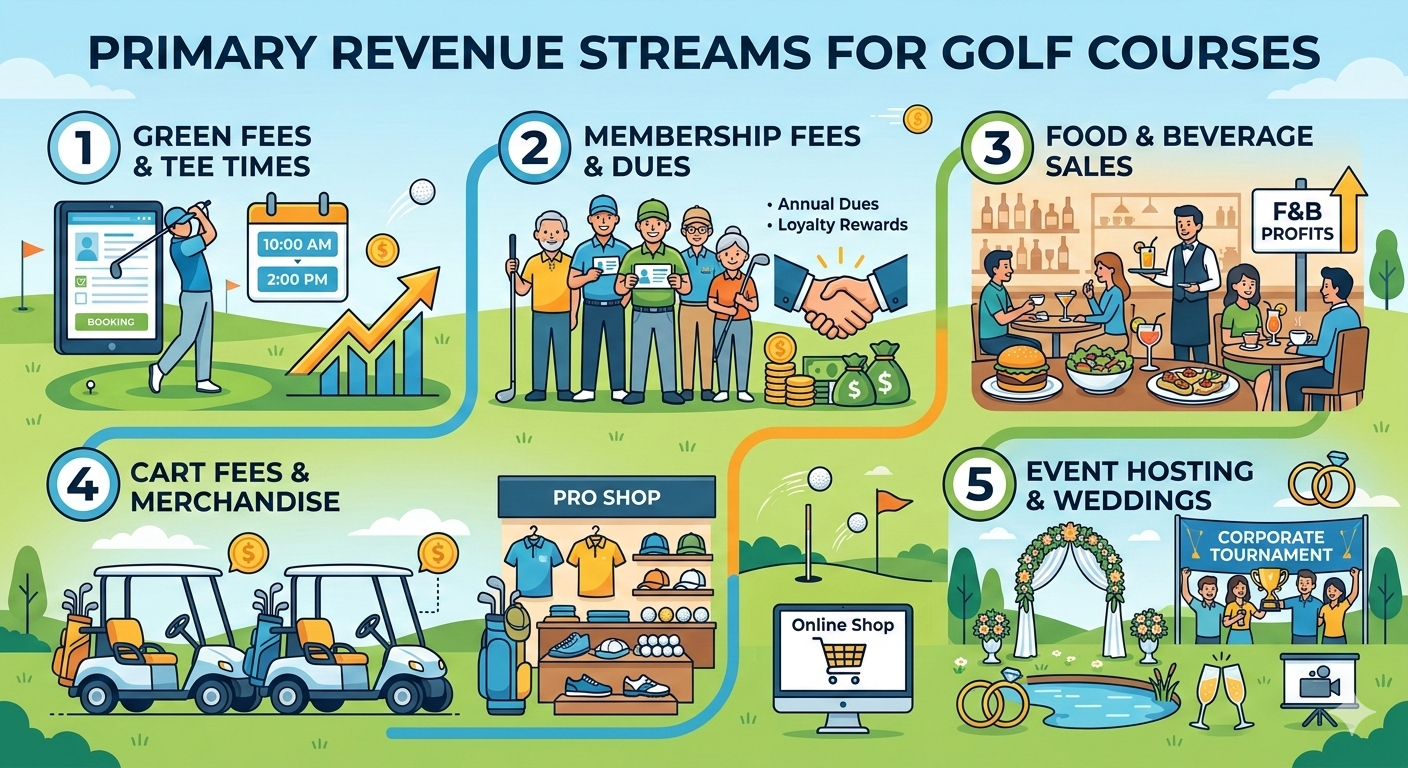
Understanding where a golf course makes money is essential to answering whether golf courses are profitable in any specific scenario.
Green Fees and Tee Times
Greens fees are the lifeblood of any public-facing golf course. Pricing strategies around tee times, including dynamic pricing based on time of day, season, and demand, are increasingly standard. Dynamic pricing, similar to airline or hotel revenue management, allows courses to maximize yield on their most valuable slots while filling off-peak hours at discounted rates. Platforms like Lightspeed Golf and tee-time management systems enable operators to automate this process and capture bookings through an online booking channel or tee time marketplace.
Membership Fees and Membership Dues
For golf clubs targeting the private or semi-private model, membership sales represent the highest-margin revenue stream. Membership fees collected upfront and ongoing membership dues create a predictable base of income that supports operational planning. Offering well-structured membership packages, from junior memberships to full family access, expands the potential market and improves membership sales volume. A loyalty rewards program that rewards frequent play and referrals further enhances member retention.
Food and Beverage Sales
Food and beverage is one of the most underperforming yet highest-potential revenue streams in golf operations. Many golf courses treat the clubhouse restaurant and halfway house as afterthoughts. Operators who invest in food and beverage operations, upgrading menus, improving service quality, and promoting the dining experience, see meaningful improvements to the bottom line. Food and beverage sales at well-run courses can account for 20–35% of total revenue.
Cart Fees and Merchandise Sales
Cart fees are an often-overlooked but reliable revenue line. Requiring carts during peak hours or premium times adds per-round revenue without additional staffing. Similarly, pro shop merchandise and online golf shops create ancillary income. An e-commerce page extending the pro shop’s reach online allows clubs to generate merchandise sales year-round, not just when members walk through the door.
Event Hosting and Wedding Services
Event hosting is one of the fastest-growing revenue-generating ideas in the golf industry. Corporate tournaments, charity organizations fundraisers, networking mixer events, and wedding services all leverage the natural beauty of a golf course setting. Tools like Cvent Supplier Network, automated RFP tools, Wedding Spot listings, and Cvent Event Diagramming software help clubs attract and convert event inquiries efficiently. A single large corporate event or wedding can generate the equivalent of several days of green fee revenue in one booking.
The Cost Side: Why Many Golf Courses Struggle
If golf courses can be profitable, why do so many fail? The answer almost always lies on the cost side of the ledger.
Golf course maintenance is expensive. Turf management, irrigation systems, maintenance equipment, water consumption, and labor represent the largest fixed costs for most operations. Environmental impact concerns and water restrictions in certain regions add regulatory complexity and expense. A golf course in an arid climate may spend significantly more on irrigation than a course in a naturally rainy region, fundamentally altering the financial model.
Golf management companies exist precisely because management expertise can be the difference between a profitable golf course and one that is perpetually cash-flow negative. These firms bring operational systems, purchasing power, and staffing models that independent owners often cannot replicate.
Noise and light pollution regulations, environmental impact assessments, and community relations add non-obvious costs that many first-time buyers of golf courses fail to account for during due diligence.
Golf Course Technology and Operational Efficiency
Modern golf operations rely heavily on technology to improve both revenue and cost efficiency. Self check-in kiosks and digital self-service kiosks reduce staffing requirements at the front desk while improving the customer experience. Golf simulators and TopTracer Range installations attract non-traditional golfers, extend playable hours into evenings and bad-weather days, and create new revenue streams entirely.
Systems like the GolfMAP system provide operators with real-time data on course utilization, player behavior, and revenue patterns. Google Analytics and booking platform data allow marketing teams to refine pricing strategies and promotional campaigns. A golf academy attached to the course adds instruction revenue while deepening the customer experience and building long-term player loyalty through a loyalty rewards program.
Lightspeed Golf and similar platforms integrate point-of-sale, tee-time management, and membership management into a single system, dramatically improving operational visibility and cash flow management.
Buying a Golf Course: Due Diligence Essentials
For those considering buying a golf course, the process requires thorough due diligence. Are golf courses profitable as acquisitions? They can be, but the purchase price, existing debt structure, deferred maintenance, and local market dynamics all determine the outcome.
Key due diligence items include reviewing the plant register for the condition of maintenance equipment, investigating any winding-up petitions or litigation history, auditing membership contracts and membership dues commitments, evaluating the existing financial model and trailing three years of cash flow, and assessing the competitive landscape.
Firms like Accountable Equity specialize in golf course acquisition analysis and can provide the financial modeling required to make an informed decision. A thorough SWOT analysis, examining strengths, weaknesses, acquisition opportunities, and threats, should accompany any offer. The exit strategy matters too: whether the plan is to operate long-term, reposition as a real estate development, or resell to golf management companies, the endgame shapes every decision from day one.
North Inch and Dolgellau Golf Club are examples of courses where community ties, historical significance, and local demographics played outsized roles in the viability of the business, factors that standard financial analysis can miss.
Are Golf Courses Profitable in Today’s Market?
Returning to the central question: are golf courses profitable today? The evidence suggests that the best-positioned courses absolutely are. Sports research company SMS INC data shows that rounds played and total spending at golf facilities remain elevated above pre-pandemic levels. The Graffis Report, one of the golf industry’s long-running financial studies, historically showed that roughly half of all golf courses operated at or near breakeven in any given year, but today’s data skews more favorably for well-managed operations.
The key differentiators between profitable and unprofitable golf courses are consistent: revenue diversification across green fees, food and beverage, event hosting, membership fees, and real estate; disciplined cost management on turf, staffing, and maintenance equipment; technology adoption through tee-time management systems, self check-in, and dynamic pricing; and a compelling customer experience that earns repeat visits and referrals.
Frequently Asked Questions
What is the average revenue of a golf course?
Average annual revenue for a golf course varies widely by type and location. A modest public golf course might generate $500,000 to $1.5 million per year, while a well-positioned private golf course or resort course can generate $3 million to $10 million or more. Revenue depends heavily on green fees, membership fees, food and beverage sales, and event hosting income.
What is the 70/30 rule in golf?
The 70/30 rule in golf operations refers to the general guideline that approximately 70% of a golf course’s revenue should come from golf operations (green fees, cart fees, membership dues) and 30% from ancillary sources (food and beverage sales, merchandise sales, event hosting). Courses that successfully grow the ancillary 30% tend to be significantly more profitable overall.
How do golf courses make a profit?
Golf courses generate profit by maximizing revenue across multiple streams, including tee times, membership fees, food and beverage, cart fees, merchandise sales, event hosting, and real estate, while controlling fixed costs like labor, maintenance equipment, and water consumption. Dynamic pricing, technology adoption, and strong membership sales all contribute to profitability.
Is golf dying or growing?
Golf is growing, not dying. Participation has reached record levels in recent years, driven by pandemic-era interest, the rise of off-course golf services like simulators and entertainment venues, and growing interest among younger demographics. The PGA Tour, LPGA Championship, and global visibility from events like the Rio 2016 Olympics have kept the sport culturally relevant and commercially vibrant.
Conclusion
Are golf courses profitable? Yes, when the right financial strategy, operational systems, and revenue diversification are in place. But profitability in the golf industry doesn’t happen by accident. It requires disciplined financial management, smart pricing strategies, investment in the customer experience, and a clear understanding of the numbers behind the business.
Whether you are evaluating buying a golf course, looking to improve the cash flow of an existing operation, or exploring golf-adjacent real estate development, working with experienced financial professionals is essential.
Our team at Oak Business Consultant specializes in accounting, financial modeling, and business advisory services for golf course owners, operators, and investors. From due diligence support to ongoing bookkeeping and cash flow management, we help golf businesses build the financial foundation they need to thrive. Contact us today to learn how our accounting services can support your golf business goals.