Case Study: Developing a Profitable Agribusiness Pricing Strategy
Client Overview
Our client operates within the agri-food industry, specializing in the production and sale of canned agricultural products. With a strong commitment to sustainable farming practices, water conservation, and community development, they proudly offer 100% American-grown foods that promote food security and minimize waste. To enhance competitiveness and profitability, the client partnered with Oak Business Consultant to refine their agribusiness pricing strategy. The primary goal was to gain clearer insights into cost structures, optimize product pricing, and align financial decisions with evolving market conditions and long-term sustainability objectives.
Client Challenges
As the client expanded within the agri-food sector, several strategic and operational challenges emerged that directly influenced profitability and market performance. These challenges underscored the need for a structured agribusiness pricing strategy and a deeper understanding of cost behavior across their product portfolio.
- Complex Cost Structures
The client faced difficulties in accurately distinguishing between fixed costs (such as facility operations and labor) and variable costs (including raw materials, packaging, and distribution). This complexity made it challenging to assess true production costs for their range of agricultural products. - Pricing and Profitability Gaps
Without a clearly defined pricing strategy, pricing decisions were often reactive rather than data-driven. This limited their ability to adjust to changing market conditions, resulting in uneven margins across product lines. - Market Volatility and Seasonal Fluctuations
Shifts in demand patterns, commodity prices, and seasonal variations created instability in both supply and pricing. These market dynamics affected cost forecasting and overall financial planning. - Data Integration and Transparency
The client’s cost and pricing data were scattered across departments, complicating the process of accurate cost calculation and market analysis. This lack of integration hindered effective decision-making and cost optimization. - Competitive Market Environment
The agribusiness market is highly competitive, with pricing pressures from both local and global producers. The client needed to safeguard their market share while maintaining profitability and aligning prices with perceived value. - Sustainability and Value Alignment
Growing consumer awareness around sustainability required the client to balance environmentally responsible practices with cost efficiency, ensuring that their pricing reflected both value and sustainability commitments.
Agribusiness Pricing Strategy Services Provided
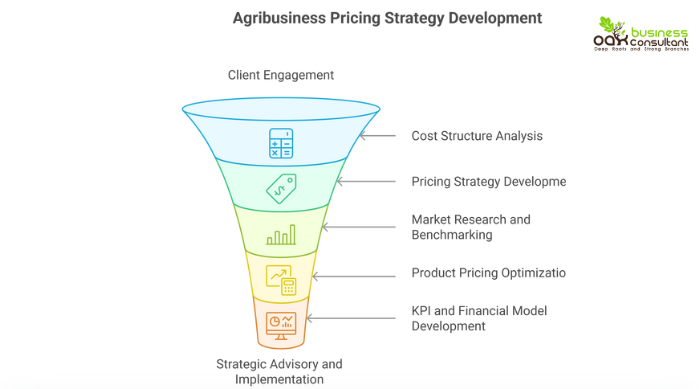
At Oak Business Consultant, we supported our client through a structured and data-driven engagement. Our focus was on building a sound agribusiness pricing strategy and strengthening their overall cost analysis framework. Each step of our process was designed to help the client improve financial clarity, enhance competitiveness, and achieve long-term profitability in the agri-food industry.
1. Cost Structure Analysis
We began by examining the client’s entire cost base. Our team identified and categorized fixed costs such as labor, rent, and equipment, alongside variable costs including raw materials, packaging, and distribution. This distinction helped the client understand how each cost component influenced production efficiency and product profitability. By breaking down the cost per unit for all agricultural products, we ensured accurate calculations for pricing and cost recovery.
2. Pricing Strategy Development
We developed a comprehensive pricing strategy tailored to the client’s business model. This included a mix of cost-based pricing, value-based pricing, and market-oriented pricing approaches. Our consultants evaluated market conditions, competitive benchmarks, and customer demand patterns to align prices with the client’s pricing objectives. The resulting framework allowed the client to maintain profitability while adapting to shifts in the agricultural products market.
3. Market Research and Benchmarking
To ensure the strategy was grounded in real-world data, we performed detailed market research and competitive analysis. Our research covered market demand, seasonal fluctuations, and pricing trends within both local and global commodity markets. This data enabled us to benchmark the client’s prices accurately and adjust their agribusiness pricing strategy in response to changing market conditions.
4. Product Pricing and Portfolio Optimization
We reviewed the client’s full product portfolio to identify profit potential and pricing inconsistencies. Through methods such as cost-plus pricing, penetration pricing, and dynamic pricing, we optimized the product pricing structure for each line. This approach helped pinpoint high-margin opportunities, refine low-performing products, and support informed market development decisions.
5. KPI and Financial Model Development
To monitor progress, we designed a comprehensive financial model supported by our Unit Metrics Analysis Dashboard. This dashboard tracked critical indicators including gross margin, cash flow, EBITDA, and free cash flow (FCF). With these insights, the client could measure performance, evaluate cost recovery, and make timely adjustments to sustain profitability.
6. Strategic Advisory and Implementation
Beyond modeling, we offered continuous strategic advisory services. Our team guided the client on pricing policy, market share expansion, and supply chain efficiency. We ensured that each recommendation aligned with their broader pricing objectives and reflected real market realities.
This hands-on approach enabled the client to implement a sustainable and adaptable agribusiness pricing strategy for long-term growth.
Outcome
The project delivered measurable improvements for the client. They gained clear visibility into fixed costs and variable costs, enabling better understanding of product-level profitability. The implementation of a new agribusiness pricing strategy aligned prices with actual market conditions, resulting in stronger gross margins, improved cost efficiency, and enhanced market share. With Oak’s financial modeling and market insights, the client now operates with greater pricing transparency, data-driven decision-making, and a solid foundation for sustainable profitability in the agricultural products sector.
What’s in It for You?
For agribusiness owners, navigating pricing and cost structures in a competitive market is challenging. Without a structured agribusiness pricing strategy, businesses risk:
- Unclear costs per product, making profitability analysis and break-even price calculations difficult.
- Ineffective pricing methods, including skimming pricing, penetration pricing, and psychological pricing, limiting revenue potential.
- Vulnerability to market fluctuations, seasonal changes, and supply chain disruptions in agricultural value chains.
- Difficulty segmenting customer segments and optimizing prices for different markets.
- Reduced visibility into market rates, market power, and competitive pricing dynamics.
How to Overcome These Challenges
Oak Business Consultant helps agribusinesses implement actionable solutions to address these challenges:
- Clarify cost structures: Analyze fixed costs, variable costs, and costs per product to understand profitability.
- Optimize pricing strategies: Apply market-based pricing, target return pricing, and price discrimination approaches across agricultural products.
- Market research and product analysis: Track price elasticity, consumer adoption, and demand patterns to inform pricing adjustments.
- Product portfolio management: Assess new products, dairy products, and seasonal crops using product life cycle analysis.
- Strategic advisory: Improve market share, refine distribution channels, and respond to supply fluctuations or trade tariffs.
Drive Growth and Profitability
Oak Business Consultant supports agribusinesses in strengthening their pricing strategies for farm and food businesses, optimizing costs, and enhancing market integration. With our guidance, you can increase sales growth, ensure sustainable margins, and maintain competitiveness across your agricultural value chains. Contact us today to learn how we can help your agribusiness achieve profitability, efficiency, and long-term success.
Frequently Asked Questions
What is an agribusiness pricing strategy?
An agribusiness pricing strategy is a structured approach to setting prices for agricultural products based on costs, market conditions, consumer demand, and competitive benchmarks. It can include methods like cost-based pricing, market-based pricing, and psychological pricing.
How do fixed and variable costs affect pricing?
Fixed costs (e.g., equipment, labor) remain constant regardless of production, while variable costs (e.g., seeds, packaging) change with output. Understanding both is essential to calculate break-even prices and optimize profitability.
How can I use price elasticity in agriculture?
Price elasticity measures how sensitive customers are to price changes. By analyzing elasticity, you can adjust prices strategically for new products or seasonal crops to maximize revenue and reduce losses.
What role do customer segments play in pricing?
Segmenting customers allows you to apply price discrimination or tailored pricing models, improving sales and market penetration. Different customer segments may respond differently to charm pricing, skimming pricing, or subscription models.
How do market conditions impact pricing in agriculture?
Factors like supply fluctuations, seasonal demand, trade tariffs, and competition affect market rates. A well-researched pricing strategy ensures your products remain competitive without sacrificing profitability.
Can this strategy work for small farms or cooperatives?
Yes. Oak Business Consultant tailors pricing strategies for farm and food businesses to suit small business owners, agricultural cooperatives, and larger firms, ensuring scalability and sustainability.
Conclusion
Oak Business Consultant helps agribusinesses optimize pricing, manage costs, and improve profitability across their agricultural products. By implementing a structured agribusiness pricing strategy, clients gain visibility into costs, increase margins, and make data-driven decisions that support sustainable growth and market competitiveness. Contact us today to learn how our team can help your agribusiness achieve efficiency, profitability, and long-term success.